01 / 21

Disc Method
Revolving Around Axes

Learn how to compute volumes of revolution by stacking infinitely thin circular discs using definite integrals.

AP Calculus AB

What Is a Solid of Revolution?

When you take a region in the plane bounded by a curve and rotate it around a line (an axis), the swept-out shape is called a solid of revolution. Think of a potter's wheel: spin a profile and you get a 3-D object.

rotate \(f(x)\) x y

The Key Idea: Slicing Into Discs

Imagine cutting the solid perpendicular to the axis of rotation. Each thin slice is a circular disc whose radius equals the function value at that point.

\(r = f(x)\) \(dx\) x

Why Does This Work?

Area of a Circle
Each cross-section is a circle with area \(\pi r^2\). The radius equals the distance from the axis to the curve.
Riemann Sum
Stack \(n\) thin cylinders of width \(\Delta x\). As \(n \to \infty\), the sum becomes a definite integral.
Exact Volume
The integral \(\displaystyle\int_a^b \pi[f(x)]^2\,dx\) captures every disc, giving the exact volume.

Formula: Revolving Around the \(x\)-Axis

a b \(f(x)\) \(y = f(x)\) x y

Here \(a\) and \(b\) are the bounds on the \(x\)-axis, and \(f(x)\) is the radius of each disc. The axis of rotation is the \(x\)-axis.

Formula: Revolving Around the \(y\)-Axis

c d \(g(y)\) \(x = g(y)\) x y

When revolving around the \(y\)-axis, rewrite the function as \(x = g(y)\). The bounds \(c\) and \(d\) are now on the \(y\)-axis, and the radius of each disc is \(g(y)\).

\(x\)-Axis vs \(y\)-Axis: Key Distinction

Revolve Around \(x\)-Axis Revolve Around \(y\)-Axis
Variable of integration \(dx\) \(dy\)
Radius of disc \(f(x)\) \(g(y)\)
Bounds \(a \le x \le b\) \(c \le y \le d\)
Discs perpendicular to \(x\)-axis \(y\)-axis
Function form needed \(y = f(x)\) \(x = g(y)\)

How to Apply the Disc Method

1
Sketch the region and identify which axis the region revolves around.
2
Express the radius as a function of the integration variable: \(f(x)\) for \(x\)-axis, \(g(y)\) for \(y\)-axis.
3
Determine the bounds of integration from the region's endpoints along that axis.
4
Set up the integral: \(V = \int \pi[\text{radius}]^2\,d(\text{variable})\).
5
Evaluate the definite integral and include units if applicable.

Example 1: \(y = \sqrt{x}\) Around the \(x\)-Axis

Find the volume when the region under \(y = \sqrt{x}\) from \(x=0\) to \(x=4\) is revolved about the \(x\)-axis.

Example 2: \(x = y^2\) Around the \(y\)-Axis

Revolve the region bounded by \(x = y^2\), the \(y\)-axis, and \(y = 3\) about the \(y\)-axis. Find the volume.

\(g(y) = y^2\) 0 3 x y

Example 3: \(y = x^2\) on \([0, 2]\) Around \(x\)-Axis

Find the volume when the region under \(y = x^2\) from \(x = 0\) to \(x = 2\) is revolved about the \(x\)-axis.

1
Radius: \(r = f(x) = x^2\)
2
Square it: \([f(x)]^2 = x^4\)
3
Integrate: \(\displaystyle V = \pi\int_0^2 x^4\,dx = \pi\left[\frac{x^5}{5}\right]_0^2\)
4
Evaluate: \(\displaystyle V = \pi\cdot\frac{32}{5} = \frac{32\pi}{5}\)

Example 4: \(y = x^2\) Around the \(y\)-Axis

Revolve the region bounded by \(y = x^2\), the \(y\)-axis, and \(y = 4\) about the \(y\)-axis.

1
Rewrite: Solve for \(x\): since \(y = x^2\), we get \(x = \sqrt{y}\). So \(g(y) = \sqrt{y}\).
2
Bounds: \(y\) ranges from \(0\) to \(4\).
3
Setup: \(\displaystyle V = \int_0^4 \pi(\sqrt{y})^2\,dy = \pi\int_0^4 y\,dy\)
4
Evaluate: \(\displaystyle V = \pi\left[\frac{y^2}{2}\right]_0^4 = \pi\cdot 8 = 8\pi\)

Visualizing a Single Disc

\(r = f(c)\) \(x = c\) \(dx\) Area = \(\pi[f(c)]^2\) Volume \(\approx \pi[f(c)]^2\,dx\)

Disc vs Washer Method

Disc Method
Use when the region touches the axis of rotation. Each cross-section is a solid circle (no hole in the middle).
Washer Method
Use when there is a gap between the region and the axis. Each cross-section is a ring (a "washer"). Its area is the area of the outer disc minus the area of the inner hole.

Common Mistakes to Avoid

Forgetting \(\pi\)
The disc is a circle, so every volume integral must include the factor \(\pi\). Without it, you compute the wrong quantity entirely.
Not Squaring the Radius
Writing \(\int f(x)\,dx\) instead of \(\int [f(x)]^2\,dx\). The area of a circle uses \(r^2\), not \(r\).
Wrong Variable
Revolving around the \(y\)-axis but integrating with respect to \(x\). Match the integration variable to the axis.

Quick Reference Summary

Step Around \(x\)-Axis Around \(y\)-Axis
1. Radius \(r = f(x)\) \(r = g(y)\)
2. Area \(\pi[f(x)]^2\) \(\pi[g(y)]^2\)
3. Integral \(\displaystyle\int_a^b \pi[f(x)]^2\,dx\) \(\displaystyle\int_c^d \pi[g(y)]^2\,dy\)
4. Key check Region touches \(x\)-axis Region touches \(y\)-axis

Worked practice: Section 9, Practice Problem 4 — Applied

Work through this original lesson problem, then reveal the solution and illustrations.

A solid concrete bollard has a profile given by y = 3 − (x²/3) for −3 ≤ x ≤ 3, where x and y are in decimeters. The bollard is formed by revolving this profile about the x-axis. (a) Write, but do not evaluate, an integral expression for the volume of the bollard. (b) Evaluate the integral to find the exact volume. (c) If concrete weighs 23 kg per cubic decimeter, find the mass of the bollard to the nearest kilogram. (d) Would the disc method still be appropriate if the profile dipped below the x-axis? Explain.

Show answer and explanation

(a) [1 point] The axis of revolution is the x-axis, so the radius at position x is r(x) = 3 − x²/3 and the limits are x = −3 to x = 3. By symmetry of the even function, we may write V = π ∫₋₃³ [3 − x²/3]² dx or equivalently V = 2π ∫₀³ [3 − x²/3]² dx. [1 point for correct integrand and limits.] (b) [2 points] Expand the integrand: [3 − x²/3]² = 9 − 2x² + x⁴/9. Then V = 2π ∫₀³ (9 − 2x² + x⁴/9) dx = 2π [9x − 2x³/3 + x⁵/45]₀³ = 2π [27 − 18 + 243/45] = 2π [27 − 18 + 27/5] = 2π [9 + 27/5] = 2π [45/5 + 27/5] = 2π · 72/5 = 144π/5. [1 point for correct antiderivatives; 1 point for correct evaluation.] (c) [1 point] Volume ≈ 144π/5 ≈ 90.48 dm³. Mass = 23 × 90.48 ≈ 2081 kg. [1 point for correct mass with proper units.] (d) [1 point] Yes, the disc method would still be appropriate because the integrand involves [f(x)]², which is non-negative regardless of the sign of f(x). A negative f(x) simply means the generating curve is below the x-axis, but the radius of the resulting disc is |f(x)|, and |f(x)|² = [f(x)]². However, one must verify that the resulting solid still has circular (not annular) cross-sections. [1 point for correct reasoning.]
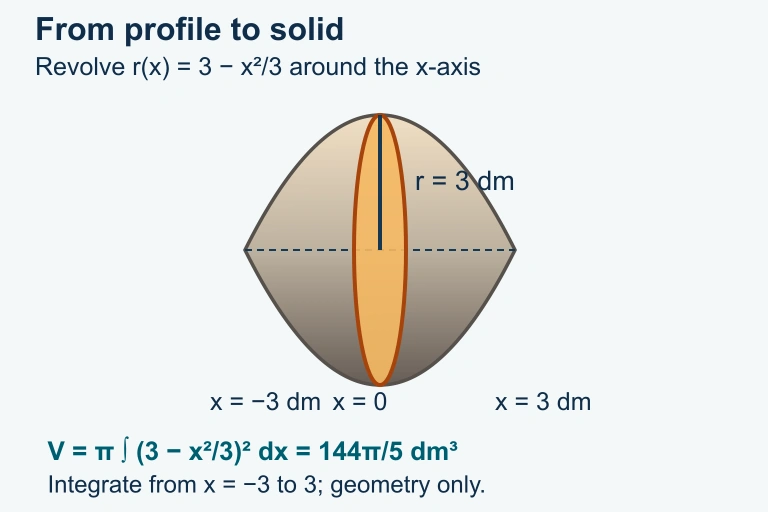
Symmetric solid formed by rotating y=3−x²/3 about the x-axis for −3≤x≤3. A central disc has radius 3; volume is 144π/5 dm³.
The geometric model gives volume 144π/5 dm³. Using the lesson's stipulated density of 23 kg/dm³ gives mass about 2,081 kg; the density is a supplied assumption.

Question 1 of 5

The region under \(y = x^3\) from \(x = 0\) to \(x = 1\) is revolved about the \(x\)-axis. Which integral gives the volume?

Question 2 of 5

Evaluate: \(\displaystyle\int_0^4 \pi x\,dx\)

Question 3 of 5

To use the disc method when revolving around the \(y\)-axis, what must you do to \(y = x^2\)?

Question 4 of 5

The region under \(y = \sin x\) from \(x = 0\) to \(x = \pi\) is revolved about the \(x\)-axis. Which integral gives the volume?

Question 5 of 5

Find the volume when the region bounded by \(x = y^3\), the \(y\)-axis, and \(y = 2\) is revolved about the \(y\)-axis.