Disc Method:
Revolving Around Other Axes
Master the technique for finding volumes of revolution when the axis of rotation is not the \(x\)-axis or \(y\)-axis.
What Is the Disc Method?
When a region in the plane is revolved around a line, it sweeps out a solid of revolution. The disc method slices this solid into thin circular discs perpendicular to the axis of rotation and sums their volumes with an integral.
Quick Review: Standard Axes
Radius = \(f(x)\)
Radius = \(g(y)\)
Why Other Axes Matter
Real-world solids are not always symmetric about the coordinate axes. A bowl, a dome, or a pipe wall may be modeled by revolving a curve around a line like \(y = -1\), \(y = 5\), or \(x = 3\). The disc method still works: you just need to adjust the radius expression.
The General Disc Formula
The key: radius = distance from curve to axis, which is \(|f(x) - k|\) or \(|g(y) - k|\).
Visualizing the Radius
Axis Below vs. Axis Above
| Axis Below Curve | Axis Above Curve | |
|---|---|---|
| Example axis | \(y = -2\) | \(y = 5\) |
| Radius | \(f(x) - k\) | \(k - f(x)\) |
| Integrand | \([f(x) - k]^2\) | \([k - f(x)]^2\) |
| After squaring | Identical: \([f(x)-k]^2\) | |
Step-by-Step Approach
Example 1: Revolving Around \(y = -1\)
Find the volume when the region bounded by \(y = \sqrt{x}\), \(y = 0\), and \(x = 4\) is revolved about the line \(y = -1\).
Example 1: Solution
Example 2: Revolving Around \(y = 4\)
Find the volume when the region bounded by \(y = x^2\), \(y = 0\), and \(x = 2\) is revolved about \(y = 4\).
Example 2: Solution
Example 3: Revolving Around \(x = 3\)
Find the volume when the region bounded by \(x = y^2\) and \(x = 1\) (for \(y \geq 0\)) is revolved about \(x = 3\).
Example 3: Solution
Since there is a gap between \(x = 1\) and \(x = 3\), we use the washer method (disc with a hole). Outer radius: \(R = 3 - y^2\). Inner radius: \(r = 3 - 1 = 2\).
Common Mistakes
Summary Table
| Axis of Rotation | Radius | Variable |
|---|---|---|
| \(y = 0\) (\(x\)-axis) | \(f(x)\) | \(dx\) |
| \(x = 0\) (\(y\)-axis) | \(g(y)\) | \(dy\) |
| \(y = k\) (below curve) | \(f(x) - k\) | \(dx\) |
| \(y = k\) (above curve) | \(k - f(x)\) | \(dx\) |
| \(x = k\) (right of curve) | \(k - g(y)\) | \(dy\) |
| \(x = k\) (left of curve) | \(g(y) - k\) | \(dy\) |
Visual Explanation
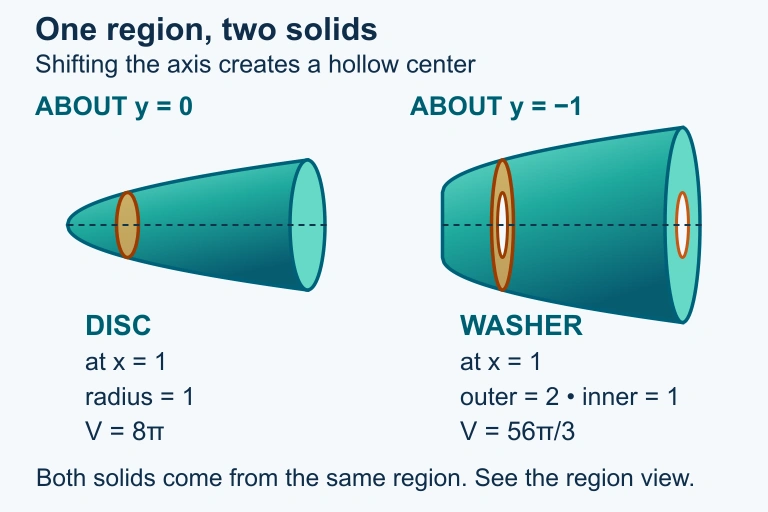
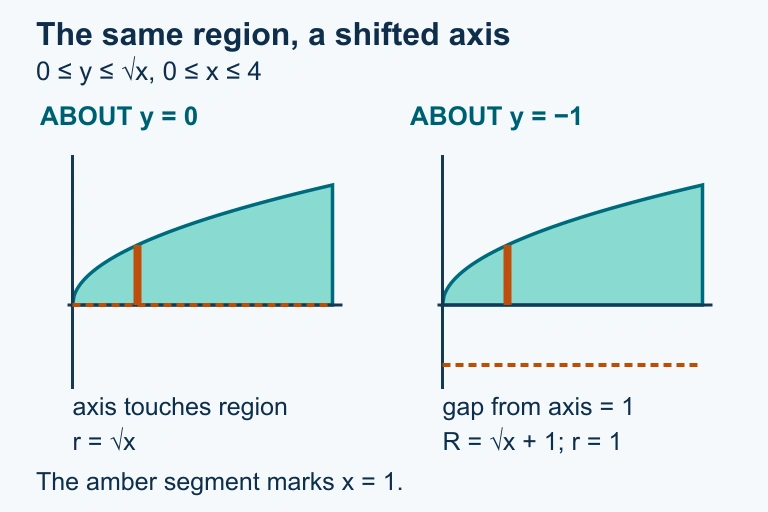
The same region 0 ≤ y ≤ √x, 0 ≤ x ≤ 4 forms discs about y = 0 and washers about y = −1. About y = 0 the radius is √x. About y = −1 the outer radius is √x + 1 and the inner radius is 1 because the axis lies one unit below the region. The corresponding volumes are π∫₀⁴ x dx = 8π and π∫₀⁴[(√x + 1)² − 1] dx = 56π/3. The filled region is identical in both panels. Rotating it about y = 0 gives discs of radius √x. Rotating it about y = −1 gives washers with outer radius √x + 1 and inner radius 1; subtract the inner-circle area. Each radius is a non-negative distance from the axis to a boundary of the region. If the region reaches the axis, a perpendicular slice produces a disc. If a gap separates the region from the axis, the slice produces a washer: use the distance to the farther boundary as the outer radius and the distance to the nearer boundary as the inner radius.
Question 1 of 5
The region bounded by \(y = x\), \(y = 0\), and \(x = 2\) is revolved about \(y = -1\). What is the radius of a typical disc?
Question 2 of 5
Which integral gives the volume when \(y = x^2\) (from \(x = 0\) to \(x = 1\)) is revolved about \(y = 2\)?
Question 3 of 5
The region bounded by \(y = \sqrt{x}\), \(y = 0\), and \(x = 9\) is revolved about \(y = -2\). What is the volume?
Question 4 of 5
A student sets up the integral \(\pi\!\int_0^3 (x^2)^2\,dx\) for the region \(y = x^2\), \(y = 0\), \(x = 3\) revolved about \(y = -1\). What did they do wrong?
Question 5 of 5
The region bounded by \(x = y\) and \(x = 0\) for \(0 \leq y \leq 2\) is revolved about \(x = 4\). Which expression gives the outer radius?