Differentiating
Inverse Trig Functions
Master the derivatives of \(\arcsin\), \(\arccos\), \(\arctan\), and their companions: the essential formulas and chain rule applications for AP Calculus.
What Are Inverse Trig Functions?
A regular trig function takes an angle and returns a ratio. An inverse trig function does the opposite: it takes a ratio and returns an angle.
Angle in, ratio out
Ratio in, angle out
Why Restricted Domains Matter
Trig functions are not one-to-one on their full domain. To define an inverse, we restrict each function to an interval where it passes the horizontal line test.
Why These Derivatives Matter
Inverse trig derivatives appear throughout calculus, especially in integration. Recognizing them lets you work both directions:
The Three Core Formulas
The Reciprocal Trio
\(\arcsin\) vs \(\arccos\): Key Distinction
| \(\arcsin(x)\) | \(\arccos(x)\) | |
|---|---|---|
| Domain | \([-1, 1]\) | \([-1, 1]\) |
| Range | \(\left[-\frac{\pi}{2}, \frac{\pi}{2}\right]\) | \([0, \pi]\) |
| Derivative | \(\frac{1}{\sqrt{1-x^2}}\) | \(\frac{-1}{\sqrt{1-x^2}}\) |
| Sign of derivative | Always positive | Always negative |
| Sum identity | \(\arcsin(x) + \arccos(x) = \dfrac{\pi}{2}\) | |
Deriving \(\frac{d}{dx}[\arcsin x]\) with a Triangle
Let \(y = \arcsin(x)\), so \(\sin(y) = x\). Differentiate both sides implicitly:
Adding the Chain Rule
When the argument is not just \(x\) but some function \(u(x)\), apply the chain rule:
Step-by-Step Strategy
Example 1: Basic Derivative
Find \(\frac{d}{dx}[\arctan(x)]\).
A light-and-camera studio with exact sightlines
 For a camera 4 m above the path, tan θ = 4/x. At x = 3 m and walking speed 2 m/s, the angular-speed magnitude is 8/25 rad/s; the sign depends on direction.
Camera: angle above horizontal
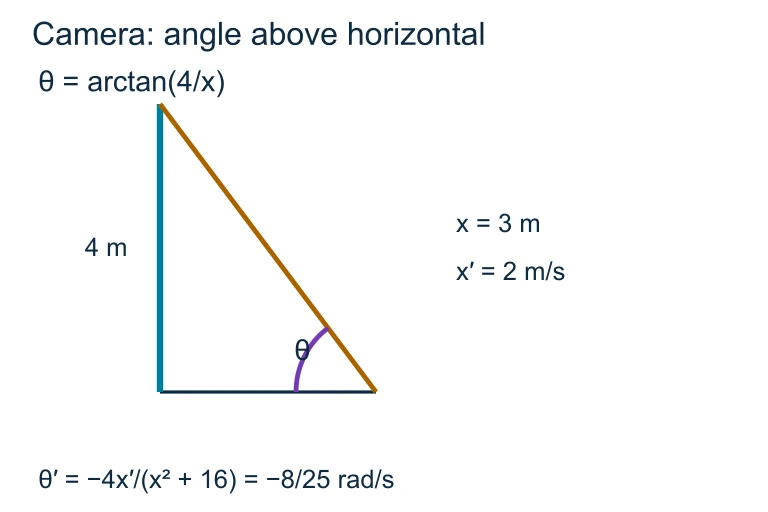 For a camera 4 m above the path, tan θ = 4/x. At x = 3 m and walking speed 2 m/s, the angular-speed magnitude is 8/25 rad/s; the sign depends on direction.
Example 2: Chain Rule Application
Find \(\frac{d}{dx}\!\left[\arcsin(3x)\right]\).
Example 3: More Complex Argument
Find \(\frac{d}{dx}\!\left[\arctan(x^2)\right]\).
Example 4: Product Rule Combination
Find \(\frac{d}{dx}\!\left[x \cdot \arcsin(x)\right]\).
Common Mistakes to Avoid
Complete Reference Table
| Function | Derivative | Domain of Derivative |
|---|---|---|
| \(\arcsin(x)\) | \(\frac{1}{\sqrt{1-x^2}}\) | \(|x| < 1\) |
| \(\arccos(x)\) | \(\frac{-1}{\sqrt{1-x^2}}\) | \(|x| < 1\) |
| \(\arctan(x)\) | \(\frac{1}{1+x^2}\) | All \(\mathbb{R}\) |
| \(\text{arccot}(x)\) | \(\frac{-1}{1+x^2}\) | All \(\mathbb{R}\) |
| \(\text{arcsec}(x)\) | \(\frac{1}{|x|\sqrt{x^2-1}}\) | \(|x| > 1\) |
| \(\text{arccsc}(x)\) | \(\frac{-1}{|x|\sqrt{x^2-1}}\) | \(|x| > 1\) |
Question 1 of 5
What is \(\dfrac{d}{dx}[\arcsin(x)]\)?
Question 2 of 5
Find \(\dfrac{d}{dx}[\arctan(5x)]\).
Question 3 of 5
What is \(\dfrac{d}{dx}[\arccos(2x)]\)?
Question 4 of 5
Find \(\dfrac{d}{dx}\!\left[\arcsin(x^3)\right]\).
Question 5 of 5
If \(f(x) = x^2 \cdot \arctan(x)\), what is \(f'(x)\)?