Derivatives of
Reciprocal Trig Functions
Master the derivatives of \(\tan x\), \(\cot x\), \(\sec x\), and \(\csc x\) using quotient rule connections and pattern recognition.
Why These Four Derivatives Matter
You already know \(\frac{d}{dx}[\sin x] = \cos x\) and \(\frac{d}{dx}[\cos x] = -\sin x\). But calculus problems rarely stop at sine and cosine. You need the derivatives of all six trig functions to handle real-world modeling, integration, and chain-rule problems on the AP exam.
The Building Blocks: Reciprocal Definitions
Visualizing \(\tan x\) and Its Derivative
Deriving \(\frac{d}{dx}[\tan x]\)
A light-and-camera studio with exact sightlines
 A rotating light turns angle change into motion along a wall. Differentiate the right-triangle relationship to connect the two rates.
Spotlight: angle from the wall normal
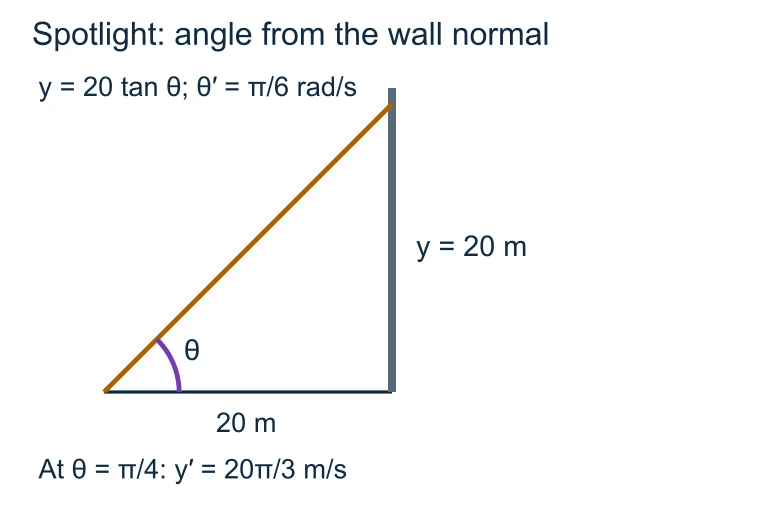 A rotating light turns angle change into motion along a wall. Differentiate the right-triangle relationship to connect the two rates.
The Complete Set of Four Formulas
\(\tan x\) vs \(\cot x\): The Negative Sign
| \(\tan x\) | \(\cot x\) | |
|---|---|---|
| Definition | \(\dfrac{\sin x}{\cos x}\) | \(\dfrac{\cos x}{\sin x}\) |
| Derivative | \(\sec^2 x\) | \(-\csc^2 x\) |
| Sign | Positive | Negative |
| Always increasing? | Yes (on each branch) | Always decreasing |
\(\sec x\) vs \(\csc x\): Same Structure, Different Sign
| \(\sec x\) | \(\csc x\) | |
|---|---|---|
| Definition | \(\dfrac{1}{\cos x}\) | \(\dfrac{1}{\sin x}\) |
| Derivative | \(\sec x \tan x\) | \(-\csc x \cot x\) |
| Structure | (itself) × (partner) | -(itself) × (partner) |
How to Apply These Derivatives
Example 1: Basic Derivative
Find \(\dfrac{d}{dx}[3\tan x - 2\sec x]\).
Example 2: Chain Rule Application
Find \(\dfrac{d}{dx}[\csc(5x^2)]\).
Example 3: Product Rule Meets Trig
Find \(\dfrac{d}{dx}[x^2 \sec x]\).
Proof: Deriving \(\frac{d}{dx}[\sec x]\)
The Negative Sign Pattern
All six trig derivatives follow a single rule about where the negative sign lands:
\(\frac{d}{dx}[\tan x] = \sec^2 x\)
\(\frac{d}{dx}[\sec x] = \sec x \tan x\)
\(\frac{d}{dx}[\cot x] = -\csc^2 x\)
\(\frac{d}{dx}[\csc x] = -\csc x \cot x\)
Common Mistakes to Avoid
Summary: All Six Trig Derivatives
| Function | Derivative | Sign |
|---|---|---|
| \(\sin x\) | \(\cos x\) | + |
| \(\cos x\) | \(-\sin x\) | \(-\) |
| \(\tan x\) | \(\sec^2 x\) | + |
| \(\cot x\) | \(-\csc^2 x\) | \(-\) |
| \(\sec x\) | \(\sec x \tan x\) | + |
| \(\csc x\) | \(-\csc x \cot x\) | \(-\) |
Question 1 of 5
What is \(\dfrac{d}{dx}[\cot x]\)?
Question 2 of 5
Find \(\dfrac{d}{dx}[\sec(4x)]\).
Question 3 of 5
Which of the following is \(\dfrac{d}{dx}[x \cdot \csc x]\)?
Question 4 of 5
If \(f(x) = \tan^2 x\), what is \(f'(x)\)?
Question 5 of 5
Which derivative is always negative wherever it is defined?