Position, Velocity &
Acceleration
Master the calculus of straight-line motion: how derivatives and integrals connect where an object is, how fast it moves, and how its speed changes.
What Is a Position Function?
A position function \( s(t) \) tells you where a particle is on a number line at any time \( t \). The input is time; the output is location.
Velocity as the Derivative
Velocity measures the rate of change of position with respect to time. It is the first derivative of the position function:
Acceleration as the Second Derivative
Acceleration measures the rate of change of velocity. It is the second derivative of position, or the first derivative of velocity:
Acceleration tells you whether the particle is speeding up or slowing down: when \( v(t) \) and \( a(t) \) share the same sign, speed increases; when they have opposite signs, speed decreases.
The Derivative Chain
Going Backwards with Integrals
Integration reverses differentiation. If you know acceleration, you can recover velocity; if you know velocity, you can recover position:
Speed vs. Velocity
Students often confuse these two. Velocity is a signed quantity (direction matters). Speed is always non-negative:
Can be positive, negative, or zero. Tells direction.
Always \( \ge 0 \). Tells magnitude only.
When Does a Particle Speed Up?
| Scenario | \( v(t) \) | \( a(t) \) | Speed |
|---|---|---|---|
| Moving right, accelerating right | + | + | Increasing |
| Moving left, accelerating left | − | − | Increasing |
| Moving right, accelerating left | + | − | Decreasing |
| Moving left, accelerating right | − | + | Decreasing |
Displacement vs. Total Distance
One cart, three meanings: position, displacement, and distance
 A cart can reverse direction while total distance continues to increase. Signed position changes give displacement; their absolute values give distance.
Position can return while distance grows
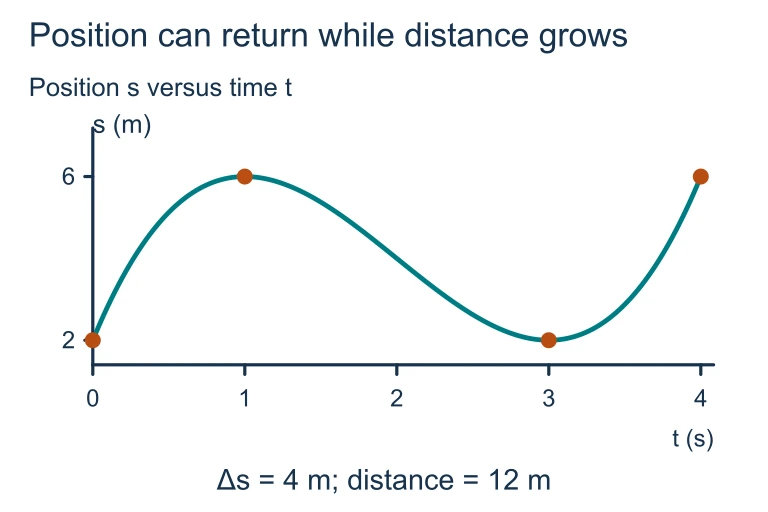 A cart can reverse direction while total distance continues to increase. Signed position changes give displacement; their absolute values give distance.
How to Solve Motion Problems
Example 1: Finding Velocity
A particle moves along a line with position \( s(t) = t^3 - 6t^2 + 9t + 2 \). Find the velocity at \( t = 1 \) and determine the direction of motion.
Example 2: Graphing the Motion
Using the same \( s(t) = t^3 - 6t^2 + 9t + 2 \), here are \( s(t) \), \( v(t) \), and \( a(t) \):
Example 3: From Acceleration to Position
A particle has acceleration \( a(t) = 6t - 4 \), with \( v(0) = 5 \) and \( s(0) = 1 \). Find \( s(t) \).
Example 4: Total Distance Traveled
Find the total distance traveled by the particle with \( v(t) = t^2 - 4 \) on \( [0, 3] \).
Common Mistakes
Summary of Relationships
| Quantity | Symbol | Derivative | Integral |
|---|---|---|---|
| Position | \( s(t) \) | \( s'(t) = v(t) \) | --- |
| Velocity | \( v(t) \) | \( v'(t) = a(t) \) | \( \int v\,dt = s(t) + C \) |
| Acceleration | \( a(t) \) | --- | \( \int a\,dt = v(t) + C \) |
| Displacement | \( \Delta s \) | \( \int_a^b v(t)\,dt = s(b) - s(a) \) | |
| Total Distance | \( D \) | \( \int_a^b |v(t)|\,dt \) | |
Question 1 of 5
A particle has position \( s(t) = 2t^3 - 9t^2 + 12t \). What is \( v(t) \)?
Question 2 of 5
At time \( t = 2 \), a particle has \( v(2) = -3 \) and \( a(2) = 5 \). Is the particle speeding up or slowing down?
Question 3 of 5
Given \( a(t) = 10 \) and \( v(0) = -3 \), find \( v(t) \).
Question 4 of 5
A particle has velocity \( v(t) = t - 2 \) on \( [0, 4] \). What is the total distance traveled?
Question 5 of 5
If \( s(t) = \sin(t) \), what is the acceleration \( a(t) \)?