Connecting a Function
and Its Derivatives
Understand how \( f \), \( f' \), and \( f'' \) are linked: how the first derivative reveals increasing/decreasing behavior and how the second derivative reveals concavity.
What Does \( f'(x) \) Tell Us?
The first derivative \( f'(x) \) represents the instantaneous rate of change of \( f(x) \). Its sign tells us whether the original function is rising or falling at any point.
A few readings leave the intervals unseen
 Separated measurements leave the behavior between samples undetermined. Two differentiable curves can pass through the same readings while having different derivatives between them.
A few readings leave the intervals unseen
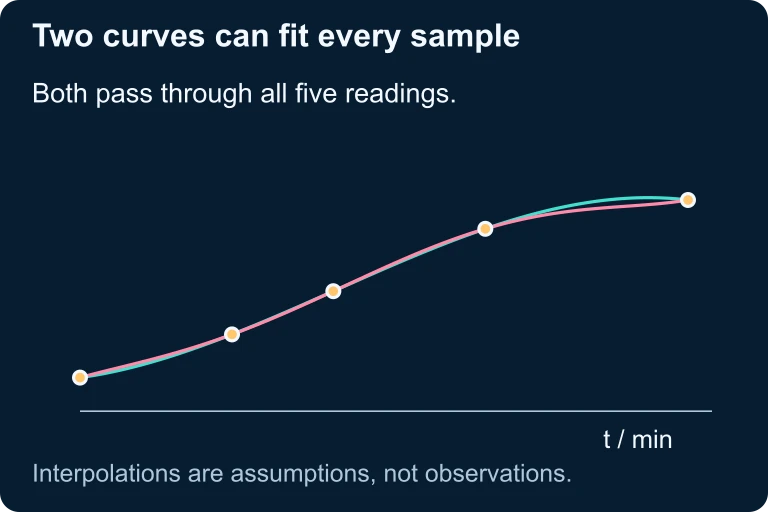 Separated measurements leave the behavior between samples undetermined. Two differentiable curves can pass through the same readings while having different derivatives between them.
What Does \( f''(x) \) Tell Us?
The second derivative \( f''(x) \) is the rate of change of the first derivative. It describes the concavity of \( f \): whether the curve bends upward or downward.
A continuous route through hills: elevation, grade, and intermediate height
 For f(x) = x³ − 3x, height, slope, and change in slope are different quantities. The extrema occur at x = −1 and 1; concavity changes at x = 0.
Height, grade and changing grade
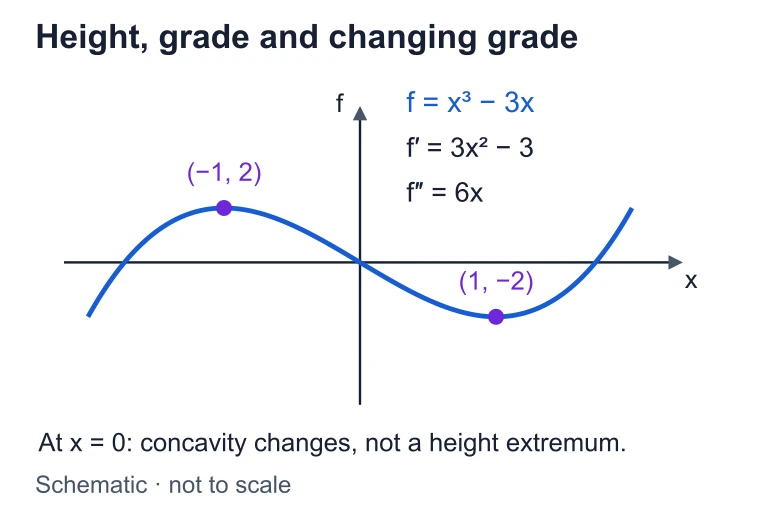 For f(x) = x³ − 3x, height, slope, and change in slope are different quantities. The extrema occur at x = −1 and 1; concavity changes at x = 0.
Seeing \( f \), \( f' \), and \( f'' \) Together
Critical Points and the First Derivative Test
A critical point occurs where \( f'(c) = 0 \) or \( f'(c) \) is undefined. To classify it, check how the sign of \( f' \) changes around \( c \):
The Second Derivative Test
An alternative way to classify critical points: evaluate \( f'' \) at the critical point \( c \) where \( f'(c) = 0 \).
First vs. Second Derivative Test
| First Derivative Test | Second Derivative Test | |
|---|---|---|
| What you check | Sign change of \( f' \) around \( c \) | Value of \( f''(c) \) |
| Requires | \( f'(c)=0 \) or undefined | \( f'(c)=0 \) and \( f'' \) exists |
| Always conclusive? | Yes | No (fails when \( f''(c)=0 \)) |
| Best when | \( f'' \) is hard to compute | \( f'' \) is easy to evaluate |
Inflection Points and Concavity Changes
An inflection point is where the concavity of \( f \) switches. This occurs where \( f''(x) = 0 \) or is undefined, and \( f'' \) changes sign.
How to Analyze a Function Completely
Example 1: \( f(x) = x^3 - 3x \)
Example 2: \( g(x) = x^4 - 4x^3 \)
Step 1: \( g'(x) = 4x^3 - 12x^2 = 4x^2(x - 3) \). Critical points at \( x = 0 \) and \( x = 3 \).
Step 2: \( g''(x) = 12x^2 - 24x = 12x(x - 2) \). Evaluate at critical points:
Example 2 continued: Inflection Points
\( g''(x) = 12x(x-2) = 0 \) at \( x = 0 \) and \( x = 2 \).
| Interval | Sign of \( g'' \) | Concavity of \( g \) |
|---|---|---|
| \( x < 0 \) | \( + \) | Concave up |
| \( 0 < x < 2 \) | \( - \) | Concave down |
| \( x > 2 \) | \( + \) | Concave up |
Example 3: Reading the Graph of \( f' \)
Given the graph of \( f'(x) \) below, determine where \( f \) has local extrema and inflection points.
The Chain of Information
Common Mistakes to Avoid
Summary: The Complete Picture
| Condition | What it means for \( f \) |
|---|---|
| \( f'(x) > 0 \) | \( f \) is increasing |
| \( f'(x) < 0 \) | \( f \) is decreasing |
| \( f'(c) = 0 \), sign change \( + \to - \) | Local maximum at \( x = c \) |
| \( f'(c) = 0 \), sign change \( - \to + \) | Local minimum at \( x = c \) |
| \( f''(x) > 0 \) | \( f \) is concave up |
| \( f''(x) < 0 \) | \( f \) is concave down |
| \( f''(c) = 0 \), sign change in \( f'' \) | Inflection point at \( x = c \) |
Question 1 of 5
If \( f'(x) > 0 \) for all \( x \) in the interval \( (a, b) \), which of the following must be true?
Question 2 of 5
Let \( f(x) = x^4 - 4x^2 \). At \( x = 0 \), the second derivative test gives \( f''(0) = -8 \). What can you conclude?
Question 3 of 5
The graph of \( f' \) changes from negative to positive at \( x = 3 \). What is true about \( f \) at \( x = 3 \)?
Question 4 of 5
For \( h(x) = x^3 \), we find \( h''(0) = 0 \). Does \( h \) have an inflection point at \( x = 0 \)?
Question 5 of 5
If \( f''(x) > 0 \) for all \( x \) in \( (a, b) \), and \( f'(c) = 0 \) for some \( c \) in \( (a, b) \), then \( f(c) \) is: