Concavity of
Functions
Learn how the second derivative reveals whether a curve bends upward or downward, and master the art of determining concavity over entire domains.
What Is Concavity?
Concavity describes the direction a curve bends. Imagine driving along a road: concavity tells you whether the road is curving like a bowl (holding water) or an umbrella (shedding water).
Visualizing Concavity
Why Does Concavity Matter?
Concavity is essential in calculus because it tells us about the behavior and shape of functions beyond what the first derivative reveals.
The Second Derivative Test
The sign of \( f''(x) \) directly determines the concavity. Think of it this way: \( f'' \) measures the rate of change of the slope. Positive means the slope is speeding up (bending up); negative means the slope is slowing down (bending down).
Inflection Points: Where Concavity Changes
Increasing/Decreasing vs. Concavity
| Increasing/Decreasing | Concavity | |
|---|---|---|
| Derivative used | \( f'(x) \) | \( f''(x) \) |
| What it measures | Direction of \( f \) | Bending of \( f \) |
| Positive sign | \( f \) is rising | \( f \) bends up |
| Negative sign | \( f \) is falling | \( f \) bends down |
| Changes at | Critical points | Inflection points |
A continuous route through hills: elevation, grade, and intermediate height
 For f(x) = x³ − 3x, height, slope, and change in slope are different quantities. The extrema occur at x = −1 and 1; concavity changes at x = 0.
Height, grade and changing grade
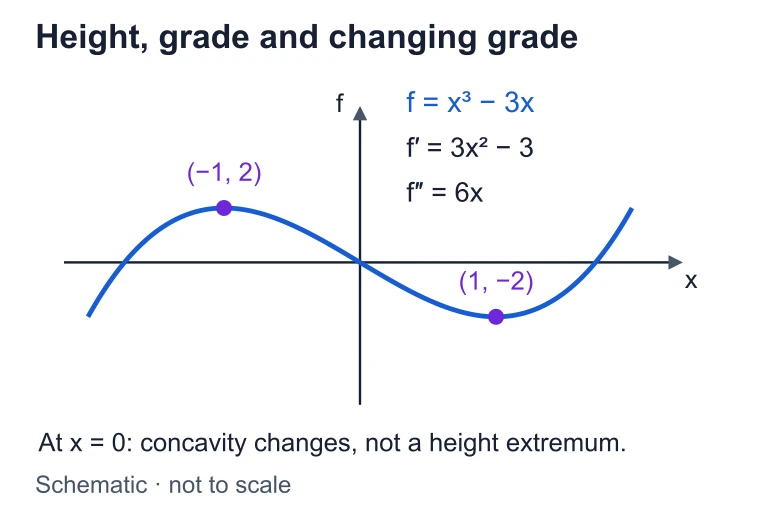 For f(x) = x³ − 3x, height, slope, and change in slope are different quantities. The extrema occur at x = −1 and 1; concavity changes at x = 0.
The Four Shape Combinations
How to Determine Concavity
Example 1: \( f(x) = x^3 - 3x^2 + 2 \)
Example 1: Graph
Example 2: \( g(x) = x^4 - 4x^3 \)
Example 3: \( h(x) = \sin(x) \) on \( [0, 2\pi] \)
Special Case: \( f''(x) = 0 \) Without an Inflection Point
Consider \( f(x) = x^4 \). We have \( f''(x) = 12x^2 \), so \( f''(0) = 0 \). But \( f''(x) \geq 0 \) for all \( x \), meaning the concavity never changes. There is no inflection point at \( x = 0 \).
Common Mistakes
Concavity Summary
| Condition | Concavity | Graph Shape |
|---|---|---|
| \( f''(x) > 0 \) | Concave Up | Opens upward (cup) |
| \( f''(x) < 0 \) | Concave Down | Opens downward (frown) |
| \( f''(x) = 0 \) + sign change | Inflection Point | Concavity switches |
| \( f''(x) = 0 \), no sign change | Same concavity | No inflection |
Question 1 of 5
On what interval is \( f(x) = x^3 - 6x^2 + 9x + 1 \) concave up?
Question 2 of 5
If \( f''(x) = x^2(x - 3) \), at which \( x \)-value does \( f \) have an inflection point?
Question 3 of 5
The function \( g(x) = e^{-x^2} \) is concave down on which interval?
Question 4 of 5
If a function \( f \) is increasing and concave down on an interval, what must be true about \( f'(x) \) and \( f''(x) \)?
Question 5 of 5
How many inflection points does \( f(x) = x^4 - 6x^2 + 8x + 3 \) have?