Calculating
Higher-Order Derivatives
Master the art of differentiating repeatedly to uncover deeper behavior of functions: concavity, inflection points, and beyond.
What Is a Higher-Order Derivative?
When you take the derivative of a function, you get its first derivative \( f'(x) \). But you can differentiate again: the derivative of \( f'(x) \) is the second derivative \( f''(x) \), and the derivative of \( f''(x) \) is the third derivative \( f'''(x) \), and so on.
A continuous route through hills: elevation, grade, and intermediate height
 For f(x) = x³ − 3x, height, slope, and change in slope are different quantities. The extrema occur at x = −1 and 1; concavity changes at x = 0.
Height, grade and changing grade
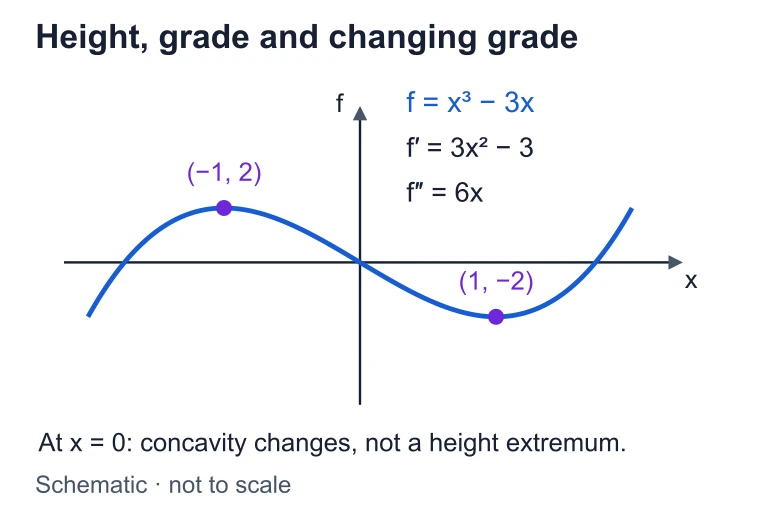 For f(x) = x³ − 3x, height, slope, and change in slope are different quantities. The extrema occur at x = −1 and 1; concavity changes at x = 0.
Notation for Higher-Order Derivatives
Why Do They Matter?
The Core Principle
To find the \( n \)-th derivative, apply the derivative operator \( n \) times in succession:
All standard differentiation rules apply at each step: power rule, product rule, chain rule, and quotient rule.
Power Rule Pattern
For \( f(x) = x^n \), repeated differentiation follows a clean pattern:
\( f'(x) \) vs \( f''(x) \): Key Distinction
| \( f'(x) \): First Derivative | \( f''(x) \): Second Derivative | |
|---|---|---|
| Measures | Rate of change (slope) | Rate of change of the slope |
| Sign tells us | Increasing (\( > 0 \)) or decreasing (\( < 0 \)) | Concave up (\( > 0 \)) or concave down (\( < 0 \)) |
| Zeros indicate | Critical points | Possible inflection points |
| Physics analogy | Velocity | Acceleration |
Visualizing \( f \), \( f' \), and \( f'' \)
How to Calculate Higher-Order Derivatives
Example 1: Polynomial
Find the first three derivatives of \( f(x) = 2x^4 - 5x^3 + x^2 - 7x + 3 \).
Example 2: Trigonometric Cycle
Find the first four derivatives of \( f(x) = \sin(x) \).
Example 3: Exponential Function
Find all derivatives of \( f(x) = e^{3x} \).
Example 4: When the Product Rule Is Needed
Find \( f''(x) \) for \( f(x) = x^2 \sin(x) \).
\( \frac{d}{dx}[2x\sin(x)] = 2\sin(x) + 2x\cos(x) \)
\( \frac{d}{dx}[x^2\cos(x)] = 2x\cos(x) - x^2\sin(x) \)
Common Mistakes to Avoid
Summary of Key Patterns
| Function | \( f^{(n)}(x) \) | Pattern |
|---|---|---|
| \( x^k \) | \( \frac{k!}{(k-n)!}\,x^{k-n} \) | Becomes 0 for \( n > k \) |
| \( e^{ax} \) | \( a^n e^{ax} \) | Never zero |
| \( \sin(x) \) | \( \sin\!\left(x + \frac{n\pi}{2}\right) \) | Cycles with period 4 |
| \( \cos(x) \) | \( \cos\!\left(x + \frac{n\pi}{2}\right) \) | Cycles with period 4 |
| \( \ln(x) \) | \( \frac{(-1)^{n-1}(n-1)!}{x^n} \) | Never zero for \( x > 0 \) |
Question 1 of 5
If \( f(x) = 3x^5 - 2x^3 + x \), what is \( f''(x) \)?
Question 2 of 5
What is the 50th derivative of \( \cos(x) \)?
Question 3 of 5
If \( g(x) = e^{-2x} \), what is \( g'''(x) \)?
Question 4 of 5
Find \( \dfrac{d^2y}{dx^2} \) if \( y = x^3 \ln(x) \).
Question 5 of 5
If \( f(x) = x^6 \), what is \( f^{(7)}(x) \)?