Area Between Curves
Functions of \( y \)
Master the technique of integrating with respect to \( y \) to find enclosed areas when curves are expressed as functions of the vertical axis.
Why Integrate with Respect to \( y \)?
Some regions are bounded by curves that are more naturally described as functions of \( y \) rather than \( x \). When curves open left/right (like horizontal parabolas), expressing them as \( x = f(y) \) and integrating along the \( y \)-axis gives us a single, clean integral instead of splitting into multiple integrals.
Horizontal vs. Vertical Slicing
Right Minus Left: The Core Idea
When integrating with respect to \( y \), we think of each infinitesimal strip as a horizontal rectangle of width \( dy \). Its length is the difference between the right boundary and the left boundary at that \( y \)-value.
The Formula
$$ A = \int_{c}^{d} \bigl[ f(y) - g(y) \bigr] \, dy $$
Integrating in \( x \) vs. \( y \)
| With respect to \( x \) | With respect to \( y \) | |
|---|---|---|
| Slice direction | Vertical strips | Horizontal strips |
| Integrand | \( f(x) - g(x) \) | \( f(y) - g(y) \) |
| Meaning | Top minus Bottom | Right minus Left |
| Limits | \( x \)-values at intersection | \( y \)-values at intersection |
| Best when | Curves are \( y = f(x) \) | Curves are \( x = f(y) \) |
How to Apply the Method
Example 1: \( x = y^2 \) and \( x = y + 2 \)
Find the area enclosed between \( x = y^2 \) and \( x = y + 2 \).
Example 1: Solution
$$ A = \int_{-1}^{2} \bigl[(y+2) - y^2\bigr]\,dy $$
Example 2: \( x = y^2 - 1 \) and \( x = 2y + 1 \)
Find the area of the region bounded by \( x = y^2 - 1 \) and \( x = 2y + 1 \).
Example 2: Solution
$$ A = \int_{1-\sqrt{3}}^{1+\sqrt{3}} (-y^2 + 2y + 2)\,dy $$
Example 3: Region with a Vertical Line
Find the area enclosed by \( x = y^2 \), the line \( x = 1 \), and the \( x \)-axis (in the first quadrant).
Example 3: Solution
$$ A = \int_{0}^{1} (1 - y^2)\,dy = \left[y - \frac{y^3}{3}\right]_0^1 = 1 - \frac{1}{3} = \frac{2}{3} $$
When Should You Choose \( dy \)?
Common Mistakes
Quick Reference Summary
| Step | Action | Key Detail |
|---|---|---|
| 1 | Sketch the region | Identify which curves bound left/right |
| 2 | Solve for \( x = f(y) \) | Both curves as functions of \( y \) |
| 3 | Find \( y \)-limits | Set \( f(y) = g(y) \), solve for \( y \) |
| 4 | Test a midpoint | Confirm right > left |
| 5 | Evaluate integral | \( \int_c^d [\text{right} - \text{left}]\,dy \) |
Worked practice: Section 9, Practice Problem 4 — Applied
Work through this original lesson problem, then reveal the solution and illustrations.
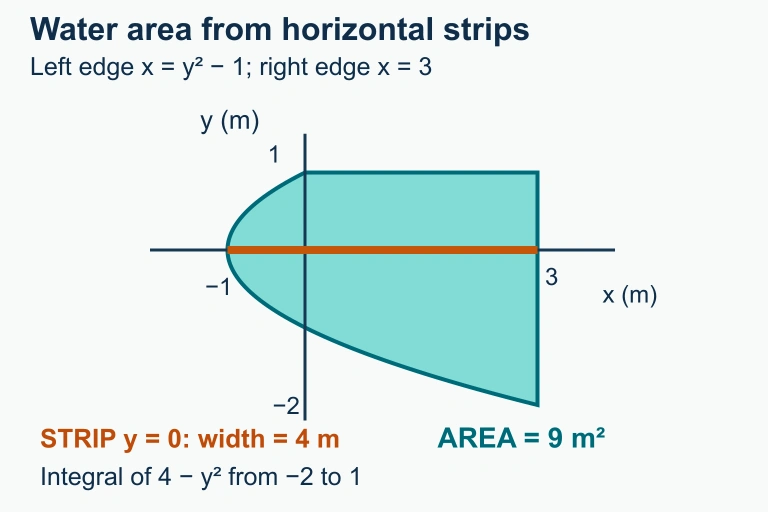
A water channel has a cross-section bounded on the left by the curve x = y² − 1 and on the right by the vertical line x = 3, for y ∈ [−2, 2]. The channel is partially filled so that the water surface is at y = 1. Set up and evaluate an integral with respect to y to find the cross-sectional area of the water in the channel (the region where −2 ≤ y ≤ 1 between the two boundaries). (a) Identify the limits of integration and the integrand. (b) Evaluate the integral to find the cross-sectional area. (c) If the channel extends 10 meters long, find the volume of water. (d) Explain why integrating with respect to y is preferable here.
Show answer and explanation
Part (a) — 1 point: The left boundary is x = y² − 1 and the right boundary is x = 3. The intersection at the bottom of the channel occurs where y² − 1 = 3, giving y = −2 (taking the negative root for the bottom). The water surface is at y = 1. So the limits are y = −2 to y = 1, and the integrand is 3 − (y² − 1) = 4 − y². Part (b) — 1 point: A = ∫ from −2 to 1 (4 − y²) dy = [4y − y³/3] from −2 to 1 = (4 − 1/3) − (−8 + 8/3) = (11/3) − (−16/3) = 27/3 = 9 square units. Part (c) — 1 point: Volume = cross-sectional area × length = 9 × 10 = 90 cubic meters (assuming consistent units). Part (d) — 1 point: Integrating with respect to y is preferable because the left boundary x = y² − 1 is a sideways parabola; solving for y in terms of x would produce two branches (y = ±√(x + 1)), requiring the region to be split. With dy-integration, the parabola is a single-valued function of y, so one integral suffices.
Question 1 of 5
Which integral correctly gives the area between \( x = y^2 \) and \( x = 4 \)?
Question 2 of 5
When integrating with respect to \( y \), the integrand represents:
Question 3 of 5
Evaluate \( \displaystyle\int_{0}^{1}(1 - y^2)\,dy \).
Question 4 of 5
The area between \( x = y + 2 \) and \( x = y^2 \) from \( y = -1 \) to \( y = 2 \) equals:
Question 5 of 5
Which integral gives the area of the region bounded by the parabola \( x = y^2 \), the y-axis, and the line \( y = 2 \)?