Area Between Curves
Functions of \( x \)
Learn to compute the exact area enclosed between two curves using definite integrals and the "top minus bottom" approach.
What Does "Area Between Curves" Mean?
When two functions \( f(x) \) and \( g(x) \) are graphed on the same axes, they may enclose a bounded region. The area of that region is what we want to compute: the total space trapped between the two curves from one intersection to the other.
From One Curve to Two Curves
You already know that \( \int_a^b f(x)\,dx \) gives the signed area between \( f(x) \) and the \( x \)-axis. The area between two curves is a natural extension: instead of measuring height from the axis, we measure the vertical distance between the curves.
Why This Matters
Computing area between curves appears throughout mathematics, physics, economics, and engineering. Any time two quantities vary with respect to the same variable, the integral of their difference tells you the net accumulation between them.
The Core Formula
The integrand \( f(x) - g(x) \) represents the vertical height of each thin rectangle. Summing these rectangles from \( a \) to \( b \) gives the total area.
What If Curves Switch Position?
Sometimes the "top" and "bottom" curves switch at a point inside the interval. When this happens, you must split the integral at every crossing point so you always subtract the lower function from the upper one.
Signed Area vs. Geometric Area
| Signed Area (Net) | Geometric Area | |
|---|---|---|
| Formula | \( \int_a^b [f(x) - g(x)]\,dx \) | \( \int_a^b |f(x) - g(x)|\,dx \) |
| Can be negative? | Yes | Never |
| Requires splitting? | Not required | Yes, at crossings |
| AP Exam asks for | Occasionally | Almost always |
How to Apply the Formula
Example 1: Parabola and Line
Find the area enclosed between \( f(x) = x + 2 \) and \( g(x) = x^2 \).
Example 1: Computing the Integral
Step 2: On \([-1, 2]\), test \( x = 0 \): \( f(0) = 2 \) and \( g(0) = 0 \), so \( f(x) \geq g(x) \). Top is \( f \), bottom is \( g \).
Example 2: Curves That Cross
Find the area between \( f(x) = x^3 \) and \( g(x) = x \) from \( x = -1 \) to \( x = 1 \).
Example 2: Evaluating Both Integrals
Example 3: Given Limits
Find the area between \( f(x) = \sin x \) and \( g(x) = 0 \) (the \( x \)-axis) on \([0, \pi]\).
Given Limits vs. Finding Limits
Problems come in two flavors. Recognizing which type you face helps you allocate your time wisely.
Common Mistakes
Summary Checklist
| Step | Action | Watch Out For |
|---|---|---|
| 1. Sketch | Graph both curves | Identify top vs. bottom |
| 2. Intersections | Solve \( f(x) = g(x) \) | Interior crossings |
| 3. Set up | \( \int [\text{top} - \text{bottom}]\,dx \) | Split if curves swap |
| 4. Evaluate | Antidifferentiate + FTC | Arithmetic errors |
| 5. Verify | Answer must be positive | Negative = mistake |
Worked practice: Section 9, Practice Problem 4 — Applied
Work through this original lesson problem, then reveal the solution and illustrations.
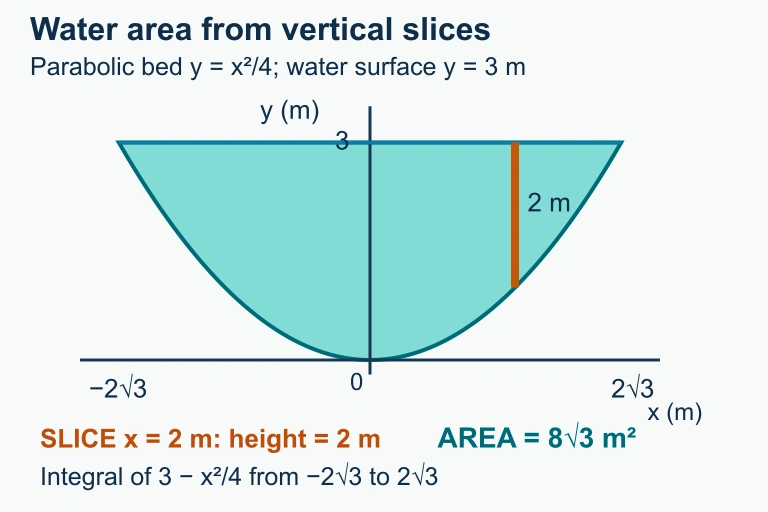
A civil engineer models the cross-section of a drainage channel. The bottom of the channel follows the curve y = x²/4 (in meters) and the water surface is at y = 3 (a horizontal line), where x is the horizontal distance from the center. Set up and evaluate the integral that gives the cross-sectional area of water in the channel.
Show answer and explanation
Point 1 (1 pt): Find intersection points. Set x²/4 = 3, so x² = 12, giving x = −2√3 and x = 2√3. Point 2 (1 pt): Set up the integral correctly. The water surface y = 3 is above the channel bottom y = x²/4 on [−2√3, 2√3], so A = ∫ from −2√3 to 2√3 of (3 − x²/4) dx. Point 3 (1 pt): Evaluate the integral. Using symmetry: A = 2∫₀^{2√3} (3 − x²/4) dx = 2[3x − x³/12] from 0 to 2√3 = 2[3(2√3) − (2√3)³/12] = 2[6√3 − (24√3)/12] = 2[6√3 − 2√3] = 2(4√3) = 8√3 ≈ 13.86 square meters.
Question 1 of 5
What is the area between \( f(x) = 4 - x^2 \) and the \( x \)-axis on \([-2, 2]\)?
Question 2 of 5
To find the area between \( y = x^2 \) and \( y = 2x \), what are the correct limits of integration?
Question 3 of 5
If \( f(x) \geq g(x) \) on \([a, c]\) and \( g(x) \geq f(x) \) on \([c, b]\), which expression gives the total area?
Question 4 of 5
A student computes \( \displaystyle\int_0^{2\pi}\sin x\,dx = 0 \) and reports the area between \( \sin x \) and the \( x \)-axis is 0. What went wrong?
Question 5 of 5
What is the area enclosed between \( y = x^2 \) and \( y = 2x \)?