Approximating Areas
With Riemann Sums
Learn how to estimate the area under a curve by partitioning an interval into rectangles and summing their areas.
Why Approximate Area Under a Curve?
In calculus, we often need to find the exact area between a function and the x-axis. But most functions don't have neat geometric formulas for their enclosed regions. Riemann sums give us a powerful way to approximate that area using simple shapes: rectangles.
What Is a Riemann Sum?
A Riemann sum divides the interval \([a, b]\) into \(n\) subintervals, builds a rectangle on each subinterval, and adds up all the rectangle areas. As \(n\) grows, the approximation gets closer to the true area.
Key Vocabulary
The Riemann Sum Formula
The choice of sample point \(x_i^*\) determines the type of Riemann sum: left endpoint, right endpoint, or midpoint.
Three Types of Riemann Sums
Overestimate vs. Underestimate
Whether a Riemann sum overestimates or underestimates the true area depends on two factors: the type of sum (left or right) and whether \(f\) is increasing or decreasing.
| Left Sum | Right Sum | |
|---|---|---|
| \(f\) is increasing | Underestimate | Overestimate |
| \(f\) is decreasing | Overestimate | Underestimate |
How to Set Up a Riemann Sum
Example: Left Riemann Sum
Approximate \(\displaystyle\int_0^4 x^2\,dx\) using a left Riemann sum with \(n = 4\).
Example: Right Riemann Sum
Now approximate \(\displaystyle\int_0^4 x^2\,dx\) using a right Riemann sum with \(n = 4\).
Example: Midpoint Sum
Approximate \(\displaystyle\int_0^4 x^2\,dx\) using a midpoint Riemann sum with \(n = 4\).
Riemann Sums from a Table
On the AP exam, you may be given a table of values instead of a formula. You apply the same process: multiply each function value by \(\Delta x\) and sum.
| \(x\) | 0 | 2 | 4 | 6 | 8 |
|---|---|---|---|---|---|
| \(f(x)\) | 3 | 7 | 11 | 9 | 5 |
Follow the salt through a working mixing rig
 Keep the unequal interval widths in a right-endpoint sum: 2×7 + 1×9 + 2×6 + 3×3 estimates 44 L of accumulated flow.
Nonuniform right endpoint sum
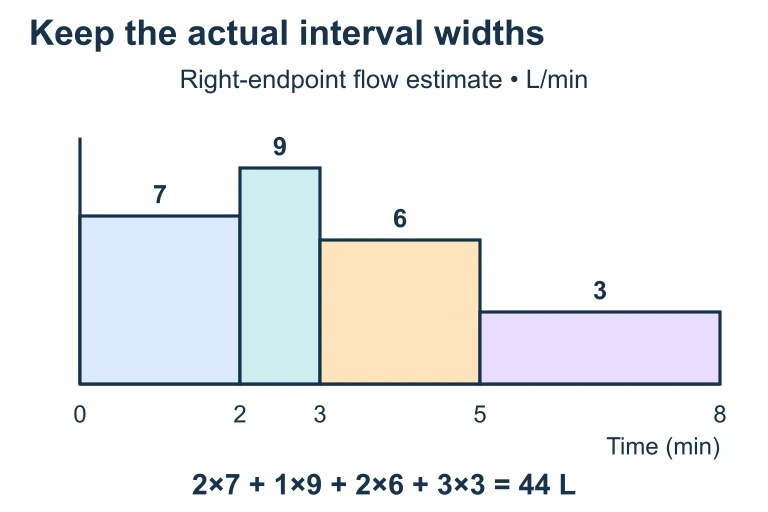 Keep the unequal interval widths in a right-endpoint sum: 2×7 + 1×9 + 2×6 + 3×3 estimates 44 L of accumulated flow.
More Rectangles = Better Accuracy
Sigma Notation for Riemann Sums
On the AP exam, you must be comfortable writing and interpreting Riemann sums in summation notation.
Common Mistakes
Summary Comparison
| Property | Left | Right | Midpoint |
|---|---|---|---|
| Sample point | \(a + i\,\Delta x\) | \(a + i\,\Delta x\) | \(a + (i-\tfrac{1}{2})\Delta x\) |
| Index range | \(i = 0, \ldots, n-1\) | \(i = 1, \ldots, n\) | \(i = 1, \ldots, n\) |
| Accuracy | Lower | Lower | Higher |
| Increasing \(f\) | Under | Over | Depends |
| Decreasing \(f\) | Over | Under | Depends |
Question 1 of 5
Using a left Riemann sum with \(n = 3\) subintervals, approximate \(\displaystyle\int_1^4 2x\,dx\).
Question 2 of 5
If \(f\) is a continuous, increasing function on \([a, b]\), which statement is true?
Question 3 of 5
A table gives values of \(g(x)\):
| \(x\) | 1 | 3 | 5 | 7 |
|---|---|---|---|---|
| \(g(x)\) | 4 | 10 | 8 | 2 |
What is the right Riemann sum approximation for \(\displaystyle\int_1^7 g(x)\,dx\) with 3 equal subintervals?
Question 4 of 5
The midpoint Riemann sum for \(\displaystyle\int_0^6 f(x)\,dx\) with \(n = 3\) uses which sample points?
Question 5 of 5
Which expression represents a right Riemann sum for \(\displaystyle\int_2^5 x^3\,dx\) with \(n\) subintervals?