01 / 21

Accumulation Functions
and Definite Integrals

Master how definite integrals model real-world accumulation: total distance, net change, and quantity built up over an interval.

AP Calculus AB

What Is Accumulation?

In calculus, accumulation means adding up tiny pieces of a quantity over an interval. If a rate function \( r(t) \) tells you how fast something changes at every instant, then the total amount accumulated from \( t = a \) to \( t = b \) is:

This connects a rate (how fast) to a total amount (how much). Every applied integral problem builds on this single idea.

Area Under the Rate Curve

t r(t) a b Shaded Area = Total Accumulation

Why Accumulation Matters

Physics
Velocity \( v(t) \) integrated gives total displacement. Acceleration integrated gives change in velocity.
Biology
A growth rate \( P'(t) \) integrated gives the total population change over time.
Economics
A marginal cost \( C'(x) \) integrated gives total cost of producing additional units.

The Accumulation Function

An accumulation function measures how much has been accumulated from a fixed starting point \( a \) up to a variable endpoint \( x \):

Here \( f(t) \) is the rate function and \( F(x) \) tells you the net total accumulated from \( t = a \) to \( t = x \). As \( x \) increases, \( F(x) \) grows (when \( f > 0 \)) or shrinks (when \( f < 0 \)).

Follow the salt through a working mixing rig
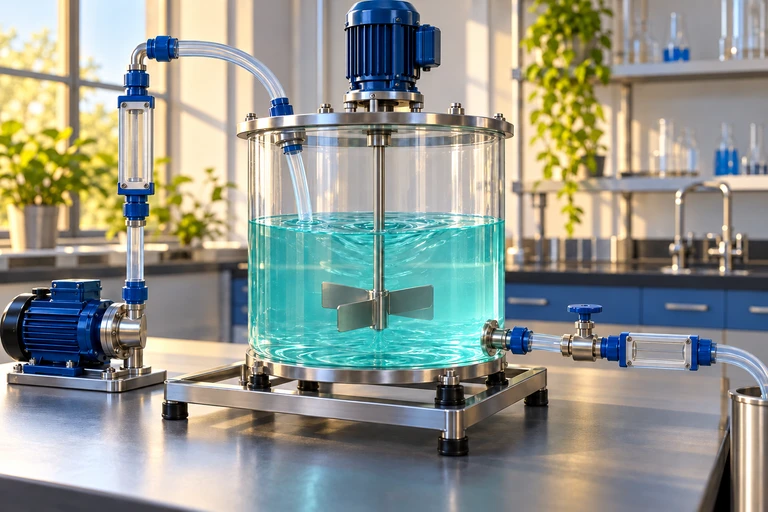
A stirred transparent tank has one upper inlet and one lower outlet with a valve. The exact diagram links its 100 L salt balance to a computed approach to equilibrium.For net flow R(t) = 4t − t² gal/min and 10 gal initially, V(t) = 10 + 2t² − t³/3. Volume peaks at t = 4 minutes, when the net rate changes from positive to negative.

Signed net flow and inventory
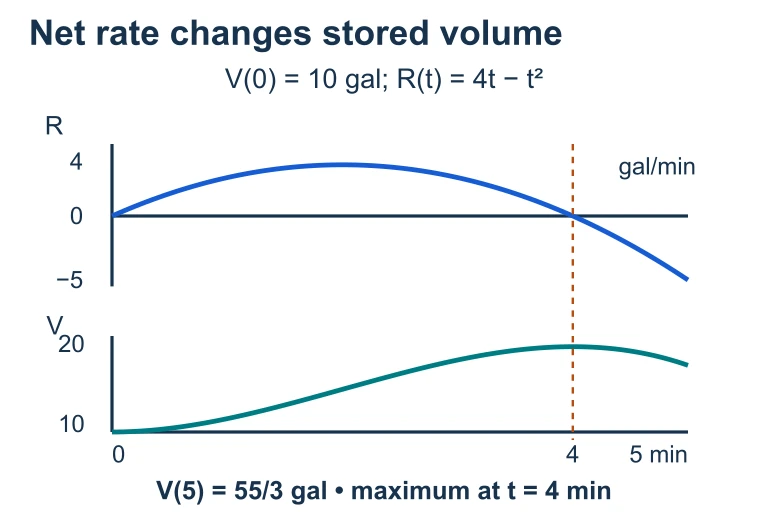
For net flow R(t) = 4t − t² gal/min and 10 gal initially, V(t) = 10 + 2t² − t³/3. Volume peaks at t = 4 minutes, when the net rate changes from positive to negative.For net flow R(t) = 4t − t² gal/min and 10 gal initially, V(t) = 10 + 2t² − t³/3. Volume peaks at t = 4 minutes, when the net rate changes from positive to negative.

FTC Part 2: Evaluating Totals

To compute a definite integral when you know an antiderivative \( F \) of \( f \):

t F(t) a b F(a) F(b) F(b)−F(a)

The net change in the antiderivative over \( [a, b] \) equals the definite integral: \( F(b) - F(a) \).

Net Change vs. Total Accumulated

Net Change (Displacement)
\( \displaystyle\int_a^b v(t)\, dt \)

Signed area: regions below the axis subtract. Can be negative.
Total Accumulated (Distance)
\( \displaystyle\int_a^b |v(t)|\, dt \)

All area counts as positive. Always non-negative.

One cart, three meanings: position, displacement, and distance
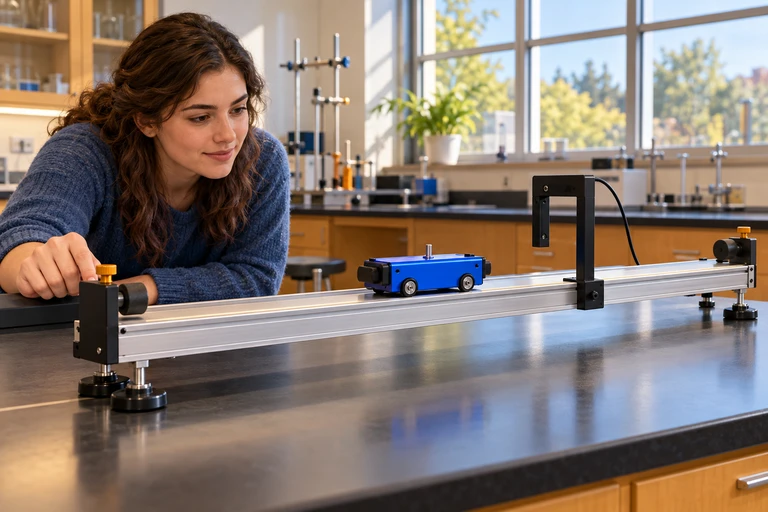
A blue dynamics cart rests on a straight laboratory rail with a photogate and end buffers; an observer stands behind the setup.Suppose v(t) = t² − 4t + 3 on [0,5] with initial position zero. Reversals at t = 1 and 3 split the motion into signed segments: displacement is 20/3 units and distance is 28/3 units.

Add every traveled segment positively
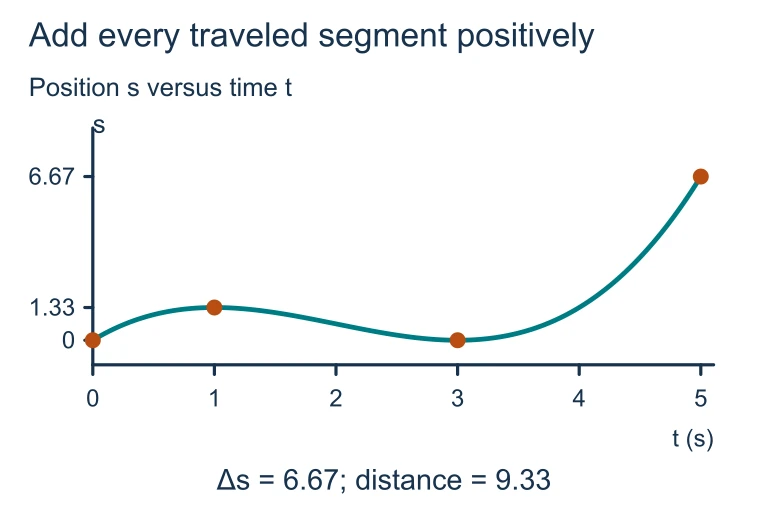
Suppose v(t) = t² − 4t + 3 on [0,5] with initial position zero. Reversals at t = 1 and 3 split the motion into signed segments: displacement is 20/3 units and distance is 28/3 units.Suppose v(t) = t² − 4t + 3 on [0,5] with initial position zero. Reversals at t = 1 and 3 split the motion into signed segments: displacement is 20/3 units and distance is 28/3 units.

How to Apply the Accumulation Framework

1
Identify the rate function. What quantity is changing and what is its rate? Look for "per hour," "per second," "per unit."
2
Set up the integral. Write \( \int_a^b r(t)\, dt \) with the correct bounds from the problem.
3
Decide: net or total? Use absolute value inside the integral if the question asks for total accumulated (not net change).
4
Evaluate. Find an antiderivative and apply FTC Part 2, or use geometry, tables, or technology as directed.
5
Interpret with units. State the result in context: "The total water added is 150 gallons" (not just "150").

Example 1: Water Tank

Water flows into a tank at a rate of \( r(t) = 6t - t^2 \) gallons per minute for \( 0 \leq t \leq 6 \). How many gallons enter the tank during this time?

Interpretation: Over the 6-minute interval, a total of 36 gallons of water flowed into the tank.

Example 1: Visualized

t (min) r(t) 0 1 2 3 4 5 6 0 3 6 9 peak: r(3) = 9 Area = 36 gal

Example 2: Velocity and Displacement

A particle moves along a line with velocity \( v(t) = t^2 - 4t + 3 \) m/s for \( 0 \leq t \leq 4 \). Find the net displacement and the total distance traveled.

Example 2: Signed Areas

t (s) v(t) 0 1 2 3 4 +4/3 −4/3 +4/3

Example 3: Table of Rates

A factory produces pollution at the rate shown below (tons/day). Use a trapezoidal sum to estimate the total pollution from day 0 to day 8.

Day \( t \) 0 2 4 6 8
\( r(t) \) tons/day 3 5 7 4 2

A few readings leave the intervals unseen

A probe touches a plain metal object and connects to a blank logger beside a notebook and separated blank reading cards.Separated measurements leave the behavior between samples undetermined. Two differentiable curves can pass through the same readings while having different derivatives between them.

A few readings leave the intervals unseen
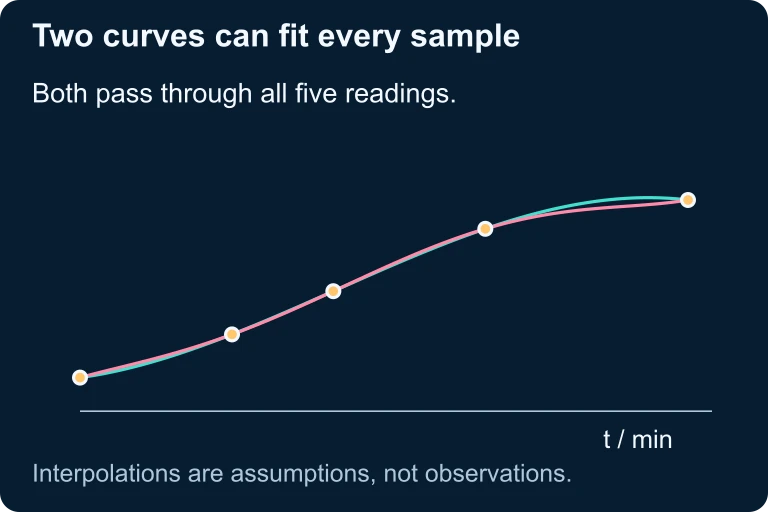
Separated measurements leave the behavior between samples undetermined. Two differentiable curves can pass through the same readings while having different derivatives between them.Separated measurements leave the behavior between samples undetermined. Two differentiable curves can pass through the same readings while having different derivatives between them.

Interpreting Units and Meaning

On the AP exam, you must interpret your answer in context with correct units. The units of \( \int_a^b r(t)\, dt \) are always:

Rate: gal/min, \( t \) in min
Integral units: gallons
Rate: m/s, \( t \) in s
Integral units: meters
Rate: people/hr, \( t \) in hr
Integral units: people

Common Mistakes

✕ Forgetting Absolute Value
Using \( \int v(t)\, dt \) for total distance instead of \( \int |v(t)|\, dt \). This gives displacement, not distance.
✕ Wrong Units
Writing "gallons per minute" for the integral when the answer should be "gallons." Multiply rate units by time units.
✕ Ignoring Initial Condition
When asked for amount at time \( b \): total = initial amount + \( \int_a^b r(t)\, dt \). Don't forget the starting value.

Summary Table

Question Type Setup Key Detail
Net change / displacement \( \int_a^b f(t)\, dt \) Signed: negative area subtracts
Total distance / amount \( \int_a^b |f(t)|\, dt \) Split at zeros, all positive
Amount at time \( b \) \( F(a) + \int_a^b f(t)\, dt \) Don't forget initial value
Average value \( \frac{1}{b-a}\int_a^b f(t)\, dt \) Divide integral by interval length

Question 1 of 5

Water flows into a pool at a rate of \( r(t) = 4t \) gallons per minute. How many gallons enter the pool from \( t = 0 \) to \( t = 5 \)?

Question 2 of 5

A particle's velocity is \( v(t) = t - 3 \) m/s for \( 0 \leq t \leq 6 \). What is the particle's total distance traveled?

Question 3 of 5

If \( F(x) = \int_2^x (3t^2)\, dt \), what is \( F'(x) \)?

Question 4 of 5

A tank initially contains 20 gallons of water. Water flows in at \( r(t) = 8 - 2t \) gal/min. How many gallons are in the tank at \( t = 4 \) minutes?

Question 5 of 5

The rate of oil leaking from a pipe is \( r(t) \) liters per hour. What does \( \int_0^{10} r(t)\, dt = 45 \) mean in context?