
SECTION 1
Historical Context & Motivation
The quest to compute volumes of curved solids reaches back to antiquity, when Archimedes determined the volume of a sphere by comparing thin cross-sectional slices to those of known solids—a technique remarkably close to modern integration. For centuries, mathematicians refined this slicing intuition, but it was not until the development of calculus in the seventeenth century that a fully general framework emerged. The washer method extends the basic disk method to handle solids of revolution that possess a hollow interior, much like a pipe or a donut. Whenever the region being revolved does not touch the axis of rotation—or is bounded by two curves at different distances from that axis—the resulting solid contains an empty core, and simple disks no longer suffice.
~250 BC • Archimedes' Method of Exhaustion
1615 • Kepler's Nova Stereometria
1635 • Cavalieri's Principle
1665–1687 • Newton & Leibniz Develop Calculus
Modern Era • Washer Method in Engineering & Design
The central question the washer method answers is: How do you compute the volume of a solid of revolution when each cross-section is an annular ring (a disk with a hole) rather than a full disk? This lesson develops the complete theory, derives the integral formulas for revolution about both the x-axis and the y-axis, and walks through the reasoning you will need on the AP Calculus AB exam.
SECTION 2
Core Principles & Definitions
Before writing any integral, you must internalize several foundational ideas that distinguish the washer method from the simpler disk method. The washer method applies whenever a region bounded by two curves is revolved around an axis, and the inner boundary of the region does not coincide with that axis, producing a hollow core in the resulting solid.
Solid of Revolution
Outer Radius R(x) or R(y)
Inner Radius r(x) or r(y)
Washer = Outer Disk − Inner Disk
Axis Determines the Variable
KEY TAKEAWAY
SECTION 3
Visual Explanation: How Washers Form
The diagram below illustrates a region bounded by an outer curve and an inner curve being revolved about the x-axis. Notice how each vertical slice of the region, when rotated 360°, sweeps out an annular ring—a washer. The outer radius extends from the x-axis to the top curve, while the inner radius extends from the x-axis to the bottom curve. The washer's thickness is the infinitesimal width dx.
In the diagram, the violet curve y = f(x) forms the outer boundary and the pink curve y = g(x) forms the inner boundary. At any x-value, the cyan dashed line from the x-axis to f(x) is the outer radius R(x), and the amber dashed line from the x-axis to g(x) is the inner radius r(x). The inset circle shows the face of the washer: the area of the violet outer disk minus the area of the pink inner hole gives π(R² − r²), the cross-sectional area at that x-value. Integrating this area from the left boundary to the right boundary sums all infinitesimally thin washers into the total volume.
 A washer separates wall material from the cavity: its area is π(R² − r²). Integrating the cavity area instead measures the volume available to hold water.
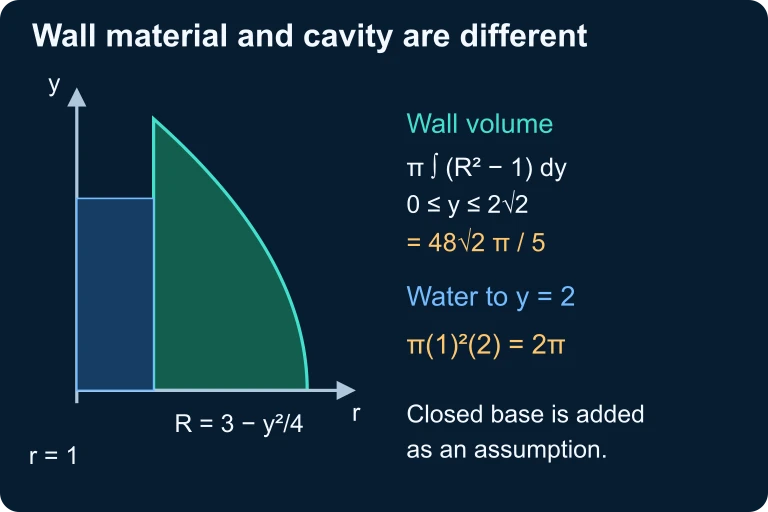 A washer separates wall material from the cavity: its area is π(R² − r²). Integrating the cavity area instead measures the volume available to hold water.
SECTION 4
Mathematical Framework
The washer method formula is derived by considering the volume of a thin cylindrical shell of thickness Δx (or Δy) with an annular cross-section. If R denotes the outer radius and r denotes the inner radius, then the cross-sectional area is πR² − πr² = π(R² − r²). Summing these infinitesimal volumes via a definite integral produces the total volume of the solid.
Revolution About the x-Axis
WASHER METHOD — REVOLUTION ABOUT THE X-AXIS
where R(x) is the outer radius (distance from the x-axis to the farther curve), r(x) is the inner radius (distance from the x-axis to the nearer curve), and [a, b] is the interval of x-values over which the region extends.
When both bounding curves lie above the x-axis, R(x) equals the top function and r(x) equals the bottom function. If a curve lies below the x-axis, you must use its absolute distance from the axis, since radii are always nonnegative. The key insight is that R(x) and r(x) are measured from the axis of revolution, not from each other.
Revolution About the y-Axis
WASHER METHOD — REVOLUTION ABOUT THE Y-AXIS
where R(y) is the outer radius (distance from the y-axis to the farther curve, expressed as x = h(y)), r(y) is the inner radius (distance from the y-axis to the nearer curve), and [c, d] is the interval of y-values.
For y-axis revolution, you slice horizontally. Each horizontal slice is perpendicular to the y-axis, and its washer has radii measured horizontally. This requires expressing the bounding curves as functions of y, i.e., solving for x in terms of y. The limits of integration c and d are the y-values where the region begins and ends.
DISK METHOD AS A SPECIAL CASE
When the region touches the axis of revolution, the inner radius is zero and the washer reduces to a solid disk. The washer formula with r = 0 recovers the standard disk method.
Common Pitfall
SECTION 5
Setting Up the Integral: A Step-by-Step Strategy
The most common source of errors on the AP exam is not the integration itself but the setup: identifying the correct axis, determining which curve is outer and which is inner, and choosing the appropriate variable of integration. The following systematic approach prevents these mistakes.
- Step 1 — Sketch the region. Graph both curves and shade the enclosed region. Mark the axis of revolution clearly.
- Step 2 — Determine the slicing direction. Slices are always perpendicular to the axis of revolution. x-axis revolution → vertical slices (integrate with respect to x). y-axis revolution → horizontal slices (integrate with respect to y).
- Step 3 — Find the limits of integration. Solve for the intersection points of the bounding curves. These give the endpoints a, b (or c, d) of the integral.
- Step 4 — Identify R and r for each slice. From the axis of revolution, measure outward. The farther curve gives R; the nearer curve gives r. Both are nonnegative.
- Step 5 — Write and evaluate the integral. Substitute into V = π∫(R² − r²) dx (or dy), expand the integrand, find the antiderivative, and apply the Fundamental Theorem of Calculus.
SETUP SHORTCUT
SECTION 6
Worked Example: Region Between y = x² and y = √x About the x-Axis
Find the volume of the solid generated by revolving the region bounded by y = √x and y = x² about the x-axis.
Volume by Washer Method (x-axis revolution)
- 1
Step 1 — Sketch and identify the region
Both curves pass through (0, 0) and (1, 1). On the interval [0, 1], √x ≥ x² (verify: at x = 0.5, √0.5 ≈ 0.707 while 0.5² = 0.25). So the region lies between the curves from x = 0 to x = 1, with y = √x on top and y = x² on the bottom. - 2
Step 2 — Determine outer and inner radii
Revolving about the x-axis, vertical slices produce washers. The outer radius is the distance from the x-axis to the top curve: R(x) = √x. The inner radius is the distance from the x-axis to the bottom curve: r(x) = x².R(x) = √x, r(x) = x² - 3
Step 3 — Write the washer integral
Substituting into V = π∫₀¹ [R(x)² − r(x)²] dx gives V = π∫₀¹ [(√x)² − (x²)²] dx = π∫₀¹ [x − x⁴] dx.V = π ∫₀¹ (x − x⁴) dx - 4
Step 4 — Evaluate the integral
Find the antiderivative: ∫(x − x⁴) dx = x²/2 − x⁵/5. Evaluate from 0 to 1: [1/2 − 1/5] − [0] = 5/10 − 2/10 = 3/10.V = 3π/10 - 5
Step 5 — Verify reasonableness
The volume 3π/10 ≈ 0.942 cubic units. The enclosing cylinder (radius 1, length 1) has volume π ≈ 3.14, and the solid should be considerably smaller since the region is thin. A volume of about 30% of the cylinder is geometrically plausible.
SECTION 7
Comparing Volume Methods
AP Calculus AB primarily tests the disk and washer methods, but it is useful to see how these relate to one another and to the shell method (which appears more often in Calculus BC). Understanding when each method is most natural helps you choose an efficient setup and avoid unnecessary algebra.
| Feature | Disk Method | Washer Method | Shell Method (BC) |
|---|---|---|---|
| When to use | Region touches axis of revolution (no hole) | Region does NOT touch axis; two boundary curves create a hole | Slicing parallel to axis is easier; avoids solving for the other variable |
| Slice direction | Perpendicular to axis | Perpendicular to axis | Parallel to axis |
| Cross-section shape | Solid circle (πR²) | Annular ring: π(R² − r²) | Thin cylindrical shell: 2πrh |
| Formula | V = π∫[R(x)]² dx | V = π∫[R² − r²] dx | V = 2π∫ x·f(x) dx |
| AP AB scope | Fully tested | Fully tested | Not required for AB |
Comparison of the three principal methods for computing volumes of solids of revolution.
CHOOSING THE RIGHT METHOD
SECTION 8
Connection to Advanced Theory: Non-Standard Axes & Beyond
Although the AP Calculus AB exam focuses on revolution about the x-axis and y-axis, the washer method generalizes naturally to revolution about any horizontal or vertical line. Understanding this extension deepens your conceptual grasp and prepares you for free-response questions that may feature axes such as y = −1 or x = 3. In those cases, the radii R and r are measured from the non-standard axis to each curve, requiring a shift in each expression. For instance, revolving about y = k instead of y = 0 changes R(x) from f(x) to |f(x) − k| and r(x) from g(x) to |g(x) − k|.
| Topic | AB Exam Scope | Extension / BC & Beyond |
|---|---|---|
| Axis of revolution | x-axis (y = 0) or y-axis (x = 0); also horizontal/vertical lines like y = k | Oblique axes, parametric curves revolved about arbitrary lines |
| Volume methods | Disk and washer methods | Shell method, Pappus' theorem, multivariable integration |
| Cross-sections | Known cross-sections (squares, semicircles, etc.) with perpendicular slicing | General cross-sections in 3D via triple integrals |
| Curve representation | y = f(x), x = g(y) | Parametric x(t), y(t); polar r(θ); implicit F(x, y) = 0 |
How the washer method fits into the broader calculus landscape.
Mastering the washer method on the standard axes provides the template for all of these extensions. The logic never changes: identify the axis, draw a representative slice perpendicular to it, measure R and r from the axis, and integrate π(R² − r²). Only the expressions for R and r become more involved as the axis or curve representation changes.
SECTION 9
Practice Problems
Question 1: CONCEPTUAL
- A. Because the formula requires factoring R² − r² as (R − r)(R + r) before integrating.
- B. Because each washer's area equals the area of the outer circle minus the area of the inner circle, and the area of a circle depends on the square of its own radius, not on the difference of two radii.
- C. Because the Fundamental Theorem of Calculus requires each term in the integrand to be squared separately.
- D. Because squaring the difference of radii would give a negative value, which is not physically meaningful.
- E. Because the disk method already accounts for the inner radius, so subtracting circles avoids double-counting.
Show answer (B)
Question 2: BASIC CALCULATION
- A. π/6
- B. π/10
- C. 2π/15
- D. π/5
- E. π/3
Show answer (C)
Question 3: INTERMEDIATE
- A. π ∫₀² [(2y)² − (y²)²] dy
- B. π ∫₀⁴ [(2y)² − (y²)²] dy
- C. π ∫₀² [(y²)² − (2y)²] dy
- D. π ∫₀⁴ [(√x)² − (x/2)²] dx
- E. π ∫₀² [(2y − y²)²] dy
Show answer (A)
Question 4: APPLIED
5 ptsShow answer
Question 5: CRITICAL THINKING
3 ptsShow answer
SUMMARY
Volume with Washer Method — Summary
Summary
The washer method computes the volume of a solid of revolution when each cross-section perpendicular to the axis of revolution is an annular ring. The volume is given by V = π∫(R² − r²), where R is the outer radius and r is the inner radius, both measured from the axis of revolution to the respective boundary curves. When the inner radius is zero, the washer formula reduces to the disk method.
To set up the integral correctly: always sketch the region, draw a representative slice perpendicular to the axis, identify R and r from the axis outward, find intersection points for the limits, and remember that R² − r² ≠ (R − r)². Revolution about the x-axis uses dx with radii as functions of x; revolution about the y-axis uses dy with radii as functions of y. These principles form the foundation for all volume-of-revolution problems on the AP Calculus AB exam.