

SECTION 1
Historical Context & Motivation
Differential equations have been central to mathematics and the sciences since the late seventeenth century, when Isaac Newton and Gottfried Wilhelm Leibniz independently developed calculus. From the very beginning, mathematicians recognized that finding a solution to a differential equation was only half the battle—one also had to verify that the proposed solution actually satisfies the equation. This process of verification became especially important as the complexity of differential equations grew and multiple solution techniques emerged, each capable of producing candidate functions that required careful checking.
1687 • Newton's Principia
1736 • Euler's Mechanica
1820s • Cauchy's Rigor
1890s • Picard's Iteration
The core question this lesson addresses is deceptively simple: given a differential equation and a proposed function, how do we rigorously confirm that the function is indeed a solution? This skill is tested repeatedly on the AP Calculus AB exam because it reinforces fluency with differentiation rules and algebraic manipulation while building conceptual understanding of what a differential equation actually means.
SECTION 2
Core Principles & Definitions
A differential equation is an equation that relates an unknown function to one or more of its derivatives. A solution to a differential equation is any function that, when substituted into the equation along with its derivatives, produces a true statement for every value in the domain under consideration. Verification is the act of performing that substitution and confirming the identity holds.
Differential Equation
General Solution
Particular Solution
Verification by Substitution
KEY TAKEAWAY
SECTION 3
Visual Explanation
The following diagram illustrates the verification workflow. Starting from a differential equation and a candidate solution, you differentiate the candidate, substitute into both sides, simplify, and compare. The process is purely mechanical once you understand the logic: compute, substitute, simplify, compare.
Notice that the verification process does not require you to solve the differential equation from scratch. You are given both the equation and the candidate, and your task is entirely about differentiation and algebra. This makes verification a powerful checking tool—even when you derive a solution yourself, the final step should always be to verify by substitution.
SECTION 4
Mathematical Framework
The formal procedure rests on a straightforward logical claim: a function y = f(x) is a solution to a differential equation if and only if substituting f(x) and its derivatives into the equation yields an identity—a statement true for all x in the domain. Let us codify this with the standard first-order and second-order forms.
FIRST-ORDER ODE
A function y = f(x) is a solution if f'(x) = g(x, f(x)) for all x in the domain.
SECOND-ORDER ODE
A function y = f(x) is a solution if f''(x) + p(x) · f'(x) + q(x) · f(x) = r(x) for all x in the domain.
VERIFICATION IDENTITY
After substitution and simplification, if the left-hand side reduces to exactly the right-hand side, then f is a verified solution.
When an initial condition is given—such as y(x₀) = y₀—verification includes one additional step: substitute x₀ into the candidate function and confirm that f(x₀) = y₀. Both the differential equation and the initial condition must be satisfied for a particular solution to be fully verified. On the AP exam, problems may require you to verify one or both of these conditions.
Common Pitfall
 In the model y = 100e^(0.4t), the relative growth rate stays at 0.4 while total growth y′ = 0.4y increases with the population.
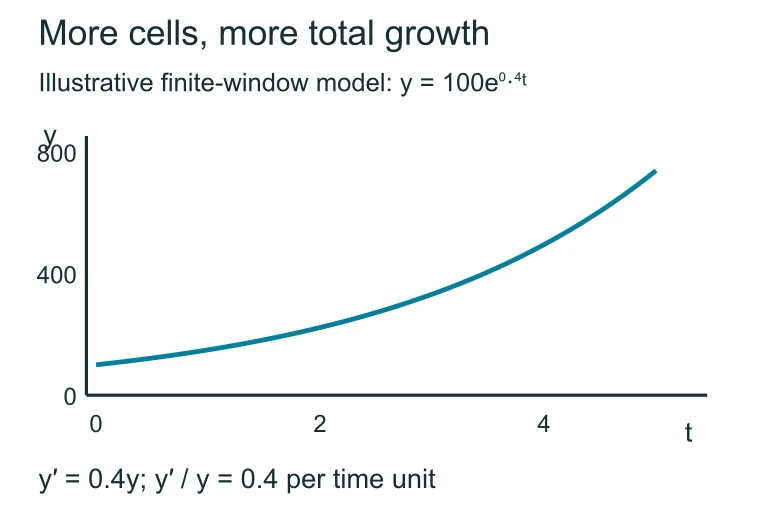 In the model y = 100e^(0.4t), the relative growth rate stays at 0.4 while total growth y′ = 0.4y increases with the population.
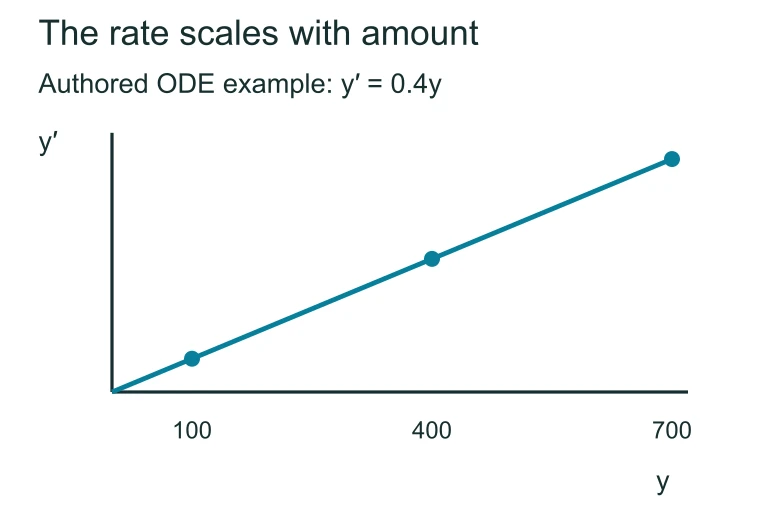 In the model y = 100e^(0.4t), the relative growth rate stays at 0.4 while total growth y′ = 0.4y increases with the population.
SECTION 5
Types of Verification Problems
Verification problems on the AP Calculus AB exam come in several flavors. Understanding these categories helps you anticipate what the question is really asking and avoid unnecessary work. The diagram below classifies the main types you will encounter.
| Type | What You're Given | Key Action |
|---|---|---|
| Verify Explicit | DE and y = f(x) | Differentiate f, substitute into DE, simplify to identity |
| Verify with IC | DE, y = f(x), and y(x₀) = y₀ | Same as above, plus confirm f(x₀) = y₀ |
| Choose from List | DE and several candidate functions | Test each candidate; only one will produce an identity |
| General Solution | DE and y = f(x, C) | Treat C as constant, differentiate, substitute |
| Implicit Solution | DE and F(x, y) = 0 | Use implicit differentiation to find dy/dx, then substitute |
Summary of verification problem types
SECTION 6
Worked Example
Let us verify that y = Ce2x is a solution to the differential equation dy/dx = 2y, and then determine the particular solution satisfying y(0) = 5.
Verify y = Ce²ˣ for dy/dx = 2y with y(0) = 5
- 1
Step 1 — Identify the DE and candidate
The differential equation is dy/dx = 2y. The candidate solution is y = Ce2x, where C is an arbitrary constant. - 2
Step 2 — Differentiate the candidate
Using the chain rule, dy/dx = d/dx[Ce2x] = C · 2e2x = 2Ce2x.dy/dx = 2Ce2x - 3
Step 3 — Substitute into the DE
The right-hand side of the DE is 2y = 2(Ce2x) = 2Ce2x. Compare: LHS = 2Ce2x and RHS = 2Ce2x.LHS = RHS ✓ — y = Ce²ˣ is a solution for all C - 4
Step 4 — Apply the initial condition
Substitute x = 0 and y = 5: 5 = Ce0 = C · 1 = C. Therefore C = 5.Particular solution: y = 5e²ˣ
FRQ Strategy
SECTION 7
Common Errors & How to Avoid Them
Students who understand the verification concept often lose points to procedural mistakes. The table below catalogs the most frequent errors and provides specific strategies for avoiding them.
| Error | Why It Happens | Prevention Strategy |
|---|---|---|
| Forgetting the chain rule | Students treat the inner function as x itself | Circle the inner function before differentiating; multiply by its derivative |
| Not substituting for y on the RHS | They replace dy/dx but leave y unchanged | Replace every y in the equation with the candidate expression |
| Sign errors in simplification | Distributing negatives incorrectly | Write each algebraic step on a new line; check sign of every term |
| Treating C as zero | Assuming the constant vanishes | Keep C explicit throughout; only set it to a value when an IC is given |
| Missing the concluding statement | Work is correct but conclusion is absent | End with 'Since LHS = RHS, the function is a solution' |
Common verification errors on the AP exam
KEY TAKEAWAY
SECTION 8
Connection to Advanced Theory
In AP Calculus AB you verify solutions for first-order ordinary differential equations, primarily of the form dy/dx = f(x, y). As you progress to AP Calculus BC and beyond, the same verification principle extends to more complex structures. The table below shows how the skill scales.
| Feature | AP Calculus AB | Advanced (BC / College) |
|---|---|---|
| Order of DE | First-order | First- and second-order |
| Solution form | Explicit y = f(x) | Explicit, implicit, parametric, power series |
| Verification tools | Direct differentiation | Implicit diff., series substitution, Wronskian |
| Existence / uniqueness | Informal understanding | Picard–Lindelöf theorem, Lipschitz conditions |
Verification in AB vs. advanced courses
The habit of verifying solutions is not merely an exam skill—it is a professional practice used by engineers, physicists, and applied mathematicians. When differential equations model real systems (population growth, circuit dynamics, fluid flow), the cost of an incorrect solution can be enormous. Verification is the final quality-control step that ensures mathematical predictions match reality.
SECTION 9
Practice Problems
Question 1: CONCEPTUAL
- A. f(x) can be obtained by integrating both sides of the equation
- B. Substituting f(x) and its derivatives into the equation yields a true statement for all x in the domain
- C. f(x) is the only function whose derivative appears in the equation
- D. The graph of f(x) passes through the origin
- E. f(x) satisfies f'(x) = 0 at every point
Show answer (B)
Question 2: BASIC CALCULATION
- A. y = 3x²
- B. y = x³ + 7
- C. y = 6x
- D. y = x² + 7
- E. y = 3x³
Show answer (B)
Question 3: INTERMEDIATE
- A. y = x²
- B. y = ln x
- C. y = 5/x
- D. y = eˣ
- E. y = −x
Show answer (C)
Question 4: APPLIED
5 ptsShow answer
Question 5: CRITICAL THINKING
4 ptsShow answer
SUMMARY
Lesson Summary
Summary
Verifying a solution to a differential equation means showing that when you differentiate the candidate function and substitute it and its derivatives into the equation, the result is an identity—both sides are equal for all x in the domain. The process is purely mechanical: compute, substitute, simplify, compare. For initial value problems, you must also confirm that the initial condition is satisfied by evaluating the candidate at the given point.
On the AP exam, always show every substitution step explicitly and end with a clear concluding statement such as 'Since LHS = RHS for all x, y = f(x) is a solution.' Mastering this technique builds the differentiation fluency and algebraic discipline that are essential throughout calculus.