

SECTION 1
Historical Context & Motivation
The problem of differentiating ratios of functions arose naturally alongside the broader development of calculus in the late seventeenth century. When Isaac Newton and Gottfried Wilhelm Leibniz independently formalized differentiation, they recognized that many physical quantities—velocity as a ratio of displacement to time, density as mass over volume—required a reliable method for handling quotients of changing quantities. While the product rule received explicit early treatment, the quotient rule was often derived as a corollary, emerging from the interplay between the product rule and the chain rule applied to negative exponents.
1665–1666 • Newton's Fluxions
1684 • Leibniz Publishes Differential Calculus
1748 • Euler's Introductio in Analysin Infinitorum
1821 • Cauchy Formalizes Limits
The central question these mathematicians confronted remains the same one we face today: given two differentiable functions f(x) and g(x), how do we systematically find the derivative of f(x)/g(x) without reverting to the limit definition each time? The quotient rule answers this question with a single, elegant formula that expresses the derivative of a ratio in terms of the derivatives of its numerator and denominator—a formula that appears repeatedly on the AP Calculus AB exam.
SECTION 2
Core Principles & Definitions
Before applying the quotient rule, it is essential to understand the foundational ideas that make the formula work. The rule is not an arbitrary shortcut; it follows directly from the limit definition of the derivative and the algebraic properties of fractions. Mastering these principles ensures you can both apply the formula confidently and verify it when needed.
Differentiability of Numerator & Denominator
Non-Zero Denominator
"Low d-High Minus High d-Low" Structure
Denominator Squared
Subtraction Order Matters
KEY TAKEAWAY
SECTION 3
Visual Explanation
A geometric interpretation of the quotient rule helps solidify the algebraic formula. The diagram below illustrates how the derivative of a quotient f(x)/g(x) can be visualized by considering the rates at which both the numerator and denominator change, and how those competing changes affect the overall ratio.
Notice how the derivative of the quotient is not simply f′(a)/g′(a)—a common misconception. The ratio of two functions changes in a more nuanced way because both the numerator and denominator are moving targets. When the denominator g(x) is increasing rapidly (large positive g′(a)), the quotient tends to decrease even if f is also growing, because the 'base' is expanding. Conversely, a shrinking denominator amplifies the quotient's growth. The quotient rule captures this tug-of-war precisely.
SECTION 4
Mathematical Framework
Let us now state the quotient rule formally, derive it from the limit definition, and examine the key equations you must internalize for the AP exam. Understanding the derivation—not just memorizing the formula—strengthens your ability to apply it correctly under pressure.
THE QUOTIENT RULE
where f(x) is the numerator function, g(x) is the denominator function, and both must be differentiable with g(x) ≠ 0.
Derivation from the Limit Definition
We begin with the limit definition of the derivative applied to the quotient q(x) = f(x)/g(x). Writing q′(x) = lim(h→0) [q(x+h) − q(x)]/h, we substitute the quotient form and combine fractions over a common denominator g(x+h)·g(x). After adding and subtracting g(x)·f(x) in the numerator to create recognizable difference quotients, we separate the expression into two limits—one involving f's difference quotient and one involving g's—and apply the limit laws. Because g is continuous (being differentiable), lim(h→0) g(x+h) = g(x), and the formula emerges cleanly.
LIMIT FORM
The key algebraic trick is adding and subtracting f(x)·g(x) in the numerator, yielding g(x)·[f(x+h) − f(x)] − f(x)·[g(x+h) − g(x)], which separates into the two standard difference quotients for f′(x) and g′(x).
Alternative Derivation via the Product Rule
A more elegant derivation rewrites f(x)/g(x) as f(x)·[g(x)]⁻¹ and applies the product rule combined with the chain rule. Differentiating, we get f′(x)·[g(x)]⁻¹ + f(x)·(−1)·[g(x)]⁻²·g′(x). Combining these terms over a common denominator of [g(x)]² yields the standard quotient rule formula. This approach reinforces a valuable insight: the quotient rule is not truly independent of the product and chain rules but rather a specialized consequence of them.
PRODUCT-CHAIN DERIVATION
This derivation is often faster on the AP exam for quotients like 1/g(x), where the product rule with g⁻¹ may be simpler than the full quotient rule.
SECTION 5
Common Forms & Classification of Quotient Rule Problems
On the AP Calculus AB exam, quotient rule problems come in several recognizable forms. Learning to classify the type of quotient you are differentiating helps you choose the most efficient strategy—sometimes the quotient rule is required, and sometimes algebraic simplification or the product rule is faster.
| Quotient Type | Example | Best Strategy |
|---|---|---|
| Rational function (polynomial / polynomial) | (x³ + 2x) / (x² − 1) | Quotient rule directly; simplify afterwards |
| Monomial denominator | (3x⁴ − x²) / x³ | Divide each term first, then use power rule |
| Trig quotient | sin(x) / cos(x) = tan(x) | Use known derivative of tan(x) = sec²(x), or derive via quotient rule |
| Constant numerator | 5 / (x² + 1) | Quotient rule with f′(x) = 0, or rewrite as 5·(x² + 1)⁻¹ |
| Nested quotient (with chain rule) | eˣ / (2x + 1)³ | Quotient rule with chain rule on denominator |
Common quotient types encountered on the AP Calculus AB exam
SECTION 6
Worked Example
Let us apply the quotient rule to a problem representative of AP exam difficulty. We will differentiate h(x) = (3x² − 5) / (x³ + 2x) step by step, identifying each component clearly before combining.
Find h′(x) where h(x) = (3x² − 5) / (x³ + 2x)
- 1
Step 1 — Identify f(x), g(x), and Their Derivatives
Set f(x) = 3x² − 5, so f′(x) = 6x. Set g(x) = x³ + 2x, so g′(x) = 3x² + 2. We confirm g(x) ≠ 0 in the domain of interest (note g(0) = 0, so h is undefined at x = 0).f′(x) = 6x, g′(x) = 3x² + 2 - 2
Step 2 — Apply the Quotient Rule Formula
Using h′(x) = [g(x)·f′(x) − f(x)·g′(x)] / [g(x)]², we substitute to get h′(x) = [(x³ + 2x)(6x) − (3x² − 5)(3x² + 2)] / (x³ + 2x)².h′(x) = [(x³ + 2x)(6x) − (3x² − 5)(3x² + 2)] / (x³ + 2x)² - 3
Step 3 — Expand the Numerator
First product: (x³ + 2x)(6x) = 6x⁴ + 12x². Second product: (3x² − 5)(3x² + 2) = 9x⁴ + 6x² − 15x² − 10 = 9x⁴ − 9x² − 10. The numerator becomes 6x⁴ + 12x² − (9x⁴ − 9x² − 10) = 6x⁴ + 12x² − 9x⁴ + 9x² + 10.Numerator = 6x⁴ + 12x² − 9x⁴ + 9x² + 10 - 4
Step 4 — Combine Like Terms and Simplify
Combining: (6x⁴ − 9x⁴) + (12x² + 9x²) + 10 = −3x⁴ + 21x² + 10. The denominator remains (x³ + 2x)². We can optionally factor the denominator as x²(x² + 2)², but the AP exam typically accepts either form.h′(x) = (−3x⁴ + 21x² + 10) / (x³ + 2x)²
AP Exam Tip
SECTION 7
Quotient Rule vs. Product Rule: Strengths & Pitfalls
Students often confuse the quotient rule with the product rule or wonder when each applies. While the two rules are algebraically related—the quotient rule can be derived from the product rule, as shown in Section 4—they have distinct structural features that lead to different common mistakes. Understanding these differences is essential for avoiding errors on timed exams.
| Feature | Product Rule | Quotient Rule |
|---|---|---|
| Formula | f′g + fg′ | (gf′ − fg′) / g² |
| Operation in numerator | Addition (+) | Subtraction (−); order matters |
| Denominator | None (result is a single expression) | [g(x)]² |
| Common error | Forgetting to differentiate both factors | Reversing subtraction order (sign error) |
| When to use | Differentiating f(x)·g(x) | Differentiating f(x)/g(x) when simplification is not feasible |
| Mnemonic | "First dee-second plus second dee-first" | "Lo dee-hi minus hi dee-lo, square the bottom and away we go" |
Comparison of the product rule and quotient rule
KEY TAKEAWAY
SECTION 8
Connections to Advanced Differentiation
The quotient rule is a gateway to more advanced differentiation techniques that appear in AP Calculus BC and multivariable calculus. Understanding where the quotient rule fits in the broader landscape helps you see it not as an isolated formula but as part of a coherent system of differentiation rules.
| Concept | AP Calculus AB | Beyond AB (BC & College) |
|---|---|---|
| Quotient rule | Applied to polynomials, trig, exponentials | Extended to parametric, polar, and vector-valued functions |
| Implicit differentiation | Quotient rule applied within implicit equations | Partial derivatives of quotients in multivariable settings |
| L'Hôpital's Rule | Not in AB curriculum | Uses derivatives of numerator and denominator separately (not the quotient rule!) to evaluate 0/0 and ∞/∞ limits |
| Higher-order derivatives | Second derivative of a quotient using the rule iteratively | General Leibniz rule for nth derivatives of products (from which quotient results follow) |
The quotient rule in context: AB vs. beyond
A particularly important connection arises with implicit differentiation, which is fully within the AP Calculus AB curriculum. When an equation defines y implicitly as a function of x, and the relationship involves a quotient, you must apply the quotient rule while remembering that y depends on x—every differentiation of y introduces a factor of dy/dx. Additionally, the quotient rule is essential for deriving the derivatives of trigonometric functions like tan(x), cot(x), sec(x), and csc(x) from the known derivatives of sin(x) and cos(x). These derivations themselves are fair game for the AP exam and reinforce the quotient rule's centrality in the differentiation toolkit.
Common AP Pitfall
SECTION 9
Practice Problems
Question 1: CONCEPTUAL
- A. f′(x)/g′(x)
- B. [f′(x)·g(x) + f(x)·g′(x)] / [g(x)]²
- C. [g(x)·f′(x) − f(x)·g′(x)] / [g(x)]²
- D. [f(x)·g′(x) − g(x)·f′(x)] / [g(x)]²
- E. [g(x)·f′(x) − f(x)·g′(x)] / [f(x)]²
Show answer (C)
Question 2: BASIC CALCULATION
- A. (−2x² − 2x − 6) / (x² − 3)²
- B. (2x² + 2x + 6) / (x² − 3)²
- C. 2 / (2x)
- D. (−2x² + 2x − 6) / (x² − 3)²
- E. (−2x² − 2x − 6) / (2x + 1)²
Show answer (A)
Question 3: INTERMEDIATE
- A. eˣ / (eˣ + 1)²
- B. 1 / (eˣ + 1)
- C. e²ˣ / (eˣ + 1)²
- D. −eˣ / (eˣ + 1)²
- E. eˣ(eˣ + 2) / (eˣ + 1)²
Show answer (A)
Question 4: APPLIED
4 ptsShow answer
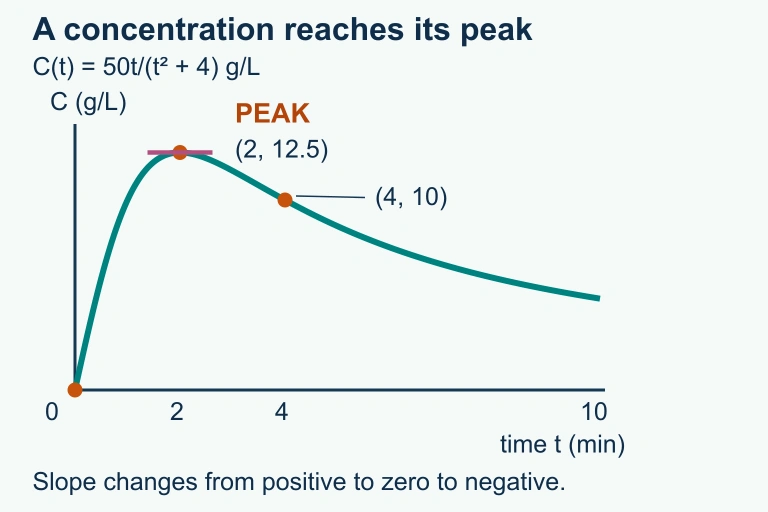 The modeled concentration rises to 12.5 g/L at 2 minutes and then falls; vessel color does not measure that concentration.
Question 5: CRITICAL THINKING
3 ptsShow answer
SUMMARY
Summary
Summary
The quotient rule provides a systematic formula for differentiating a ratio of two functions: d/dx[f/g] = [g·f′ − f·g′] / g². The rule requires both functions to be differentiable and the denominator to be non-zero. Its structure features a critical subtraction in the numerator (unlike the product rule's addition), and reversing the order is the most common source of error. The mnemonic "lo dee-hi minus hi dee-lo, square the bottom and away we go" encodes the correct order.
Strategically, the quotient rule is most efficient when the denominator is a multi-term expression that resists simplification. For monomial denominators, algebraic simplification followed by the power rule is often faster. The quotient rule can be derived from the product rule and chain rule, confirming it is not an independent axiom but a convenient packaging of those two rules. Mastery of the quotient rule—including its derivation, strategic application, and algebraic simplification of results—is essential for success on the AP Calculus AB exam, where it appears in multiple-choice questions, free-response problems, and as a building block for deriving the derivatives of trigonometric functions like tan(x), sec(x), cot(x), and csc(x).