

SECTION 1
Historical Context & Motivation
The development of calculus in the late seventeenth century required mathematicians to handle increasingly complex expressions, many of which arose as products of simpler functions. Physical quantities such as work (force × displacement), momentum (mass × velocity), and revenue (price × quantity) are naturally products, so the ability to differentiate products was essential from the very beginning. Both Isaac Newton and Gottfried Wilhelm Leibniz independently arrived at rules for differentiating products as part of their broader systematic approaches to the calculus. Over time, these rules were formalized into the concise statement we now call the Product Rule—one of the most frequently used differentiation formulas in all of mathematics.
1665–1666 • Newton's Fluxions
1684 • Leibniz Publishes Nova Methodus
1748 • Euler's Introductio
1821 • Cauchy's Rigorous Foundations
A natural but incorrect instinct when differentiating a product is to simply differentiate each factor separately and multiply the results. If f(x) = x² and g(x) = x³, then f(x) · g(x) = x⁵, whose derivative is 5x⁴—clearly not f′(x) · g′(x) = 2x · 3x² = 6x³. The gap between this naive guess and the correct answer motivates the precise statement of the Product Rule: how do we correctly differentiate a product of two functions?
SECTION 2
Core Principles & Definitions
Before stating the rule formally, it helps to understand the conceptual pillars that support it. The Product Rule is not an arbitrary formula; it emerges naturally from the limit definition of the derivative and reflects how small changes in two interacting quantities combine to produce a total change. The following foundational ideas clarify why the rule takes the form it does and how to apply it reliably.
Differentiability of Each Factor
Linearity of the Derivative
Two-Term Structure
Extension to More Factors
KEY TAKEAWAY
SECTION 3
Visual Explanation
The most intuitive geometric proof of the Product Rule comes from thinking of the product f(x) · g(x) as the area of a rectangle whose side lengths are f(x) and g(x). When x changes by a small increment Δx, both sides change: f changes by Δf and g changes by Δg. The new area is (f + Δf)(g + Δg) = fg + f · Δg + g · Δf + Δf · Δg. The change in area is thus f · Δg + g · Δf + Δf · Δg. Dividing by Δx and taking the limit as Δx → 0 causes the last term to vanish, leaving f · g′ + g · f′.
This area model is more than a mnemonic—it constitutes a genuine geometric proof of the Product Rule. The key insight is that the cross-terms f · Δg and g · Δf both scale linearly with Δx, so they survive the limit process. The corner term Δf · Δg scales as (Δx)², so dividing by Δx still leaves a factor of Δx, which tends to zero. This is why the Product Rule contains exactly two terms rather than three.
 Increasing both side lengths adds two strips and a corner. Dividing the area change by the input change and taking a limit gives the product rule, (fg)′ = f′g + fg′.
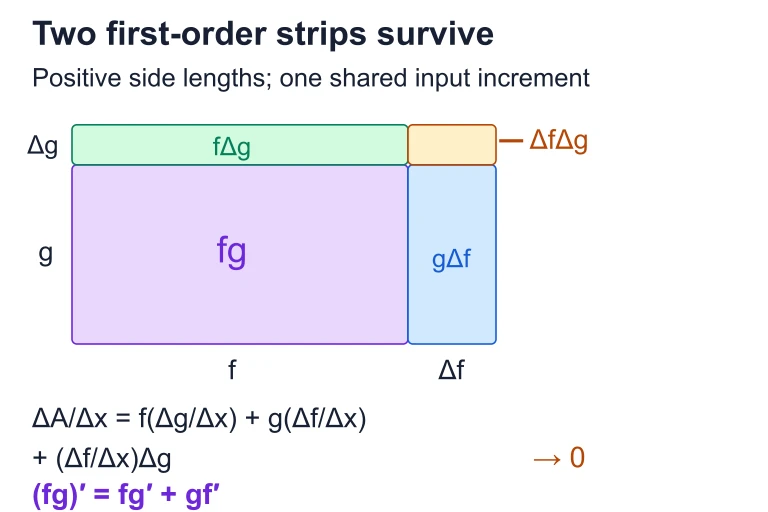 Increasing both side lengths adds two strips and a corner. Dividing the area change by the input change and taking a limit gives the product rule, (fg)′ = f′g + fg′.
SECTION 4
Mathematical Framework
We now present the formal statement, followed by a rigorous proof from the limit definition. Understanding this derivation is essential for AP Calculus AB, because the exam frequently tests whether students can apply the Product Rule correctly and understand its structure.
THE PRODUCT RULE
Where f and g are differentiable functions of x. In Leibniz notation: d(uv)/dx = (du/dx)v + u(dv/dx).
Proof from the Limit Definition
Starting from the definition of the derivative, we write the derivative of the product as a limit, then employ the classic algebraic trick of adding and subtracting the same term in the numerator to factor the expression.
STEP 1 — LIMIT DEFINITION
This is the standard difference quotient applied to the product f · g.
STEP 2 — ADD AND SUBTRACT f(x+h)g(x)
Inserting −f(x+h)g(x) + f(x+h)g(x) = 0 into the numerator allows factoring.
STEP 3 — FACTOR AND SEPARATE
As h → 0, f(x+h) → f(x) by continuity (differentiability implies continuity), [g(x+h)−g(x)]/h → g′(x), and [f(x+h)−f(x)]/h → f′(x). The result is f(x)g′(x) + g(x)f′(x). ∎
Common Mnemonic
SECTION 5
Common Forms & Classification
The Product Rule appears in many guises on the AP exam. Recognizing these common product forms is essential for efficiency and accuracy. Below, a reference table shows the most frequently tested product types and their derivatives, all derived from the single formula (fg)′ = f′g + fg′.
| Product Form | f(x) | g(x) | Derivative (fg)′ |
|---|---|---|---|
| x² · sin x | x² | sin x | 2x sin x + x² cos x |
| eˣ · ln x | eˣ | ln x | eˣ ln x + eˣ/x |
| (3x + 1)(x² − 4) | 3x + 1 | x² − 4 | 3(x² − 4) + (3x + 1)(2x) |
| x³ · eˣ | x³ | eˣ | 3x²eˣ + x³eˣ = eˣ(3x² + x³) |
| √x · cos x | cos x | (1/(2√x)) cos x − √x sin x |
Common product forms and their derivatives
The graph above illustrates a critical feature: the derivative of a product can have a much more complex shape than either factor alone. The oscillating behavior of h′(x) results from the interplay of the two terms 2x sin x and x² cos x. On the AP exam, you may be asked to identify intervals where h is increasing or decreasing by analyzing the sign of h′—skills that depend on correctly applying the Product Rule first.
SECTION 6
Worked Example
Let us work through a complete example that combines the Product Rule with other differentiation techniques, mirroring the complexity of a typical AP Calculus AB free-response question.
Differentiate y = (2x³ + 5x) · eˣ
- 1
Step 1 — Identify the Factors
We recognize this as a product of two functions. Let f(x) = 2x³ + 5x and g(x) = eˣ. Both are differentiable for all real numbers, so the Product Rule applies. - 2
Step 2 — Differentiate Each Factor
Using the power rule: f′(x) = 6x² + 5. The exponential function is its own derivative: g′(x) = eˣ.f′(x) = 6x² + 5, g′(x) = eˣ - 3
Step 3 — Apply the Product Rule
By the Product Rule, dy/dx = f′(x) · g(x) + f(x) · g′(x) = (6x² + 5) · eˣ + (2x³ + 5x) · eˣ. - 4
Step 4 — Simplify
Factor out the common factor eˣ: dy/dx = eˣ[(6x² + 5) + (2x³ + 5x)] = eˣ(2x³ + 6x² + 5x + 5).dy/dx = eˣ(2x³ + 6x² + 5x + 5) - 5
Step 5 — Verify
As a sanity check, evaluate at x = 0. The original function gives y(0) = (0 + 0)(1) = 0, and the derivative gives y′(0) = e⁰(0 + 0 + 0 + 5) = 5. One can verify numerically that the tangent line y = 5x closely approximates the function near x = 0.
AP Tip
SECTION 7
Product Rule vs. Other Differentiation Rules
Students often confuse when to use the Product Rule versus the Chain Rule or the Quotient Rule, or they fail to recognize that the Product Rule is even needed. The following comparison table clarifies when each rule applies, how to recognize the appropriate situation, and what the resulting derivative looks like.
| Rule | When to Use | Formula | Key Signal |
|---|---|---|---|
| Product Rule | Two functions multiplied: f(x) · g(x) | f′g + fg′ | Both factors contain x and are multiplied |
| Quotient Rule | One function divided by another: f(x)/g(x) | (f′g − fg′) / g² | A fraction with x in both numerator and denominator |
| Chain Rule | A function composed inside another: f(g(x)) | f′(g(x)) · g′(x) | A function applied to an inner expression |
| Sum/Difference | Functions added or subtracted: f(x) ± g(x) | f′ ± g′ | Terms separated by + or − |
Comparison of major differentiation rules
WHEN RULES COMBINE
Common Error Alert
SECTION 8
Connection to Advanced Theory
The Product Rule is not merely a computational tool—it is a cornerstone of differential calculus that extends into integration theory, multivariable calculus, and beyond. Understanding these connections deepens your appreciation of the rule and previews material you will encounter in AP Calculus BC and college-level courses.
| Concept in AP Calculus AB | Extension in Advanced Courses |
|---|---|
| Product Rule: (fg)′ = f′g + fg′ | Integration by Parts: ∫f g′ dx = fg − ∫f′g dx (derived by integrating the Product Rule) |
| Product of two single-variable functions | Product of multivariable functions: ∂(fg)/∂x = (∂f/∂x)g + f(∂g/∂x) in multivariable calculus |
| Finite products f · g | Leibniz's General Rule: (fg)⁽ⁿ⁾ = Σ C(n,k) f⁽ᵏ⁾g⁽ⁿ⁻ᵏ⁾, a formula for the nth derivative of a product |
| Scalar-valued Product Rule | Vector-valued Product Rule: d/dt[f(t) · r(t)] = f′(t)r(t) + f(t)r′(t) for vector functions |
How the Product Rule extends into higher mathematics
The most important immediate extension for AP students is integration by parts, which is simply the Product Rule run in reverse. By rearranging (fg)′ = f′g + fg′ and integrating both sides, one obtains ∫fg′ dx = fg − ∫f′g dx. This technique, covered in AP Calculus BC, becomes one of the most powerful integration methods in all of calculus. Mastering the Product Rule now builds the conceptual foundation for that later work.
SECTION 9
Practice Problems
Question 1: CONCEPTUAL
- A. −5
- B. 7
- C. 11
- D. 15
- E. 19
Show answer (C)
Question 2: BASIC CALCULATION
- A. x³(4 cos x − x sin x)
- B. −4x³ sin x
- C. x³(4 cos x + x sin x)
- D. −x⁴ sin x
- E. 4x³ cos x + x⁴ sin x
Show answer (A)
Question 3: INTERMEDIATE
- A. e²ˣ(6x² − 2x + 6x − 2)
- B. (6x − 2)(2e²ˣ)
- C. e²ˣ(6x² + 2x)
- D. e²ˣ(6x² − 6x + 2)
- E. 2e²ˣ(3x² − 2x + 1)
Show answer (C)
Question 4: APPLIED
6 ptsShow answer
Question 5: CRITICAL THINKING
4 ptsShow answer
SUMMARY
Summary
Summary
The Product Rule states that for two differentiable functions f and g, the derivative of their product is d/dx[f · g] = f′g + fg′. This rule is derived from the limit definition of the derivative using the algebraic technique of adding and subtracting a strategic term. Geometrically, it corresponds to the area model of a rectangle with changing side lengths, where the cross-terms survive the limit but the corner rectangle vanishes.
Key points to remember: the derivative of a product is not the product of the derivatives; the rule extends to products of three or more functions by repeated application; and it frequently appears in combination with the Chain Rule on the AP exam. Mastering the Product Rule also prepares you for integration by parts, which is the integral counterpart of this fundamental differentiation technique.