
SECTION 1
Historical Context & Motivation
The study of how changing quantities influence one another has been central to mathematics and the sciences since the invention of calculus in the late seventeenth century. When Isaac Newton and Gottfried Wilhelm Leibniz independently developed the tools of differentiation and integration, they were motivated in large part by physical problems—planetary motion, fluid flow, and projectile trajectories—in which multiple quantities change simultaneously and are linked by geometric or physical constraints. The idea that you could differentiate an equation relating two or more variables with respect to a single parameter, typically time, became one of the most practical applications of the chain rule. Today we call these scenarios related rates problems, and they remain a cornerstone of introductory calculus courses because they bridge the gap between abstract differentiation techniques and real-world modeling.
1687 • Newton's Principia
1748 • Euler's Analytica
1797 • Lagrange's Théorie des Fonctions
1960s • Modern Calculus Curriculum
The central question that related rates problems address is deceptively simple: if I know how fast one quantity is changing, how fast is a related quantity changing at a specific instant? Answering this requires recognizing the geometric or physical equation that ties the variables together, applying the chain rule to differentiate implicitly with respect to time, and then substituting known values to isolate the desired rate. Mastering this technique equips you to tackle a wide range of AP Calculus AB free-response and multiple-choice questions that assess your ability to model dynamic situations mathematically.
SECTION 2
Core Principles & Definitions
Before diving into computations, it is essential to internalize the foundational ideas that make related rates problems work. Each of these principles reflects a deeper calculus concept—the chain rule, implicit differentiation, or the interpretation of derivatives as instantaneous rates—applied to a scenario in which multiple quantities evolve together over time.
Everything Is a Function of Time
The Linking Equation
Implicit Differentiation with Respect to t
Substitute at the Specific Instant
Interpret and Verify
KEY TAKEAWAY
SECTION 3
Visual Explanation — The Ladder Problem
The classic sliding ladder problem is the quintessential related rates scenario and an ideal vehicle for visual understanding. A ladder of fixed length leans against a vertical wall; its base slides away from the wall at a known rate. We want to determine how fast the top of the ladder descends along the wall at a particular moment. The diagram below illustrates the geometry and the direction of each rate.
Notice several things in the diagram. First, x(t) and y(t) are both functions of time even though the Pythagorean theorem is a purely geometric statement. Second, the ladder length L is a constant, so its derivative with respect to time is zero—this is precisely what generates a relationship between dx/dt and dy/dt. Third, the sign convention is physically meaningful: the base moves to the right (positive dx/dt) while the top slides down (negative dy/dt), consistent with the fact that the two rates must have opposite signs for the ladder's length to remain constant.
SECTION 4
Mathematical Framework
Every related rates problem reduces to the same calculus machinery: start with an equation relating the variables, differentiate implicitly with respect to t using the chain rule, and then solve algebraically for the unknown rate. Below are the key equations that appear most frequently on the AP Calculus AB exam.
CHAIN RULE (IMPLICIT IN t)
If u is any quantity that depends on time, differentiating a function of u with respect to t produces f′(u) multiplied by du/dt. This is the engine behind every related rates derivation.
PYTHAGOREAN RELATION
Used in ladder and distance problems. Because L is constant, the right side is zero after differentiation.
VOLUME OF A CONE
Appears in conical tank or sand pile problems. If the radius and height maintain a fixed ratio (similar triangles), substitute r = kh before differentiating to reduce the number of variables.
TRIGONOMETRIC RELATION
Frequently used when an angle changes as lengths change—e.g., the angle of elevation from a fixed point to a moving object. Remember to apply the quotient rule on the right side.
Common Pitfall
 As water rises in a conical tank, its surface radius and depth increase together. Similar triangles express r in terms of h before the volume equation is differentiated.
SECTION 5
Step-by-Step Strategy & Problem Types
While related rates problems can involve an enormous variety of physical contexts—expanding balloons, draining tanks, moving shadows—the solution strategy is remarkably uniform. The flowchart below codifies the five-step process, and the table that follows categorizes the most common problem types by their linking equations.
Common Problem Types
| Problem Type | Linking Equation | Key Consideration |
|---|---|---|
| Ladder / Distance | x² + y² = L² | L is constant; dL/dt = 0 |
| Expanding Sphere / Balloon | V = (4/3)πr³ or S = 4πr² | Often only one variable; straightforward chain rule |
| Conical Tank | V = (1/3)πr²h with r = kh | Use similar triangles to eliminate r before differentiating |
| Shadow / Angle of Elevation | tan θ = y/x or similar trig | Differentiate trig functions carefully; keep track of sec²θ |
| Area of Expanding Shape | A = πr², A = s², A = (1/2)bh, etc. | May involve product rule if two dimensions change independently |
Frequently tested related rates scenarios on the AP Calculus AB exam
 Similar triangles connect a 6 ft person, a wall 20 ft from the light, and the shadow height. Differentiate with respect to time to find how the shadow changes as the person moves.
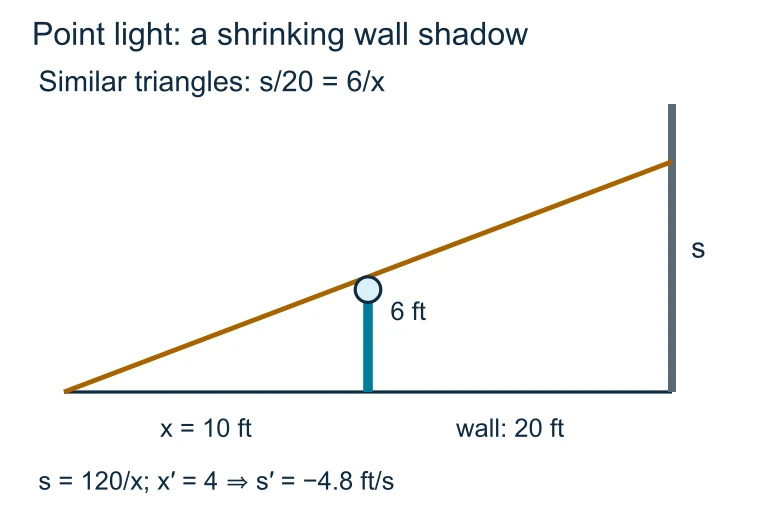 Similar triangles connect a 6 ft person, a wall 20 ft from the light, and the shadow height. Differentiate with respect to time to find how the shadow changes as the person moves.
SECTION 6
Worked Example — Conical Sand Pile
Sand is poured onto a pile at a rate of 3 ft³/min. The pile maintains the shape of a right circular cone whose height is always equal to twice its base radius. How fast is the height of the pile increasing when the height is 4 ft?
Conical Sand Pile
- 1
Step 1 — Draw and Label Variables
We sketch a cone with base radius r and height h. Both r and h are functions of time t. We are given dV/dt = 3 ft³/min and that h = 2r (i.e., r = h/2). We want dh/dt when h = 4. - 2
Step 2 — Write the Linking Equation
The volume of a cone is V = (1/3)πr²h. Since the cone's proportions are fixed with r = h/2, we eliminate r: V = (1/3)π(h/2)²h = (1/3)π(h²/4)h = πh³/12.V = πh³/12 - 3
Step 3 — Differentiate Implicitly with Respect to t
Applying the chain rule: dV/dt = (π/12) × 3h² × (dh/dt) = (πh²/4)(dh/dt).dV/dt = (πh²/4)(dh/dt) - 4
Step 4 — Substitute Known Values
Substitute dV/dt = 3 and h = 4: 3 = (π(4)²/4)(dh/dt) = (16π/4)(dh/dt) = 4π(dh/dt). - 5
Step 5 — Solve and Interpret
Solving for dh/dt: dh/dt = 3/(4π) ft/min ≈ 0.239 ft/min. Since dh/dt is positive, the height is increasing—consistent with sand being added to the pile.dh/dt = 3/(4π) ft/min ≈ 0.239 ft/min
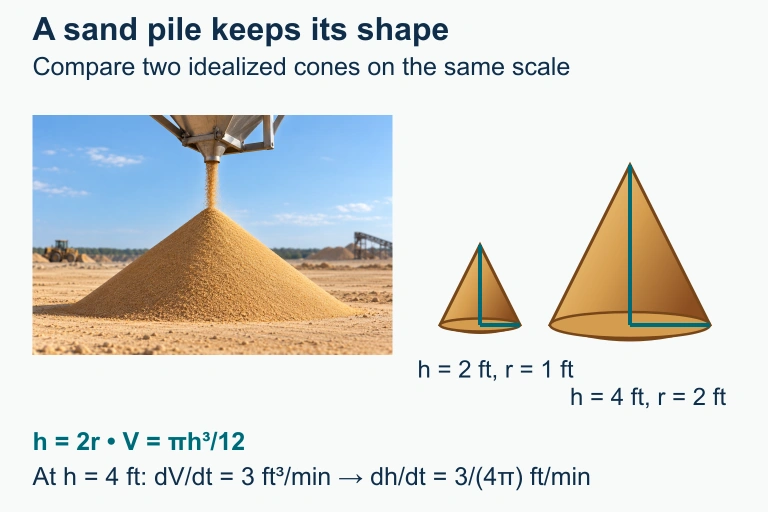 For an idealized cone with h=2 r, adding 3 ft³/min at h=4 ft raises the height at 3/(4π)ft/min. The photo is qualitative; h=2r applies only to the separate idealized cone construction.
SECTION 7
Common Pitfalls & Exam Tips
Related rates problems are among the most nuanced on the AP Calculus AB exam because errors can creep in at multiple stages—from misidentifying the linking equation to confusing signs or units. The table below contrasts frequent mistakes with the correct approaches, and the key takeaway offers a mental model for avoiding these traps on test day.
| Common Pitfall | Correct Approach |
|---|---|
| Substituting numerical values before differentiating, which eliminates the rate terms | Always differentiate the general equation first, then substitute the snapshot values |
| Forgetting the chain rule—writing d(x²)/dt = 2x instead of 2x(dx/dt) | Every variable is a function of t; each differentiation produces a dx/dt, dy/dt, etc. |
| Using the wrong geometric formula (e.g., volume of a cylinder for a cone) | Read the problem carefully; sketch the geometry and confirm the formula before proceeding |
| Ignoring sign conventions—reporting a positive rate when the quantity is decreasing | A decreasing quantity has a negative rate; include the sign and state its meaning in context |
| Failing to reduce the number of variables using constraints (e.g., similar triangles) | Before differentiating, use any given proportional relationships to express V, A, etc., in terms of a single variable |
| Dropping units from the final answer | Always include units (e.g., ft/s, cm²/min); the AP exam expects them in free-response answers |
Pitfall vs. Correct Approach for Related Rates
EXAM STRATEGY
SECTION 8
Connection to Advanced Topics
Related rates problems in AP Calculus AB are restricted to single-variable implicit differentiation with respect to time, but the underlying idea—that differentiation encodes how changes propagate through a network of dependent variables—scales dramatically in more advanced mathematics. Understanding where the AB-level technique sits in the broader landscape can deepen your conceptual appreciation and prepare you for future coursework.
| AP Calculus AB (This Course) | Advanced Extensions |
|---|---|
| Differentiate implicitly with respect to a single parameter t | Multivariable calculus uses partial derivatives and the total derivative (chain rule for several variables) to handle functions of multiple independent parameters |
| One linking equation relating two or three variables | Differential equations model systems with many interacting rates simultaneously—e.g., predator-prey models, electrical circuits |
| Solve for an instantaneous rate at a single moment | In physics and engineering, you solve for rate functions over time intervals, leading to systems of ODEs and numerical methods like Euler's method |
| Constants come from fixed geometry (e.g., ladder length) | Constraint optimization (Lagrange multipliers) generalizes the idea of a fixed constraint linking variables to optimization in higher dimensions |
How related rates ideas extend beyond AP Calculus AB
If you continue to AP Calculus BC, you will encounter parametric equations and polar coordinates, both of which involve differentiating interrelated quantities—effectively related-rates reasoning applied to curves described by a parameter. In multivariable calculus, the multivariable chain rule generalizes the single-parameter chain rule you use here: if z = f(x, y) and both x and y depend on t, then dz/dt = (∂f/∂x)(dx/dt) + (∂f/∂y)(dy/dt). This is precisely the related-rates formula in a more general notation, confirming that the skills you build now form the conceptual foundation for much of what follows.
SECTION 9
Practice Problems
Question 1: CONCEPTUAL
- A. The differentiated equation becomes 0 = 0, which provides no information about the rates.
- B. The differentiated equation produces the correct rates but with opposite signs.
- C. The differentiated equation yields dy/dt = −dx/dt, which is always true.
- D. The student obtains a valid equation relating dx/dt and dy/dt, but only at that specific instant.
- E. The student obtains an equation with an extra constant term that can simply be subtracted out.
Show answer (A)
Question 2: BASIC CALCULATION
- A. 1/(π) cm/s
- B. 1/(2π) cm/s
- C. 2/(5π) cm/s
- D. 5/(2π) cm/s
- E. 50/(π) cm/s
Show answer (B)
Question 3: INTERMEDIATE
- A. −5/6 ft/s
- B. −12/5 ft/s
- C. −10/13 ft/s
- D. 5/6 ft/s
- E. −5/12 ft/s
Show answer (A)
Question 4: APPLIED
5 ptsShow answer
Question 5: CRITICAL THINKING
3 ptsShow answer
SUMMARY
Summary
Summary
Related rates problems ask you to determine the rate of change of one quantity given the rate of change of another, where the quantities are connected by a linking equation (Pythagorean theorem, volume formula, trigonometric identity, etc.). The solution method follows a consistent five-step procedure: (1) draw and label a diagram with variables, (2) write the linking equation relating all changing quantities, (3) differentiate implicitly with respect to time using the chain rule, (4) substitute known values at the specific instant, and (5) solve for the unknown rate and interpret its sign and units.
The most critical rule is to never substitute numerical values before differentiating—doing so eliminates the rate terms entirely. When multiple variables appear in the linking equation but a geometric constraint (such as similar triangles) reduces the number of independent variables, use that constraint to simplify the equation before differentiating. Common problem types include ladder/distance, expanding volume, conical tank, and angle of elevation scenarios. These skills extend directly into multivariable calculus and differential equations, where systems of interacting rates are analyzed with the same foundational logic.