
AP Calculus AB • Applications of Integration

Connecting Position, Velocity, and Acceleration of Functions Using Integrals

Use integrals to recover velocity from acceleration and position from velocity, reversing differentiation to reconstruct motion.

AP Calculus AB illustration with a smooth curve, infinity sign, and measuring ruler
Inside this lesson 10 sections 5 questions 9 figures

SECTION 1

Historical Context & Motivation

The study of motion — where an object is, how fast it travels, and how its speed changes — lies at the very heart of calculus. In AP Calculus AB you have already learned that differentiation converts a position function into a velocity function, and a velocity function into an acceleration function. The natural follow-up question is equally powerful: given acceleration, can we recover velocity? Given velocity, can we reconstruct position? The answer is yes — through integration. This inverse relationship was the engine behind Newton's and Leibniz's creation of the calculus itself, and it remains one of the most important applications tested on the AP exam.

1638 • Galileo's Kinematic Laws

Galileo published 'Two New Sciences,' establishing that the distance fallen by an object under uniform acceleration grows as the square of the elapsed time — an early, informal integration of constant acceleration.

1668 • James Gregory's Antiderivative Insight

Gregory demonstrated that the area under a velocity-time curve equals the change in position, foreshadowing the Fundamental Theorem of Calculus.

1687 • Newton's Principia Mathematica

Newton formalized F = ma, linking force to acceleration and requiring what we now call antidifferentiation to recover velocity and position from a known acceleration.

1693 • Leibniz's Integral Notation

Leibniz published the elongated-S notation ∫ for integration, giving mathematicians a concise language for accumulating rates of change — the notation we still use today.

The central question this lesson addresses is deceptively simple: if you know how fast something is changing, can you determine the quantity itself? More precisely, when acceleration a(t) is given, how do you find v(t)? And when v(t) is given, how do you find s(t)? Mastering these integral-based connections will allow you to move fluidly between every layer of the motion hierarchy, which is exactly what the AP Calculus AB exam demands.

SECTION 2

Core Principles & Definitions

Before diving into computations, it is essential to cement the conceptual chain that links the three fundamental kinematic quantities. Differentiation moves down the chain (position → velocity → acceleration), while integration moves back up (acceleration → velocity → position). Every integral introduces an arbitrary constant of integration, which is determined by an initial condition — a known value of the function at a specific time. Without an initial condition, you obtain a family of antiderivatives rather than the unique function that describes a particular motion.

1

Position s(t)

The location of a particle on a line at time t. Measured in units of length (meters, feet). Obtained by integrating velocity: s(t) = s(t₀) + ∫ from t₀ to t of v(τ) dτ.
2

Velocity v(t)

The rate of change of position: v(t) = s′(t). Signed quantity — positive means motion in the positive direction. Recovered from acceleration: v(t) = v(t₀) + ∫ from t₀ to t of a(τ) dτ.
3

Acceleration a(t)

The rate of change of velocity: a(t) = v′(t) = s″(t). Indicates speeding up or slowing down depending on its sign relative to velocity.
4

Displacement vs. Distance

Displacement = ∫ v(t) dt (net change, can be negative). Total distance traveled = ∫ |v(t)| dt (always non-negative). AP exams frequently test whether students distinguish between these two.
5

Initial Conditions

A known value such as s(0) = 3 or v(0) = −2 determines the constant of integration C, converting a general antiderivative into the specific function for the given scenario.
✦

KEY TAKEAWAY

Think of integration as an odometer. Your speedometer displays velocity — the rate at which distance accumulates. The odometer integrates that velocity over time, tallying up total distance. If you also know your starting odometer reading (the initial condition), you can pinpoint your exact position at any moment. In the same way, integrating acceleration gives you velocity, and integrating velocity gives you position, provided you anchor each integral with an initial value.

SECTION 3

Visual Explanation — The Kinematic Chain

The Position–Velocity–Acceleration ChainPositions(t)Velocityv(t) = s'(t)Accelerationa(t) = v'(t)d/dtd/dt∫ dt∫ dtDefinite Integral InterpretationDisplacement (net change in position)s(b) − s(a) = ∫ₐᵇ v(t) dtTotal Distance Traveled∫ₐᵇ |v(t)| dtChange in Velocityv(b) − v(a) = ∫ₐᵇ a(t) dtRecovering v(t) with ICv(t) = v(t₀) + ∫ₜ₀ᵗ a(τ) dτ
The top row shows the three kinematic quantities connected by differentiation (rightward, in cyan) and integration (leftward, in violet). The bottom four boxes summarize the key integral formulas — displacement, total distance, change in velocity, and the general recovery formula with an initial condition.

The diagram above encapsulates the entire logical structure of rectilinear motion in calculus. Notice the symmetry: differentiation moves one step to the right (from position to velocity to acceleration), while integration moves one step to the left. Every definite integral of velocity over an interval [a, b] yields the displacement — the net change in position — whereas integrating the absolute value |v(t)| gives the total distance traveled. This distinction is one of the most frequently tested ideas on the AP exam. If a particle moves forward 5 meters and then backward 3 meters, its displacement is 2 meters, but its total distance traveled is 8 meters.

SECTION 4

Mathematical Framework

The Fundamental Theorem of Calculus (FTC) is the engine that drives every computation in this topic. Part 1 of the FTC tells us that if f is continuous on [a, b], then the function F(x) = ∫ from a to x of f(t) dt is an antiderivative of f, meaning F′(x) = f(x). Part 2 says ∫ from a to b of f(t) dt = F(b) − F(a) for any antiderivative F. Applied to motion, the FTC lets us recover position from velocity and velocity from acceleration using definite or indefinite integrals.

VELOCITY FROM ACCELERATION

v(t)=v(t0)+∫fromt0totofa(τ)dτv(t) = v(t₀) + ∫ from t₀ to t of a(τ) dτ

v(t₀) is the initial velocity at time t₀; a(τ) is the acceleration function; τ is a dummy variable of integration.

POSITION FROM VELOCITY

s(t)=s(t0)+∫fromt0totofv(τ)dτs(t) = s(t₀) + ∫ from t₀ to t of v(τ) dτ

s(t₀) is the initial position; v(τ) is the velocity function. This formula gives the exact position at any time t.

DISPLACEMENT OVER [a, b]

Δs=s(b)−s(a)=∫fromatobofv(t)dtΔs = s(b) − s(a) = ∫ from a to b of v(t) dt

Displacement is the net change in position. It can be positive, negative, or zero.

TOTAL DISTANCE TRAVELED

D=∫fromatobof∣v(t)∣dtD = ∫ from a to b of |v(t)| dt

The absolute value ensures that distances covered while moving in the negative direction are added rather than subtracted. To evaluate, split the integral at each zero of v(t) and take the absolute value of each piece.

⚠

AP Exam Tip

When the problem says 'total distance traveled,' you must use ∫|v(t)| dt. When it says 'displacement' or 'change in position,' use ∫ v(t) dt without the absolute value. Mixing these up is the single most common error on motion FRQs.

SECTION 5

Interpreting Velocity & Acceleration Graphs

On the AP exam, you will frequently be given the graph of a velocity function and asked to extract information about position or acceleration. The key insight is that the signed area between v(t) and the t-axis equals displacement. Regions above the axis contribute positive area (motion in the positive direction), while regions below the axis contribute negative area (motion in the negative direction). Total distance is simply the sum of all areas taken as positive. Meanwhile, the slope of the velocity graph at any point gives the instantaneous acceleration.

Velocity Graph: v(t) = t² − 4t + 3 on [0, 5]43210−1012345tv(t)t = 1t = 3A₁ (+)A₂ (−)A₃ (+)
The velocity function v(t) = t² − 4t + 3 crosses zero at t = 1 and t = 3 (yellow dots). The green-shaded regions A₁ and A₃ represent positive displacement (particle moving in the positive direction). The red-shaded region A₂ represents negative displacement. Displacement = A₁ − A₂ + A₃, while total distance = A₁ + A₂ + A₃.

For the velocity function v(t) = t² − 4t + 3 shown above, the zeros occur at t = 1 and t = 3 because the function factors as (t − 1)(t − 3). On the interval [0, 1], v(t) > 0, so the particle moves in the positive direction, accumulating positive displacement equal to area A₁. On [1, 3], v(t) < 0, meaning the particle reverses, and the integral contributes −A₂. On [3, 5], v(t) > 0 again, contributing +A₃. Therefore, the displacement over [0, 5] is A₁ − A₂ + A₃, whereas the total distance traveled is A₁ + A₂ + A₃. To evaluate these numerically, you compute each integral separately, taking the absolute value of the integral over [1, 3].

Question TypeWhat to ComputeGraphical Meaning
Displacement on [a, b]∫ from a to b of v(t) dtNet signed area between v(t) and the t-axis
Total distance on [a, b]∫ from a to b of |v(t)| dtSum of all areas (ignore sign)
Position at time ts(t₀) + ∫ from t₀ to t of v(τ) dτStarting position plus cumulative signed area
When does the particle change direction?Find t where v(t) = 0 and v changes signWhere the curve crosses the t-axis
Is the particle speeding up or slowing down?Check signs of v(t) and a(t)Speeding up when v and a have the same sign

Common AP question types involving velocity graphs

SECTION 6

Worked Example

A particle moves along the x-axis with velocity v(t) = t² − 4t + 3 for t ≥ 0. At time t = 0 the particle is at position s(0) = 2. Find (a) the displacement of the particle on [0, 4], (b) the total distance traveled on [0, 4], and (c) the position of the particle at t = 4.

Full Solution: Position, Displacement, and Total Distance

  1. 1

    Step 1 — Find the zeros of v(t)

    Set v(t) = t² − 4t + 3 = 0. Factor: (t − 1)(t − 3) = 0, so t = 1 and t = 3. The velocity changes sign at these values. On [0, 1], v(t) > 0; on [1, 3], v(t) < 0; on [3, 4], v(t) > 0.
    Zeros: t = 1, t = 3
  2. 2

    Step 2 — Compute the displacement ∫₀⁴ v(t) dt

    Find the antiderivative: ∫(t² − 4t + 3) dt = t³/3 − 2t² + 3t + C. Evaluate from 0 to 4: [4³/3 − 2(4²) + 3(4)] − [0] = [64/3 − 32 + 12] − 0 = 64/3 − 20 = (64 − 60)/3 = 4/3.
    Displacement = 4/3 units
  3. 3

    Step 3 — Compute each piece for total distance

    Integral on [0, 1]: [1/3 − 2 + 3] − 0 = 4/3. Integral on [1, 3]: [27/3 − 18 + 9] − [1/3 − 2 + 3] = [9 − 18 + 9] − [4/3] = 0 − 4/3 = −4/3. So |−4/3| = 4/3. Integral on [3, 4]: [64/3 − 32 + 12] − [9 − 18 + 9] = 4/3 − 0 = 4/3.
    Pieces: |4/3| + |−4/3| + |4/3| = 4/3 + 4/3 + 4/3
  4. 4

    Step 4 — Sum absolute values for total distance

    Total distance = 4/3 + 4/3 + 4/3 = 12/3 = 4. Notice that total distance (4) is greater than displacement (4/3), which makes sense because the particle reversed direction twice.
    Total distance = 4 units
  5. 5

    Step 5 — Find the position at t = 4

    Use s(4) = s(0) + displacement = 2 + 4/3 = 6/3 + 4/3 = 10/3. Equivalently, s(4) = s(0) + ∫₀⁴ v(t) dt = 2 + 4/3 = 10/3.
    s(4) = 10/3 units

SECTION 7

Displacement vs. Total Distance — Common Pitfalls

FeatureDisplacementTotal Distance
DefinitionNet change in position: s(b) − s(a)Total length of path traveled
Integral∫ from a to b of v(t) dt∫ from a to b of |v(t)| dt
Can be negative?Yes — if net motion is in the negative directionNever — always ≥ 0
Graphical meaningSigned area (above minus below)Sum of all areas regardless of sign
Relationship|Displacement| ≤ Total Distance alwaysEqual to |Displacement| only if v(t) doesn't change sign
Common AP phrasing"change in position," "displacement""total distance traveled," "how far does the particle travel"

Side-by-side comparison of displacement and total distance

✦

KEY TAKEAWAY

Imagine walking three blocks east and then two blocks west. Your displacement is one block east, but your total distance traveled is five blocks. The definite integral ∫ v(t) dt counts signed direction (displacement), while ∫ |v(t)| dt counts every step regardless of direction (total distance). On the AP exam, read the problem wording with surgical precision — the difference between these two integrals is usually worth 2–3 points on an FRQ.
💡

Speeding Up vs. Slowing Down

A particle is speeding up when velocity and acceleration have the same sign (both positive or both negative). It is slowing down when they have opposite signs. This is distinct from 'positive acceleration' — a negative acceleration can cause the particle to speed up if the velocity is also negative. Always check both signs.

A blue dynamics cart rests on a straight laboratory rail with a photogate and end buffers; an observer stands behind the setup.Suppose v(t) = t² − 4t + 3 on [0,4] with initial position 2. The final position is 10/3, displacement is 4/3 units, and total distance is 4 units.
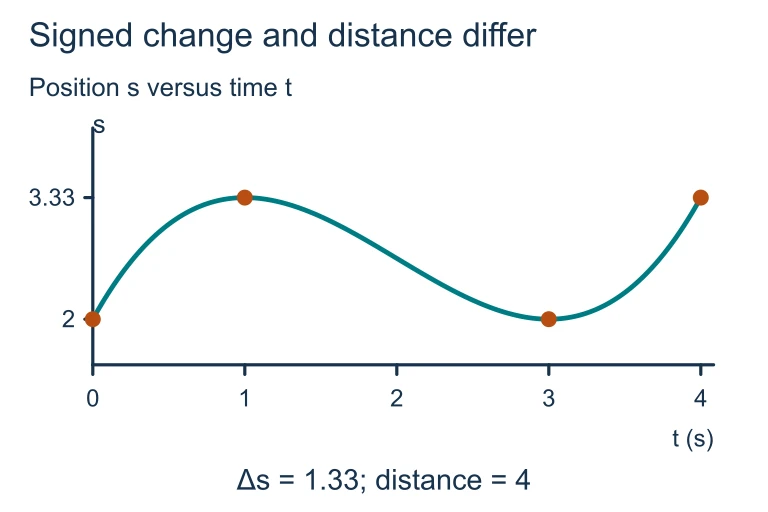
Suppose v(t) = t² − 4t + 3 on [0,4] with initial position 2. The final position is 10/3, displacement is 4/3 units, and total distance is 4 units.Suppose v(t) = t² − 4t + 3 on [0,4] with initial position 2. The final position is 10/3, displacement is 4/3 units, and total distance is 4 units.

SECTION 8

Connections to Advanced Theory

The one-dimensional motion framework you have learned generalizes beautifully in more advanced courses. In AP Calculus BC, motion extends to parametric and vector-valued functions, where the position is given as a vector r(t) = ⟨x(t), y(t)⟩ and velocity and acceleration become vector quantities. The concept of integrating acceleration to obtain velocity carries over component-wise, and the speed (magnitude of velocity) replaces |v(t)| in the arc-length integral for total distance. In multivariable calculus and physics, line integrals generalize this further, integrating vector fields along curves.

ConceptAP Calculus AB (This Course)AP Calculus BC / Beyond
Motion typeRectilinear (one dimension)Parametric / vector (two or three dimensions)
Positions(t) — scalar functionr(t) = ⟨x(t), y(t)⟩ — vector function
Speed|v(t)| — absolute value of velocity‖v(t)‖ = √(x′(t)² + y′(t)²)
Total distance∫ |v(t)| dt∫ √(x′² + y′²) dt — arc length
Differential equationsSeparable DEs for simple acceleration modelsSystems of DEs, Euler's method for approximation

How this topic extends in more advanced courses

Understanding the integral-based relationship between position, velocity, and acceleration in one dimension provides the conceptual scaffold for all of these extensions. Every technique you practice here — splitting integrals at sign changes, applying initial conditions, and distinguishing displacement from total distance — transfers directly to higher dimensions with only notational changes.

SECTION 9

Practice Problems

Question 1: CONCEPTUAL

A particle moves along the x-axis with velocity v(t) for 0 ≤ t ≤ 6. On the interval [2, 5], v(t) < 0. Which of the following statements is true?
  • A. The particle is at a position to the left of the origin for 2 < t < 5.
  • B. The displacement of the particle on [2, 5] is negative.
  • C. The acceleration of the particle is negative for 2 < t < 5.
  • D. The total distance traveled on [2, 5] is negative.
  • E. The particle returns to its starting position at t = 5.
Show answer (B)
The correct answer is B. Since v(t) < 0 on [2, 5], the integral ∫₂⁵ v(t) dt must be negative, which means the displacement is negative (the particle moves in the negative direction). Choice A is wrong because negative velocity tells us the direction of motion, not the particle's position relative to the origin — the particle could still be to the right of the origin. Choice C is wrong because the acceleration is v′(t), the slope of the velocity curve, which can be positive or negative regardless of the sign of v itself. Choice D is wrong because total distance = ∫|v(t)| dt ≥ 0 always. Choice E is wrong because we have no information suggesting ∫₂⁵ v(t) dt = 0.

Question 2: BASIC CALCULATION

A particle moves along the x-axis with acceleration a(t) = 6t − 2 and initial velocity v(0) = 5. What is v(3)?
  • A. 16
  • B. 21
  • C. 26
  • D. 31
  • E. 36
Show answer (C)
Using v(t) = v(0) + ∫₀ᵗ a(τ) dτ, we compute v(3) = 5 + ∫₀³ (6τ − 2) dτ = 5 + [3τ² − 2τ] from 0 to 3 = 5 + (27 − 6) − 0 = 5 + 21 = 26. Choice A (16) results from using ∫₀³ (6τ) dτ = 27 without the −2τ term, then subtracting from the initial velocity: 27 − 6 − 5 = 16, a sign/subtraction error. Choice B (21) results from forgetting the initial condition v(0) = 5. Choice C (26) is correct. Choice D (31) results from integrating 6t − 2 incorrectly as 3t² + 2t, giving 5 + (27 + 6) − 0 = 5 + 33 − 7 = 31, a sign error on the −2t term. Choice E (36) could result from integrating 6t − 2 as 3t² + 2t and obtaining 5 + (27 + 6) = 38, then making an additional arithmetic slip to get 36.

Question 3: INTERMEDIATE

A particle moves along the x-axis with velocity v(t) = sin(πt) for 0 ≤ t ≤ 2. What is the total distance traveled by the particle on this interval?
  • A. 0
  • B. 2/π
  • C. 4/π
  • D. 2
  • E. π
Show answer (C)
The correct answer is C. The velocity v(t) = sin(πt) is zero at t = 0, 1, 2. On [0, 1], v(t) ≥ 0, and on [1, 2], v(t) ≤ 0. Total distance = ∫₀¹ sin(πt) dt + ∫₁² |sin(πt)| dt. Each integral equals [−cos(πt)/π]. On [0,1]: (−cos π/π) − (−cos 0/π) = (1/π) − (−1/π) = 2/π. On [1,2]: |[−cos(2π)/π − (−cos π/π)]| = |(−1/π) − (1/π)| = 2/π. Total = 2/π + 2/π = 4/π. Choice A (0) is the displacement — a common trap since the symmetric positive and negative areas cancel. Choice B (2/π) accounts for only one half of the motion. Choice D and E result from incorrect antiderivatives.

Question 4: APPLIED

5 pts
A car travels along a straight road. Its acceleration is given by a(t) = 4 − 2t m/s² for 0 ≤ t ≤ 5 seconds. At time t = 0, the car has velocity v(0) = 3 m/s and position s(0) = 10 m. (a) Find v(t) for 0 ≤ t ≤ 5. (b) At what time does the car change direction? Justify your answer. (c) Find the position s(t) for 0 ≤ t ≤ 5. (d) What is the total distance traveled by the car on the interval [0, 5]?
Show answer
Rubric (5 points): (a) [1 point] v(t) = v(0) + ∫₀ᵗ (4 − 2τ) dτ = 3 + [4τ − τ²] from 0 to t = 3 + 4t − t². Award 1 point for correct antiderivative with initial condition applied. (b) [1 point] Set v(t) = 0: 3 + 4t − t² = 0 → t² − 4t − 3 = 0 → t = (4 ± √28)/2 = 2 ± √7. Since √7 ≈ 2.646, t = 2 − √7 < 0 (rejected) and t = 2 + √7 ≈ 4.646. The car changes direction at t = 2 + √7 because v(t) changes sign from positive to negative at this point (v is positive just before and negative just after). Award 1 point for correct time and sign-change justification. (c) [1 point] s(t) = s(0) + ∫₀ᵗ v(τ) dτ = 10 + ∫₀ᵗ (3 + 4τ − τ²) dτ = 10 + [3τ + 2τ² − τ³/3] from 0 to t = 10 + 3t + 2t² − t³/3. Award 1 point for correct position function with initial condition. (d) [2 points] Let t* = 2 + √7. Total distance = ∫₀^(t*) v(t) dt + |∫_(t∗)5(t*)^5 v(t) dt|. First integral: s(t*) − s(0) = 3t* + 2(t*)² − (t*)³/3. Second integral: |s(5) − s(t*)|. s(5) = 10 + 15 + 50 − 125/3 = 10 + 65 − 125/3 = 75 − 125/3 = 100/3. Compute s(t*) and take absolute value of each piece, then sum. Award 1 point for splitting at the correct zero of v(t), 1 point for correct numerical answer.

Question 5: CRITICAL THINKING

3 pts
Let v(t) be a continuous velocity function on [0, 8] with v(0) = 0, v(4) = −3, and v(8) = 0. It is known that ∫₀⁸ v(t) dt = −6 and ∫₀⁸ |v(t)| dt = 14. (a) Explain the physical meaning of the value −6 in the context of this problem. (b) A student claims that the particle must have changed direction at least twice on [0, 8]. Is this claim necessarily true? Justify your reasoning using the given information.
Show answer
Rubric (3 points): (a) [1 point] The value −6 is the displacement (net change in position) of the particle on [0, 8]; that is, s(8) − s(0) = −6. This means the particle's final position is 6 units to the left of (or in the negative direction from) its starting position. Award 1 point for identifying −6 as displacement and interpreting it correctly. (b) [2 points] The claim is not necessarily true — only one direction change is guaranteed, not two. Setup: Let P be the total area where v(t) > 0 and N be the total area where v(t) < 0. Then displacement = P − N = −6 and total distance = P + N = 14. Solving gives P = 4 and N = 10. Since P = 4 > 0, the velocity must be positive on some subinterval of [0, 8]. Since v(0) = 0, the particle can begin by moving in the positive direction (v becomes positive immediately after t = 0). This departure from rest into positive velocity is not a direction change — the particle was at rest and simply started moving. The velocity must then cross from positive to negative at some time c in (0, 4), since v(4) = −3 < 0 and the velocity was positive before c. This crossing constitutes one direction change. After that, the velocity remains negative through t = 4 (where v(4) = −3) and then v(8) = 0. However, reaching v(8) = 0 from negative values does not require the velocity to become positive again. The particle could simply decelerate and arrive at v = 0 from below, meaning it stops but does not reverse. All P = 4 units of positive area can be accounted for on the interval before the first zero crossing, and all N = 10 units of negative area on the interval after. Therefore, only one direction change (from positive to negative velocity) is guaranteed. The student's claim that the particle must have changed direction at least twice is not necessarily true. Award 1 point for correctly setting up and solving P − N = −6 and P + N = 14 to get P = 4 and N = 10. Award 1 point for a correct justification that only one direction change is guaranteed — noting that v(0) = 0 means the initial move to positive velocity is not a direction change, and that v(8) = 0 can be approached from below without a second sign change — and concluding the claim is not necessarily true.

SUMMARY

Lesson Summary

Summary

This lesson established the integral-based connections between the three fundamental kinematic quantities. Integration reverses differentiation: integrating acceleration yields velocity, and integrating velocity yields position. Each integral requires an initial condition to determine the constant of integration and produce a unique solution.

The critical distinction tested on the AP exam is between displacement (∫ v(t) dt, which is the net signed area under the velocity curve) and total distance traveled (∫ |v(t)| dt, which requires splitting the integral at zeros of v(t) and summing absolute values). Remember: a particle changes direction where v(t) = 0 and v changes sign, and it is speeding up when velocity and acceleration share the same sign.

Varsity Tutors • AP Calculus AB • Connecting Position, Velocity, and Acceleration of Functions Using Integrals