

SECTION 1
Historical Context & Motivation
The concept of the derivative did not spring fully formed from a single moment of inspiration; it grew from centuries of human effort to describe change in the physical world. Long before formal notation existed, mathematicians and natural philosophers grappled with problems of motion, growth, and accumulation—problems that demanded a language for instantaneous rates. The historical arc of the derivative shows that interpretation in context was never an afterthought; it was the very purpose of the calculus from its inception.
c. 1670 • Newton's Fluxions
1684 • Leibniz's Differential Calculus
1748 • Euler Formalizes Function Concept
1821 • Cauchy's Limit Definition
2000s • AP Calculus Emphasizes Context
The central question this lesson addresses is deceptively simple: If you can compute a derivative, can you explain what that number actually means? On the AP Calculus AB exam, earning full credit on free-response questions often hinges not on algebraic skill alone but on the ability to write a clear, unit-accurate sentence interpreting f′(a) in the language of the problem. This lesson equips you with a systematic framework to do exactly that.
SECTION 2
Core Principles & Definitions
Before diving into applications, it is essential to crystallize several foundational ideas that govern how we read and communicate the meaning of a derivative. Each principle below connects the abstract limit definition to a concrete statement about the world. Mastering these principles turns a number into a narrative.
Derivative as Instantaneous Rate
Units of the Derivative
The Interpretation Sentence
Sign Conveys Direction
Approximation Power
KEY TAKEAWAY
SECTION 3
Visual Explanation — The Tangent Line as Rate
The derivative at a point is the slope of the tangent line to the curve at that point. Visually, this slope captures how steeply the output is rising or falling per unit of input. The diagram below shows a function representing the volume of water in a tank over time, with the tangent line drawn at t = 3 hours to illustrate the instantaneous rate of change.
Notice how the tangent line captures the behavior of the curve at precisely t = 3. To the left, secant lines connecting t = 3 to nearby points would give average rates; the tangent is what those secant lines approach as the second point slides toward t = 3. A correct contextual interpretation of this derivative would read: At t = 3 hours, the volume of water in the tank is decreasing at a rate of approximately 55 gallons per hour. That single sentence contains the four critical components: what is changing (volume), when (t = 3), direction (decreasing), and units (gallons per hour).
 For net flow R(t) = 4t − t² gal/min and 10 gal initially, V(t) = 10 + 2t² − t³/3. Volume peaks at t = 4 minutes, when the net rate changes from positive to negative.
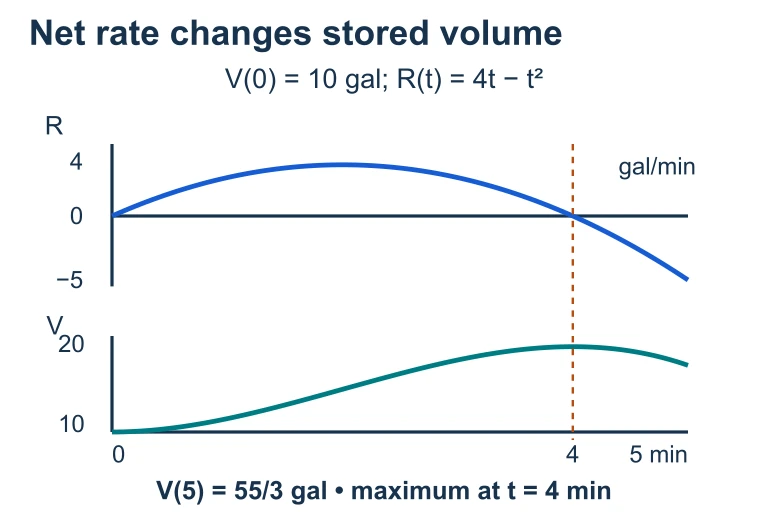 For net flow R(t) = 4t − t² gal/min and 10 gal initially, V(t) = 10 + 2t² − t³/3. Volume peaks at t = 4 minutes, when the net rate changes from positive to negative.
SECTION 4
Mathematical Framework
The formal definition of the derivative provides the mathematical backbone for every contextual interpretation. Understanding the notation and the limit process clarifies why derivative values carry the units they do and why the tangent-line interpretation is valid.
LIMIT DEFINITION OF THE DERIVATIVE
Here f(a + h) − f(a) has the same units as the output of f, and h has the same units as the input. The quotient therefore has units of output per input, which persists through the limit.
UNITS OF THE DERIVATIVE
If P(t) measures a population in thousands of people and t is measured in years, then P′(t) is in thousands of people per year.
LOCAL LINEAR APPROXIMATION
This approximation is the predictive power of the derivative: knowing f′(a) lets you estimate f for inputs near a. The quality of the estimate degrades as Δx grows, reflecting the curvature ignored by the tangent line.
On the AP exam, you may encounter Leibniz notation (dy/dx), prime notation (f′(x)), or context-specific labels such as dC/dq for marginal cost. Regardless of notation, the interpretive process is identical. First, identify the dependent and independent variables from the problem stem. Second, form the ratio of their units to determine the derivative's units. Third, use the sign of the derivative to describe whether the quantity is increasing or decreasing. Fourth, anchor the interpretation to the specific input value at which the derivative is evaluated.
AP EXAM TIP
SECTION 5
The Four-Component Interpretation Template
Consistently scoring full credit on interpretation problems requires a systematic approach. The following template breaks a complete derivative interpretation into four essential components. If your written sentence includes all four, you have a robust answer.
| Context | f(x) and units | x and units | f′(x) units & meaning |
|---|---|---|---|
| Position | s(t), meters | t, seconds | m/s — velocity (rate of change of position) |
| Cost | C(q), dollars | q, items | $/item — marginal cost of the next item |
| Temperature | T(t), °F | t, minutes | °F/min — rate of heating or cooling |
| Population | P(t), thousands | t, years | thousands/year — growth or decline rate |
| Fuel | F(d), gallons | d, miles | gal/mile — fuel consumption rate |
Common derivative contexts encountered on the AP Calculus AB exam
When you encounter a derivative interpretation question on the exam, the table above is essentially encoded in the problem itself. The exam will provide the context—what the function models and what the input represents—and your task is to decode the derivative's value using the four-component template. Practice forming complete sentences from the data, and be vigilant about the sign: saying the temperature is 'increasing at a rate of −3 °F per minute' is contradictory and will cost you credit.
SECTION 6
Worked Example
Let us work through a complete interpretation problem of the type frequently seen on the AP exam. Suppose the temperature of a cup of coffee t minutes after it is placed on a counter is modeled by the function H(t), measured in degrees Fahrenheit. You are told that H(5) = 142 and H′(5) = −4.3. Interpret the meaning of H′(5) in the context of this problem.
Interpreting H′(5) = −4.3
- 1
Step 1 — Identify What Is Changing
The function H(t) represents the temperature of the coffee in degrees Fahrenheit. This is the quantity whose rate of change we are interpreting.Component 1: temperature of the coffee - 2
Step 2 — Anchor to the Specific Input
The derivative is evaluated at t = 5, so we are describing the rate at the moment 5 minutes after the coffee is placed on the counter.Component 2: at t = 5 minutes - 3
Step 3 — Determine Direction and Rate
Since H′(5) = −4.3 is negative, the temperature is decreasing. The magnitude 4.3 tells us how fast. We say the temperature is decreasing at a rate of 4.3 (not −4.3, since 'decreasing' already conveys the sign).Component 3: decreasing at a rate of 4.3 - 4
Step 4 — State the Units
H is in °F and t is in minutes, so H′(t) has units of degrees Fahrenheit per minute.Component 4: °F per minute - 5
Step 5 — Compose the Full Sentence
Putting all four components together yields the exam-ready interpretation:At t = 5 minutes, the temperature of the coffee is decreasing at a rate of 4.3 degrees Fahrenheit per minute.
COMMON MISTAKE
 Temperature and its rate of change have different units. At 5 minutes, the coffee is 142 °F and cooling at 4.3 °F per minute.
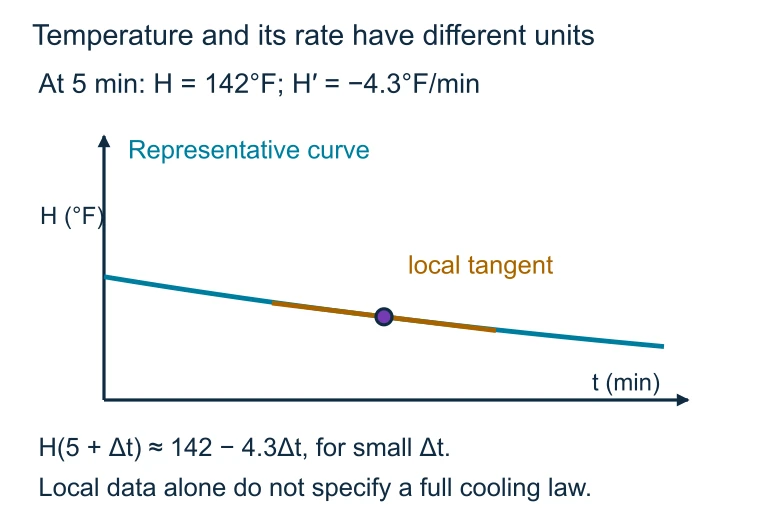 Temperature and its rate of change have different units. At 5 minutes, the coffee is 142 °F and cooling at 4.3 °F per minute.
SECTION 7
Common Pitfalls & Best Practices
Understanding the template is necessary but not sufficient; students lose points on the AP exam through predictable errors. The table below contrasts common mistakes with best-practice corrections, so you can proofread your own interpretation sentences before moving on.
| Common Pitfall | Why It Loses Credit | Best Practice |
|---|---|---|
| Omitting units | Units are integral to the meaning of a rate; '−4.3' alone is meaningless. | Always write units as [output unit] per [input unit]. |
| Using generic variable names | Saying 'f is changing' instead of naming the real-world quantity removes context. | Use the context: 'the population,' 'the cost,' 'the temperature.' |
| Contradicting the sign | 'Increasing at −3 units/sec' is a logical contradiction. | Match the word (increasing/decreasing) to the sign, and use the magnitude. |
| Confusing f(a) with f′(a) | f(a) is the value of the function; f′(a) is its rate of change—different concepts. | Clearly distinguish: f(a) is 'how much,' f′(a) is 'how fast.' |
| Forgetting 'at x = a' | Without the specific input, the statement applies nowhere in particular. | Always include the specific moment or point: 'at t = 5 minutes.' |
Five common pitfalls and their corrections for derivative interpretation problems
KEY TAKEAWAY
SECTION 8
Connection to Advanced Concepts
Interpreting the first derivative in context is the gateway skill for a family of related concepts in calculus. The second derivative, integrals, and differential equations all build on the same interpretive framework. Understanding the derivative contextually now prepares you for increasingly sophisticated analyses throughout the course.
| Concept (This Lesson) | Advanced Extension | Contextual Connection |
|---|---|---|
| f′(a) = instantaneous rate of change | f″(a) = rate of change of the rate | If f′ is velocity, f″ is acceleration—how quickly velocity itself is changing. |
| Derivative gives rate at a point | Definite integral accumulates change | ∫ f′(t) dt from a to b gives the net change in f from a to b (Fundamental Theorem of Calculus). |
| Sign of f′ indicates increasing/decreasing | Sign changes of f′ identify extrema | A temperature that stops decreasing and starts increasing has a local minimum—the coffee is now warming up. |
| Local linear approximation using f′(a) | Euler's method for differential equations | Repeatedly applying the approximation f(a + h) ≈ f(a) + f′(a)·h to trace a solution curve numerically. |
How derivative interpretation connects to more advanced AP Calculus AB topics
As you progress through the AP Calculus AB curriculum, notice that nearly every new concept—related rates, optimization, accumulation functions—requires you to translate mathematical expressions into contextual meaning. The interpretive skill you develop here is not an isolated exam trick; it is the connective tissue of applied calculus. When you encounter a free-response question that says 'interpret the meaning of' any quantity, the same four-component framework applies: what, when, direction, and units.
SECTION 9
Practice Problems
Question 1: CONCEPTUAL
- A. The puppy weighs 1.5 pounds at 8 weeks.
- B. At 8 weeks, the puppy's weight is increasing at a rate of 1.5 pounds per week.
- C. The puppy gains a total of 1.5 pounds over the first 8 weeks.
- D. At 1.5 weeks, the puppy's weight is 8 pounds.
- E. The average weight of the puppy over 8 weeks is 1.5 pounds.
Show answer (B)
Question 2: BASIC CALCULATION
- A. The cost of producing 50 items is $6.
- B. When 50 items have been produced, the cost is increasing at a rate of $6 per item.
- C. Each of the first 50 items costs $6 to produce.
- D. The profit from selling 50 items is $6.
- E. Producing 6 additional items beyond 50 will cost exactly $50.
Show answer (B)
Question 3: INTERMEDIATE
- A. At t = 4 minutes, the volume is decreasing at 35 liters per minute. This instantaneous rate is less steep than the average rate over [2, 8], suggesting the tank drains faster at times outside t = 4.
- B. At t = 4 minutes, the volume is increasing at 35 liters per minute because the derivative is positive when the tank is being drained.
- C. The volume has decreased by 35 liters after 4 minutes.
- D. At t = 4 minutes, 35 liters remain in the tank.
- E. At t = 4 minutes, the volume is decreasing at 48.33 liters per minute because the instantaneous and average rates are always equal.
Show answer (A)
Question 4: APPLIED
4 ptsShow answer
Question 5: CRITICAL THINKING
3 ptsShow answer
SUMMARY
Lesson Summary
Summary
The derivative f′(a) represents the instantaneous rate of change of f at x = a, with units of output per input. A complete contextual interpretation must include all four components: what quantity is changing, when or where (the specific input value), the direction and magnitude (increasing or decreasing, with the numerical rate), and the correct units. The sign of the derivative tells you the direction: positive means increasing, negative means decreasing.
On the AP Calculus AB exam, mastering this skill means you can confidently handle interpretation prompts on free-response questions and quickly identify correct interpretation sentences in multiple-choice questions. Remember to use context-specific language (not generic variable names), state units as a ratio of output to input units, and never contradict the sign of the derivative with your directional language. The local linear approximation extends interpretation into prediction: f(a + Δx) ≈ f(a) + f′(a)·Δx. This framework connects directly to advanced topics including the second derivative (rate of change of the rate), the Fundamental Theorem of Calculus, and differential equations.