
SECTION 1
Historical Context & Motivation
From the moment Newton and Leibniz formalized calculus in the late seventeenth century, mathematicians recognized that the derivative was far more than an abstract slope — it was a tool for describing how physical quantities evolve over time. Related rates problems arise naturally whenever two or more quantities are linked by an equation and each quantity changes with time. The question becomes: if we know how fast one quantity is changing, can we determine how fast the other is changing? This simple but powerful idea connects geometry, algebra, and the chain rule into a unified problem-solving framework that has driven applications in physics, engineering, and the natural sciences for over three centuries.
1687 • Newton's Principia
1748 • Euler's Analytical Methods
1797 • Lagrange's Derivative Notation
1960s • Calculus Curriculum Standardization
The central question that related rates addresses is deceptively straightforward: when quantities are bound together by a geometric or physical equation, and each quantity varies with time, how does the rate of change of one quantity determine the rate of change of another? Answering this question requires combining implicit differentiation with the chain rule — the very tools you have already developed in this course.
SECTION 2
Core Principles & Definitions
Related rates problems share a common structure: two or more quantities, each a function of time, are connected by an equation. By differentiating the entire equation with respect to time t and substituting known rates, you solve for the unknown rate. Before diving into technique, it is essential to internalize the foundational ideas that make related rates work.
Variables as Functions of Time
The Linking Equation
Implicit Differentiation with Respect to t
Substitute the Known Instant
KEY TAKEAWAY
SECTION 3
Visual Explanation
The Related Rates Workflow
The diagram above captures the essence of every related rates problem you will encounter on the AP exam. Notice that Step 3 — differentiation with respect to t — is the mathematical heart of the process. Every variable that changes with time must be differentiated using the chain rule, producing a dy/dt or dr/dt factor. Constants and fixed quantities do not generate rate terms, which is why distinguishing constants from variables is critical before you differentiate.
SECTION 4
Mathematical Framework
The mathematical engine behind related rates is the chain rule applied implicitly. When an equation relates variables x and y, and both depend on t, differentiating with respect to t transforms a static geometric relationship into a dynamic rate equation.
CHAIN RULE (IMPLICIT w.r.t. t)
Each variable that depends on t contributes a rate term. In AP Calculus AB, you apply this through standard implicit differentiation rather than partial derivative notation.
PYTHAGOREAN RELATION EXAMPLE
When the sides of a right triangle change over time, differentiating the Pythagorean theorem yields a rate equation linking dx/dt, dy/dt, and dz/dt.
VOLUME OF A CONE
If the cone's proportions are fixed (e.g., r = kh for constant k), substitute before differentiating to reduce the number of variables and simplify the rate equation.
Common Pitfall
SECTION 5
Common Problem Types & Geometry
The AP Calculus AB exam draws related rates problems from a handful of recurring geometric and physical scenarios. Recognizing the underlying geometry quickly is the first step to an efficient solution. The diagram below illustrates the three most common setups, and the table that follows summarizes the linking equations and typical rate expressions for each.
| Scenario | Linking Equation | Rate Equation (after d/dt) |
|---|---|---|
| Expanding circle | A = πr² | dA/dt = 2πr (dr/dt) |
| Sliding ladder | x² + y² = L² | 2x(dx/dt) + 2y(dy/dt) = 0 |
| Filling cone (r = kh) | V = (π k²/3) h³ | dV/dt = π k² h² (dh/dt) |
| Shadow length | Similar triangles: s/h = (s+d)/H | H(ds/dt) = h(ds/dt + dd/dt) |
Common related rates scenarios and their rate equations
SECTION 6
Worked Example — The Sliding Ladder
A 10-foot ladder leans against a vertical wall. The bottom of the ladder slides away from the wall at a rate of 2 ft/s. How fast is the top of the ladder sliding down the wall when the bottom is 6 feet from the wall?
Sliding Ladder Problem
- 1
Step 1 — Draw and Label
Let x = distance from the wall to the base of the ladder and y = height of the top of the ladder on the wall. The ladder has fixed length L = 10 ft. We are given dx/dt = 2 ft/s and need to find dy/dt when x = 6. - 2
Step 2 — Write the Linking Equation
By the Pythagorean theorem: x² + y² = 10² = 100. This equation holds at every instant.x² + y² = 100 - 3
Step 3 — Differentiate Both Sides with Respect to t
Applying d/dt to both sides and using the chain rule on each term: 2x(dx/dt) + 2y(dy/dt) = 0.2x(dx/dt) + 2y(dy/dt) = 0 - 4
Step 4 — Find y at the Given Instant
When x = 6: 6² + y² = 100, so y² = 64, giving y = 8 ft (positive because height is above ground).y = 8 ft - 5
Step 5 — Substitute and Solve
Substitute x = 6, y = 8, dx/dt = 2 into the rate equation: 2(6)(2) + 2(8)(dy/dt) = 0 → 24 + 16(dy/dt) = 0 → dy/dt = −24/16 = −3/2 ft/s.dy/dt = −3/2 ft/s - 6
Step 6 — Interpret the Result
The negative sign indicates that y is decreasing — the top of the ladder slides down the wall at 3/2 ft/s (or 1.5 ft/s) when the base is 6 feet from the wall.
SECTION 7
Common Strategies & Pitfalls
| Strategy ✓ | Common Pitfall ✗ |
|---|---|
| Always draw a labeled diagram with variables for each changing quantity. | Labeling a changing quantity with a fixed number in the diagram — this leads to treating it as a constant. |
| Eliminate extra variables using geometric constraints (e.g., similar triangles, fixed ratios) before differentiating. | Differentiating an equation with too many unknowns and being unable to solve for the target rate. |
| Differentiate first, then substitute specific values at the given instant. | Substituting numeric values before differentiating, which kills derivative terms and produces wrong answers. |
| Attach correct signs to rates: positive if increasing, negative if decreasing. | Ignoring the sign convention: e.g., if a distance is shrinking, its rate must be negative. |
| State the answer with units and interpret its sign in context. | Leaving the answer as a bare number without units or interpretation. |
Do's and Don'ts for related rates problems
KEY TAKEAWAY
SECTION 8
Connections to Advanced Topics
Related rates is not an isolated technique — it is a gateway to several deeper ideas in calculus and applied mathematics. Understanding how it connects to more advanced topics will help you see its place in the broader mathematical landscape and prepare you for problems that blend multiple concepts.
| Related Rates Concept | Advanced Extension | Where You'll See It |
|---|---|---|
| Implicit differentiation w.r.t. t | Partial derivatives and total differentials (Multivariable Calculus) | AP Calculus BC, college Calc III |
| Rate equation from geometry | Differential equations modeling growth, decay, and fluid flow | Later AP Calculus AB units, engineering courses |
| Linking equation from similar triangles | Optimization problems — finding max/min values of rates | AP Calculus AB Unit 5 (Optimization) |
| Interpreting sign of dy/dt | Qualitative analysis of motion — velocity, acceleration, direction | AP Physics C, dynamics |
On the AP Calculus AB exam, related rates problems appear in both the multiple-choice and free-response sections. The free-response versions typically present a physical scenario, provide a table or description of how quantities change, and ask you to compute a rate at a specific instant and interpret its meaning. Mastering the five-step framework now will pay dividends when you encounter these multi-part questions under timed conditions.
SECTION 9
Practice Problems
Question 1: CONCEPTUAL
- A. Because the chain rule only works on equations with variables
- B. Because substituting first converts variables to constants, eliminating derivative terms that should appear
- C. Because substitution changes the linking equation into a different geometric relationship
- D. Because numerical values make the equation dimensionally inconsistent
- E. Because the problem cannot be set up without first finding dy/dt symbolically
Show answer (B)
Question 2: BASIC CALCULATION
- A. 8π cm²/s
- B. 12π cm²/s
- C. 24π cm²/s
- D. 36π cm²/s
- E. 48π cm²/s
Show answer (C)
Question 3: INTERMEDIATE
- A. −5/4 ft/s
- B. −5/12 ft/s
- C. −15/13 ft/s
- D. −12/5 ft/s
- E. −36/5 ft/s
Show answer (A)
Question 4: APPLIED
4 ptsShow answer
Question 5: CRITICAL THINKING
3 ptsShow answer
 For a tank 12 ft high with top radius 4 ft, r = h/3 and V = πh³/27. An inflow of 8 ft³/min raises the water at 2/π ft/min when h = 6 ft.
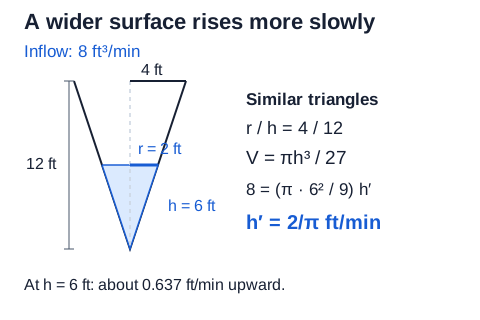 For a tank 12 ft high with top radius 4 ft, r = h/3 and V = πh³/27. An inflow of 8 ft³/min raises the water at 2/π ft/min when h = 6 ft.Open full diagram
SUMMARY
Lesson Summary
Summary
Related rates problems connect two or more quantities that each vary with time through a linking equation — typically drawn from geometry (Pythagorean theorem, volume formulas, similar triangles). The solution method applies implicit differentiation with respect to t using the chain rule to produce a rate equation that links the derivatives of all changing quantities.
The five-step framework — diagram, equation, differentiate, substitute, solve — works for every related rates problem. The most critical rule is to never substitute numerical values before differentiating. Always interpret your final answer with correct units and sign to convey whether the quantity is increasing or decreasing at the given instant.