
SECTION 1
Historical Context & Motivation
The problem of determining the volume of curved solids predates calculus itself, reaching back to the geometers of ancient Greece who sought rigorous ways to measure shapes that resisted simple dissection into prisms and pyramids. Archimedes made the earliest breakthrough by showing that the volume of a sphere equals two-thirds the volume of its circumscribing cylinder, a result he prized so highly that he requested it be inscribed on his tombstone. His technique—exhaustion by inscribed and circumscribed slices—anticipated the disc method by nearly two millennia. The formal tool of integration, however, would not arrive until the seventeenth century, when Newton and Leibniz independently constructed the calculus that unified area, tangent, and volume problems under one framework.
~250 BCE • Archimedes' Method of Exhaustion
1615 • Kepler's Nova Stereometria
1635 • Cavalieri's Principle
1665–1676 • Newton & Leibniz Develop Calculus
The central question the disc method answers is deceptively simple: given a region in the plane bounded by a known curve, what is the exact volume of the solid formed when that region is revolved around an axis? This question arises naturally in engineering (computing the capacity of tanks, nozzles, and turbine components), physics (moments of inertia of rotationally symmetric objects), and pure mathematics (understanding how area and volume relate through revolution). With the definite integral at our disposal, we can answer it precisely by summing an infinite number of infinitesimally thin circular slices—discs—stacked along the axis of rotation.
SECTION 2
Core Principles & Definitions
The disc method rests on the same slicing philosophy that underlies all cross-sectional volume formulas: approximate a solid by a stack of thin slabs whose volumes you can compute, then take the limit as the slab thickness approaches zero. When a plane region is revolved about an axis, every cross-section perpendicular to that axis is a circle (a disc), and the radius of each disc is determined by the distance from the generating curve to the axis of revolution. The following foundational ideas structure the entire technique.
Solid of Revolution
Disc as Cross-Section
Integration Variable Matches Axis
Radius from Function Value
Limits of Integration
KEY TAKEAWAY
SECTION 3
Visual Explanation: Revolving Around the x-Axis
In the diagram above, focus on a single representative disc located at position x along the axis. Its face is a circle of radius r = f(x), so its cross-sectional area is A(x) = π[f(x)]². The disc has an infinitesimal thickness dx, giving it an infinitesimal volume dV = π[f(x)]² dx. Summing (integrating) all such infinitesimal volumes from x = a to x = b yields the total volume of the solid. Notice that the dashed reflection below the x-axis suggests the lower half of the solid; because revolution is symmetric, the single integral already accounts for the full circular cross-section.
SECTION 4
Mathematical Framework
The derivation of the disc formula follows directly from the general cross-sectional volume formula. If a solid extends from x = a to x = b and every cross-section perpendicular to the x-axis has a known area A(x), then V = ∫ₐᵇ A(x) dx. For a solid of revolution about the x-axis, each cross-section is a circle with radius f(x), so A(x) = π[f(x)]². Substituting yields the disc formula. An analogous argument applies when the axis of revolution is the y-axis.
DISC METHOD — REVOLUTION ABOUT THE x-AXIS
f(x) = radius of each disc (the distance from the curve to the x-axis); a and b = the x-bounds of the region; dx = infinitesimal thickness along the x-axis.
DISC METHOD — REVOLUTION ABOUT THE y-AXIS
g(y) = radius of each disc (the distance from the curve, rewritten as x = g(y), to the y-axis); c and d = the y-bounds of the region; dy = infinitesimal thickness along the y-axis.
INFINITESIMAL DISC VOLUME
Each disc is a very thin cylinder: volume = (area of circular face) × (thickness). Summing all such cylinders via integration gives the exact total volume.
Choosing the Variable of Integration
SECTION 5
Detailed Breakdown: x-Axis vs. y-Axis Revolution
Although the disc formula has the same structure regardless of which axis you revolve around, the practical setup differs in important ways. When revolving about the x-axis, the radius is read directly from y = f(x), and the limits are x-values. When revolving about the y-axis, you must solve the equation for x in terms of y to obtain x = g(y), and the limits become y-values. The following comparison table and second diagram highlight these differences.
| Feature | Revolution About x-Axis | Revolution About y-Axis |
|---|---|---|
| Axis of revolution | y = 0 (the x-axis) | x = 0 (the y-axis) |
| Disc radius | r = f(x) | r = g(y), where x = g(y) |
| Disc thickness | dx (along x-axis) | dy (along y-axis) |
| Limits of integration | x = a to x = b | y = c to y = d |
| Volume formula | V = π ∫ₐᵇ [f(x)]² dx | V = π ∫_c^d [g(y)]² dy |
| Typical setup step | Use y = f(x) directly | Solve y = f(x) for x to get x = g(y) |
Side-by-side comparison of disc method setup for each axis
Comparing the two diagrams reveals the essential symmetry of the disc method: the mathematics is identical, but the orientation rotates ninety degrees. In the x-axis case, discs stand upright and are stacked horizontally; in the y-axis case, discs lie flat and are stacked vertically. The most common mistake students make on the AP exam is forgetting to re-express the curve in terms of the correct variable. Always ask: Is my radius expressed as a function of my integration variable? If the answer is yes, you are set up correctly.
SECTION 6
Worked Example
Let us compute the volume of the solid generated by revolving the region bounded by y = √x, y = 0, and x = 4 about the x-axis.
Volume by Disc Method — Revolving y = √x About the x-Axis
- 1
Step 1 — Sketch and Identify the Region
The curve y = √x starts at the origin and increases to the right, reaching y = 2 at x = 4. The region lies above the x-axis (y = 0) and to the left of x = 4. Because the region is bounded below by the axis of revolution itself, there is no hole in any cross-section, confirming that the disc method (not the washer method) is appropriate. - 2
Step 2 — Identify the Radius and Limits
Each disc is perpendicular to the x-axis. The radius of a disc at position x is the vertical distance from the x-axis to the curve: r(x) = √x. The limits of integration are x = 0 (where the curve begins) to x = 4 (the right boundary).r(x) = √x, a = 0, b = 4 - 3
Step 3 — Write the Volume Integral
Substituting into V = π ∫ₐᵇ [f(x)]² dx gives V = π ∫₀⁴ (√x)² dx = π ∫₀⁴ x dx. Notice how squaring the square root simplifies the integrand to just x.V = π ∫₀⁴ x dx - 4
Step 4 — Evaluate the Integral
The antiderivative of x is x²/2. Evaluating from 0 to 4: V = π [x²/2]₀⁴ = π [(4²/2) − (0²/2)] = π [16/2 − 0] = π · 8 = 8π.V = 8π - 5
Step 5 — Interpret the Result
The exact volume of the paraboloid generated by revolving y = √x about the x-axis from x = 0 to x = 4 is 8π cubic units (approximately 25.13 cubic units). This is consistent with Archimedes' classical result that the volume of a paraboloid is half that of its circumscribing cylinder, since the cylinder would have radius 2 and height 4, giving π(2²)(4) = 16π, and 16π/2 = 8π.
SECTION 7
Strengths, Limitations, and Comparisons
The disc method is elegant and efficient for certain configurations, but it is not the right tool for every volume-of-revolution problem. Understanding when it works well—and when an alternative method is preferable—will save time on the AP exam and avoid setup errors.
| Aspect | Disc Method | Washer Method |
|---|---|---|
| Cross-section shape | Solid circle (no hole) | Annulus (ring with a hole) |
| When to use | Region is bounded directly by the axis of revolution on one side | Region has a gap between the inner boundary and the axis of revolution |
| Formula | V = π ∫ [R(x)]² dx | V = π ∫ {[R(x)]² − [r(x)]²} dx |
| Complexity | Simpler—only one radius to identify | Requires identifying both outer and inner radii |
| Limitation | Cannot handle regions with an interior hole relative to the axis | Reduces to the disc method when inner radius = 0 |
Disc method vs. washer method
WHEN TO USE WHICH METHOD
SECTION 8
Connection to Advanced Theory
The disc method is your entry point into a family of volume techniques that extend throughout multivariable calculus and mathematical physics. In AP Calculus AB, you encounter revolution about the x- or y-axis; in BC and beyond, the axis of revolution can be any horizontal or vertical line (y = k or x = h), which modifies the radius expression but not the underlying logic. The table below previews how the disc method connects to more general ideas.
| AP Calculus AB Disc Method | Advanced Extension |
|---|---|
| Revolution about x- or y-axis only | Revolution about any line y = k or x = h; radius = |f(x) − k| |
| Disc (solid circle) cross-sections | Washer (annular) cross-sections and shell method for non-standard axes |
| Single integral in one variable | Double and triple integrals in cylindrical/spherical coordinates (Calc III) |
| Volume of solids of revolution | Volume of solids with known cross-sections of any shape (squares, equilateral triangles, semicircles) |
From disc method to advanced volume techniques
On the AP Calculus AB exam specifically, the disc (and washer) method appears regularly in both the multiple-choice and free-response sections. Free-response questions often present a region defined by two or more curves and ask you to set up—and sometimes evaluate—the integral that gives the volume when the region is revolved about a given axis. The key skills tested are correctly identifying the radius function, choosing the right variable of integration, finding the limits of integration (often by solving equations for intersection points), and carrying out the integration. Mastery of the disc method also builds the conceptual foundation for the general cross-section volume formula V = ∫ₐᵇ A(x) dx, where A(x) can be any cross-sectional shape—not just a circle. The disc method is simply the special case where every A(x) = πr².
SECTION 9
Practice Problems
Question 1: CONCEPTUAL
- A. The circumference of a typical disc
- B. The lateral surface area of the solid
- C. The cross-sectional area of a typical disc
- D. The volume of one complete disc of finite thickness
- E. The arc length of the generating curve at position x
Show answer (C)
Question 2: BASIC CALCULATION
- A. 4π
- B. 32π/5
- C. 8π
- D. 16π/3
- E. 32π/3
Show answer (B)
Question 3: INTERMEDIATE
- A. 96π/5
- B. 128π/7
- C. 48π
- D. 32π/3
- E. 64π/5
Show answer (A)
Question 4: APPLIED
5 ptsShow answer
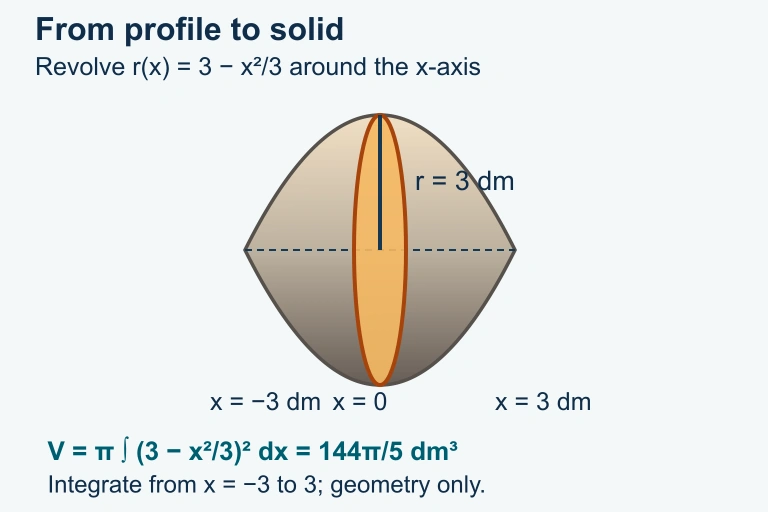 The geometric model gives volume 144π/5 dm³. Using the lesson's stipulated density of 23 kg/dm³ gives mass about 2,081 kg; the density is a supplied assumption.
Question 5: CRITICAL THINKING
3 ptsShow answer
SUMMARY
Lesson Summary
Summary
The disc method computes the volume of a solid of revolution by summing the volumes of infinitely many thin circular cross-sections (discs). When a region is revolved about the x-axis, the formula is V = π ∫ₐᵇ [f(x)]² dx, where f(x) is the radius of each disc and [a, b] are the x-bounds. When revolving about the y-axis, rewrite the curve as x = g(y) and integrate V = π ∫_c^d [g(y)]² dy with y-bounds [c, d].
The critical setup skill is ensuring that the radius is expressed as a function of the integration variable, which always runs along the axis of revolution. The disc method applies when the region is bounded directly by the axis so that every cross-section is a full circle. If a gap exists between the region and the axis, the washer method (which subtracts the inner radius) is required instead. Mastery of the disc method also prepares you for the general cross-sectional volume formula V = ∫ A(x) dx, which extends beyond circular slices to any known cross-sectional shape.