
SECTION 1
Historical Context & Motivation
The problem of computing volumes of curved solids has captivated mathematicians for millennia. Archimedes used the method of exhaustion to determine the volume of a sphere by inscribing and circumscribing it with cylinders—an approach remarkably close to the integral calculus that would not be formalized for nearly two thousand years. The underlying insight was always the same: decompose a complex three-dimensional shape into thin, manageable slices whose volumes can be summed.
~250 BCE • Archimedes' Method of Exhaustion
1615 • Kepler's Nova Stereometria
1635 • Cavalieri's Principle
1665–1676 • Newton & Leibniz Formalize Calculus
Most introductory treatments of the disc method revolve a region around the x-axis or y-axis. However, the AP Calculus AB exam frequently requires you to revolve around other horizontal and vertical lines such as y = 3, x = −1, or y = −2. The central question becomes: how does the radius of each disc change when the axis of revolution is no longer a coordinate axis? Answering this question is the focus of the present lesson.
SECTION 2
Core Principles & Definitions
Before extending the disc method to arbitrary axes, it is essential to solidify the foundational ideas that make the technique work. The disc method is, at its heart, a special case of the method of known cross-sections: when a solid of revolution is sliced perpendicular to the axis of revolution, each cross-section is a circle (a disc). The volume of each infinitesimally thin disc is πr²·(thickness), and the total volume is the definite integral of these disc volumes along the axis.
Axis of Revolution
Radius as a Distance
No Hollow Region
Integration Variable Matches Axis Direction
Limits of Integration
KEY TAKEAWAY
SECTION 3
Visual Explanation
The same region 0 ≤ y ≤ √x, 0 ≤ x ≤ 4 forms discs about y = 0 and washers about y = −1. About y = 0 the radius is √x. About y = −1 the outer radius is √x + 1 and the inner radius is 1 because the axis lies one unit below the region. The corresponding volumes are π∫₀⁴ x dx = 8π and π∫₀⁴[(√x + 1)² − 1] dx = 56π/3.
Each radius is a non-negative distance from the axis to a boundary of the region. If the region reaches the axis, a perpendicular slice produces a disc. If a gap separates the region from the axis, the slice produces a washer: use the distance to the farther boundary as the outer radius and the distance to the nearer boundary as the inner radius.
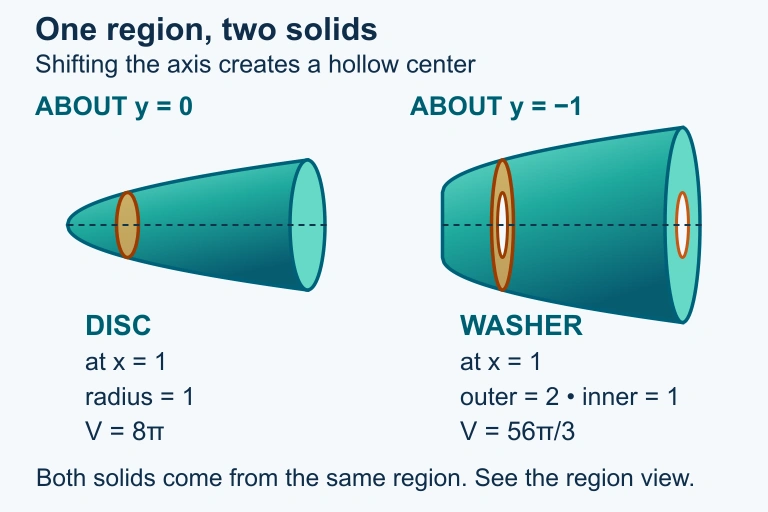 Moving the axis from y=0 to y=−1 leaves the region unchanged but opens an inner radius of 1, so discs become washers.
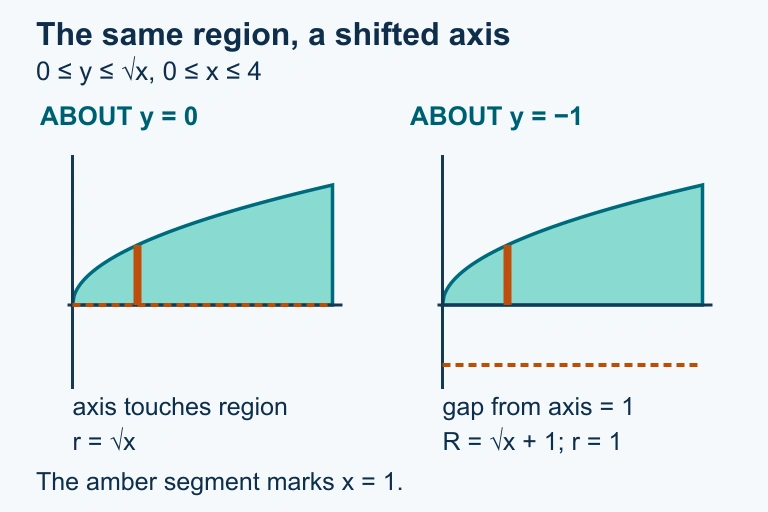 The same region 0≤y≤√x, 0≤x≤4, shown with axes of rotation y=0 and y=−1. For the shifted axis, outer radius is √x+1 and inner radius is 1.
SECTION 4
Mathematical Framework
We now formalize the disc method for non-standard axes of revolution. The key modification is always the same: express the radius of each disc as the perpendicular distance from the curve to the axis, rather than simply using the function value.
Case 1: Revolution Around a Horizontal Line y = k
HORIZONTAL AXIS y = k
where f(x) is the curve bounding the region, k is the y-value of the axis of revolution, and [a, b] are the x-limits of the region. The quantity [f(x) − k] represents the radius of each disc.
If the axis y = k lies above the curve, then f(x) − k is negative over the region, but squaring eliminates the sign. You may equivalently write [k − f(x)]² and obtain the same result. The key is that the integrand is always [distance]², which is inherently non-negative.
Case 2: Revolution Around a Vertical Line x = k
VERTICAL AXIS x = k
where x = g(y) is the curve solved for x as a function of y, k is the x-value of the axis of revolution, and [c, d] are the y-limits. Each disc is now horizontal, and its radius is the horizontal distance from the curve to the line x = k.
Determining the Radius Sign Convention
RADIUS FORMULA
Because the radius is squared, both forms produce the same volume integral. However, writing the radius with the correct sign helps you verify that r ≥ 0 on the interval of integration—a useful sanity check.
AP Exam Tip
SECTION 5
Radius Determination by Axis Position
The single most important skill for this topic is determining the correct radius expression based on the relative position of the axis and curve. The following table and diagram systematically cover the four geometric configurations you will encounter on the AP exam.
| Configuration | Axis | Radius | Volume Integral |
|---|---|---|---|
| Horizontal axis below curve | y = k, k < f(x) | r = f(x) − k | V = π ∫ₐᵇ [f(x) − k]² dx |
| Horizontal axis above curve | y = k, k > f(x) | r = k − f(x) | V = π ∫ₐᵇ [k − f(x)]² dx |
| Vertical axis left of curve | x = k, k < g(y) | r = g(y) − k | V = π ∫_c^d [g(y) − k]² dy |
| Vertical axis right of curve | x = k, k > g(y) | r = k − g(y) | V = π ∫_c^d [k − g(y)]² dy |
Summary of radius expressions for all four axis-curve configurations
SECTION 6
Worked Example
Let us compute the volume of the solid obtained by revolving the region bounded by y = x², y = 0, and x = 2 about the line y = 5.
Volume by Revolution Around y = 5
- 1
Step 1 — Sketch and Identify the Configuration
The curve y = x² sits between y = 0 and y = 4 on [0, 2]. The axis y = 5 lies above the entire region. This is Configuration B (horizontal axis above curve). The region touches the axis at no point, so we need the washer method in general—but here the region extends from y = 0 to y = x², and the axis is above both. The outer radius is from y = 5 to y = 0 (the line y = 0 is farther from the axis), and the inner radius is from y = 5 to y = x². Wait—let us reconsider: the region is bounded by y = x², y = 0, and x = 2. When we revolve about y = 5, the axis does not touch the region, so this becomes a washer problem. Let us simplify to a pure disc problem instead. - 2
Step 1 (Revised) — Restate as a Pure Disc Problem
Consider the region bounded by y = x² and the line y = 4 (which intersect at x = ±2). Revolve this region about the line y = 4. Since the axis y = 4 is the upper boundary, the region extends downward from the axis to the curve y = x². The solid has no hole—each cross-section perpendicular to the x-axis is a full disc.Pure disc method applies; axis y = 4 is above curve y = x² - 3
Step 2 — Determine the Radius
Each disc has its center on the axis y = 4 and extends down to the curve y = x². The radius is the distance from the axis to the curve:r(x) = 4 − x² - 4
Step 3 — Set Up the Integral
The region spans from x = −2 to x = 2 (intersection of y = x² and y = 4). By the disc method:V = π ∫₋₂² (4 − x²)² dx - 5
Step 4 — Exploit Symmetry and Expand
Because (4 − x²)² is an even function, we can write V = 2π ∫₀² (4 − x²)² dx. Expanding: (4 − x²)² = 16 − 8x² + x⁴.V = 2π ∫₀² (16 − 8x² + x⁴) dx - 6
Step 5 — Evaluate the Integral
Integrate term by term: ∫₀²(16 − 8x² + x⁴) dx = [16x − (8/3)x³ + (1/5)x⁵]₀². At x = 2: 16(2) − (8/3)(8) + (1/5)(32) = 32 − 64/3 + 32/5. Finding a common denominator of 15: 480/15 − 320/15 + 96/15 = 256/15.V = 2π · (256/15) = 512π/15 - 7
Step 6 — Verify Reasonableness
The enclosing cylinder (radius 4, height 4) has volume π(4)²(4) = 64π ≈ 201.1. Our answer 512π/15 ≈ 107.2, which is less than the cylinder—confirming our result is plausible.V = 512π/15 ≈ 107.2 cubic units
SECTION 7
Disc Method vs. Washer Method: When Each Applies
A frequent source of confusion on the AP exam is deciding whether a given revolution problem requires the disc method or the washer method. The distinction hinges entirely on whether the cross-section perpendicular to the axis of revolution is a solid disc (no hole) or an annular washer (a disc with a hole). When the axis of revolution is not a coordinate axis, this determination requires particular care because the axis may or may not coincide with a boundary of the region.
| Feature | Disc Method | Washer Method |
|---|---|---|
| Cross-section shape | Solid circle (disc) | Annulus (ring) |
| Axis relationship | Axis is a boundary of the region, or region extends from axis to one curve | Axis does NOT touch the region; a gap exists between the axis and the nearest boundary |
| Number of radii | One: R(x) or R(y) | Two: R_outer and r_inner |
| Volume formula | V = π ∫ R² dx (or dy) | V = π ∫ (R² − r²) dx (or dy) |
| Common error with non-standard axes | Using f(x) instead of f(x) − k for the radius | Subtracting radii instead of squaring each separately: (R − r)² ≠ R² − r² |
Comparison of disc and washer methods
DECISION RULE
SECTION 8
Connections to Advanced Methods
The disc method for non-standard axes is a stepping stone toward several more advanced volume-computation techniques. Understanding how the radius adapts to different axes of revolution prepares you for the shell method (which uses cylindrical shells instead of circular discs) and for volumes computed by general cross-sections (squares, equilateral triangles, semicircles). All of these rely on the same fundamental principle: express a geometric quantity—area of a cross-section—as a function of a single variable, then integrate.
| Feature | Disc / Washer Method | Shell Method |
|---|---|---|
| Cross-section type | Circular disc or annular washer | Cylindrical shell (thin hollow cylinder) |
| Slicing direction | Perpendicular to axis of revolution | Parallel to axis of revolution |
| Integration variable | Same direction as the axis | Perpendicular to the axis |
| Non-standard axis adjustment | Modify the radius: |f(x) − k| | Modify the shell radius: |x − k| or |y − k| |
| Tested on AP Calculus AB? | Yes — frequently | No — AP Calculus BC only |
Disc/Washer vs. Shell Method
For AP Calculus AB, mastery of the disc and washer methods—including revolutions about non-standard axes—covers all volume-of-revolution questions that may appear. If you continue to AP Calculus BC or multivariable calculus, the shell method and Pappus' theorem provide elegant alternatives that sometimes simplify otherwise difficult integrals. The conceptual habit of measuring every geometric quantity from the axis of revolution will transfer seamlessly to these advanced contexts.
SECTION 9
Practice Problems
Question 1: CONCEPTUAL
- A. r = x
- B. r = x − 2
- C. r = x + 2
- D. r = 2 − x
- E. r = −2 − x
Show answer (C)
Question 2: BASIC CALCULATION
- A. π(9 − 3 + 1/5) = 31π/5
- B. 13π/6
- C. 7π/2
- D. The setup requires the washer method, not the disc method
- E. 8π/3
Show answer (D)
Question 3: INTERMEDIATE
- A. 512π/15
- B. 256π/15
- C. 128π/5
- D. 32π/3
- E. 64π
Show answer (A)
Question 4: APPLIED
5 ptsShow answer
Question 5: CRITICAL THINKING
3 ptsShow answer
SUMMARY
Lesson Summary
Summary
The disc method computes volumes of solids of revolution by integrating the areas of circular cross-sections along the axis of revolution. When the axis is a non-standard line such as y = k or x = k, the only change to the formula is in the radius expression: the radius becomes the distance from the curve to the axis, computed as |f(x) − k| for horizontal axes or |g(y) − k| for vertical axes. The volume formula is V = π ∫ [radius]² d(variable).
The disc method applies only when the axis is a boundary of the region (no gap between the axis and the region). If a gap exists, the washer method is required instead. The essential strategy for any problem is: sketch the region and axis, draw a representative perpendicular segment from the axis to the curve, and label the distance as the radius. This single habit prevents the most common AP exam errors and generalizes to all axis positions.