
SECTION 1
Historical Context & Motivation
Trigonometric functions have been central to mathematics since ancient civilizations used them for astronomical computation and land surveying, yet the notion of inverse trigonometric functions — functions that answer the question "what angle produces this ratio?" — took centuries to formalize. The need to differentiate these inverses arose naturally during the development of calculus, when mathematicians sought antiderivatives for expressions such as 1/√(1 − x²) and 1/(1 + x²). Understanding the historical arc that led to their differentiation formulas reveals why these results occupy a permanent place in the calculus toolkit.
~150 CE • Ptolemy's Chord Tables
1676 • Newton's Inverse Series
1697 • Bernoulli & Integration Links
1748 • Euler's Introductio
1797 • Lagrange's Derivative Notation
The central question this lesson addresses is straightforward yet far-reaching: given that trigonometric functions like sin, cos, and tan are not one-to-one on their natural domains, how do we rigorously define their inverses, and what are the derivative formulas for those restricted inverses? Mastering these derivatives is essential not only for the differentiation unit of AP Calculus AB but also for integration techniques you will encounter when evaluating definite integrals involving rational and radical expressions.
SECTION 2
Core Principles & Definitions
Before computing any derivative, you need a precise understanding of what an inverse trigonometric function actually is and why domain restrictions are indispensable. The foundational ideas below form the bedrock upon which every differentiation formula rests. Because sinusoidal functions oscillate forever, they fail the horizontal line test on (−∞, ∞), so we must restrict their domains to intervals where they are strictly monotonic. Only then can we define a proper inverse that assigns exactly one angle to each ratio.
Domain Restriction
Inverse Function Theorem
Chain Rule Composition
Pythagorean Identities
KEY TAKEAWAY
SECTION 3
Visual Explanation — Graphs of Inverse Trig Functions
A visual comparison of arcsin x, arccos x, and arctan x on the same coordinate plane reveals their distinct domains, ranges, and curvatures. The diagram below plots all three inverse trigonometric functions tested on the AP exam, with their restricted domains and ranges clearly labeled. Notice that arcsin x and arctan x are odd functions (symmetric about the origin), while arccos x has a vertical shift that breaks this symmetry.
Several features visible in the diagram directly inform the derivatives. The slope of arcsin x steepens dramatically as x approaches ±1, which corresponds to the factor 1/√(1 − x²) blowing up at the endpoints. By contrast, arctan x flattens toward its asymptotes, reflecting the denominator (1 + x²) growing without bound and driving the derivative toward zero. The arccos x curve mirrors arcsin x vertically, which explains why its derivative carries a negative sign: d/dx[arccos x] = −1/√(1 − x²). These graphical observations serve as a valuable check on your algebraic work.
SECTION 4
Mathematical Framework — Deriving the Formulas
The derivative formulas for inverse trigonometric functions are not arbitrary; each one follows from the same elegant technique — implicit differentiation combined with a Pythagorean identity. We begin with the derivation for arcsin x to establish the pattern, then present the remaining formulas that you should commit to memory for the AP exam.
Derivation of d/dx [arcsin x]
Let y = arcsin x, so that sin y = x with y ∈ [−π/2, π/2]. Differentiating both sides implicitly with respect to x gives cos y · (dy/dx) = 1, hence dy/dx = 1/cos y. Since sin²y + cos²y = 1, we have cos y = √(1 − sin²y) = √(1 − x²). The positive square root is justified because y lies in [−π/2, π/2], where cosine is non-negative. Substituting back yields the formula below.
DERIVATIVE OF ARCSIN
The domain excludes x = ±1 because the function has vertical tangent lines at the endpoints. With the chain rule: d/dx [arcsin(u)] = (1/√(1 − u²)) · du/dx.
DERIVATIVE OF ARCCOS
The negative sign arises because arccos x decreases as x increases. Equivalently, arcsin x + arccos x = π/2, so their derivatives must sum to zero.
DERIVATIVE OF ARCTAN
Derived by setting y = arctan x, so tan y = x, differentiating to get sec²y · dy/dx = 1, and using sec²y = 1 + tan²y = 1 + x². This derivative is defined for all real x.
AP Exam Tip
 For a camera 4 m above the path, tan θ = 4/x. At x = 3 m and walking speed 2 m/s, the angular-speed magnitude is 8/25 rad/s; the sign depends on direction.
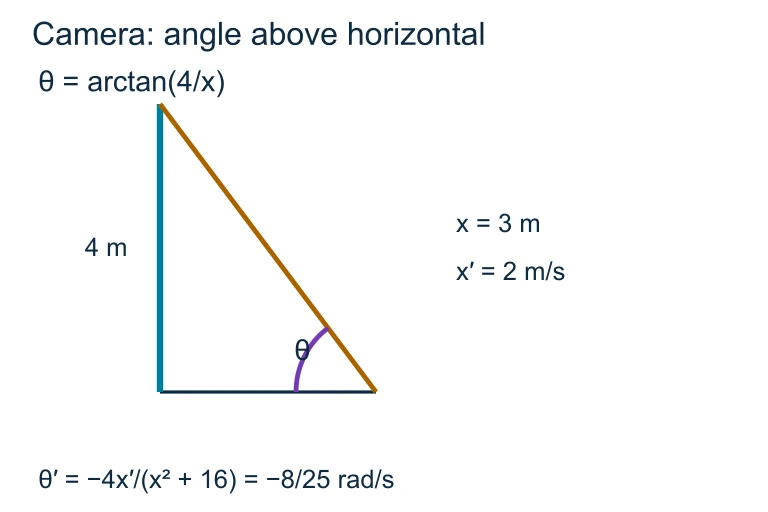 For a camera 4 m above the path, tan θ = 4/x. At x = 3 m and walking speed 2 m/s, the angular-speed magnitude is 8/25 rad/s; the sign depends on direction.
SECTION 5
Detailed Breakdown — Complete Derivative Table
The table below consolidates all six inverse trigonometric derivative formulas for reference. While the AP Calculus AB exam emphasizes arcsin, arccos, and arctan, understanding the full set sharpens your recognition of structural patterns — in particular, note how each "co-function" derivative is simply the negation of its counterpart.
| Function y = f(x) | Derivative dy/dx | Domain of Derivative |
|---|---|---|
| arcsin x | 1 / √(1 − x²) | (−1, 1) |
| arccos x | −1 / √(1 − x²) | (−1, 1) |
| arctan x | 1 / (1 + x²) | (−∞, ∞) |
| arccot x | −1 / (1 + x²) | (−∞, ∞) |
| arcsec x | 1 / (|x|√(x² − 1)) | |x| > 1 |
| arccsc x | −1 / (|x|√(x² − 1)) | |x| > 1 |
Complete inverse trigonometric derivative formulas
Key structural patterns emerge from the table and the derivative graph. First, every cofunction pair (arcsin/arccos, arctan/arccot, arcsec/arccsc) produces derivatives that differ only by a sign: the cofunction derivative is the negative of the function's derivative. Second, the radical √(1 − x²) appears whenever the original trig function involves sine or cosine, while the expression (1 + x²) appears for tangent and cotangent. Third, the derivative of arctan x is the only one defined on all real numbers, which is why arctan appears so frequently in antiderivative problems on the AP exam.
SECTION 6
Worked Example — Chain Rule with Inverse Trig
The following worked example demonstrates the most common AP exam pattern: differentiating an inverse trig function whose argument is a non-trivial expression in x. We find dy/dx for y = arctan(3x²).
Find dy/dx for y = arctan(3x²)
- 1
Step 1 — Identify the Outer and Inner Functions
This is a composite function with the outer function f(u) = arctan u and the inner function u = 3x². By the chain rule, dy/dx = f′(u) · du/dx. - 2
Step 2 — Apply the Arctan Derivative Formula
The derivative of arctan u with respect to u is 1/(1 + u²). Substituting u = 3x² gives the outer derivative as 1/(1 + (3x²)²) = 1/(1 + 9x⁴).Outer derivative: 1/(1 + 9x⁴) - 3
Step 3 — Differentiate the Inner Function
The inner function is u = 3x², so du/dx = 6x by the power rule.Inner derivative: du/dx = 6x - 4
Step 4 — Multiply by the Chain Rule
Combining both pieces: dy/dx = [1/(1 + 9x⁴)] · 6x.dy/dx = 6x / (1 + 9x⁴) - 5
Step 5 — Verify with a Graphical Check
At x = 0, dy/dx = 0, which matches the fact that arctan(3x²) has a horizontal tangent at the origin (since 3x² has a minimum there). At x = 1, dy/dx = 6/10 = 0.6, a reasonable positive slope. The formula passes basic sanity checks.
Common Mistake Alert
SECTION 7
Comparing Inverse Trig Derivatives — Strengths & Pitfalls
It is instructive to compare the three primary inverse trig derivatives side by side, noting where students typically encounter difficulties and what structural features can help you choose the right formula quickly during an exam.
| Feature | arcsin x | arccos x | arctan x |
|---|---|---|---|
| Derivative sign | Always positive | Always negative | Always positive |
| Denominator type | √(1 − x²) — radical | √(1 − x²) — radical | (1 + x²) — polynomial |
| Domain of derivative | (−1, 1) — bounded | (−1, 1) — bounded | (−∞, ∞) — all reals |
| Common AP context | Antiderivatives involving 1/√(a² − x²) | Related rates with angles | Antiderivatives involving 1/(a² + x²) |
| Common student error | Forgetting |x| < 1 restriction | Dropping the negative sign | Not squaring the entire u in 1/(1 + u²) |
Side-by-side comparison of the three primary inverse trig derivatives
KEY TAKEAWAY
SECTION 8
Connections to Integration and Advanced Theory
The derivative formulas for inverse trig functions have a dual life: read in reverse, they are antiderivative formulas. This duality makes inverse trig functions among the most powerful tools in the integration toolkit that you will encounter in later units of AP Calculus AB and in AP Calculus BC. The table below maps each derivative formula to its corresponding integral form, previewing how these results will reappear.
| Derivative (This Unit) | Corresponding Antiderivative (Later Units) |
|---|---|
| d/dx [arcsin(x/a)] = 1/√(a² − x²) | ∫ dx/√(a² − x²) = arcsin(x/a) + C |
| d/dx [arctan(x/a)] = a/(a² + x²) | ∫ dx/(a² + x²) = (1/a) arctan(x/a) + C |
| d/dx [arcsec(|x|/a)] = a/(|x|√(x² − a²)) | ∫ dx/(|x|√(x² − a²)) = (1/a) arcsec(|x|/a) + C |
Derivative-antiderivative duality for inverse trig functions
Beyond integration, these derivatives also appear in related rates problems involving angles. For example, if a camera tracks a rocket rising vertically, the angle of elevation θ = arctan(h/d), where h is the rocket's height and d is the horizontal distance. Differentiating with respect to time t requires the arctan derivative and the chain rule — precisely the skills developed in this lesson. In multivariable calculus, inverse trig functions become essential for evaluating double integrals in polar coordinates and for parametrizing curves on the unit circle. The foundational differentiation skills you build here remain relevant throughout higher mathematics.
SECTION 9
Practice Problems
Question 1: CONCEPTUAL
- A. Because arccos x is always negative on (−1, 1).
- B. Because arccos x is a strictly decreasing function on its domain [−1, 1], so its rate of change must be negative everywhere the derivative exists.
- C. Because the cosine function is negative in the second quadrant, and the inverse inherits this sign.
- D. Because the implicit differentiation of cos y = x introduces a factor of −sin y, and sin y is always negative on [0, π].
- E. Because the derivative of arccos x equals the derivative of arcsin x, and both are negative.
Show answer (B)
Question 2: BASIC CALCULATION
- A. 1 / √(1 − 25x²)
- B. 5 / √(1 − 5x²)
- C. 5 / √(1 − 25x²)
- D. 5 / (1 + 25x²)
- E. −5 / √(1 − 25x²)
Show answer (C)
Question 3: INTERMEDIATE
- A. 2x · arctan(x) + x² / (1 + x²)
- B. 2x / (1 + x²)
- C. 2x · arctan(x) + x / (1 + x²)
- D. 2x · arctan(x) − x² / (1 + x²)
- E. x² / (1 + x²) + 2x · arctan(x) + 2
Show answer (A)
Question 4: APPLIED
4 ptsShow answer
Question 5: CRITICAL THINKING
3 ptsShow answer
SUMMARY
Lesson Summary
Summary
Differentiating inverse trigonometric functions requires three interlocking skills. First, you must understand domain restrictions that make sin, cos, and tan one-to-one, enabling their inverses to be well-defined functions. Second, you need the three core derivative formulas: d/dx[arcsin x] = 1/√(1 − x²), d/dx[arccos x] = −1/√(1 − x²), and d/dx[arctan x] = 1/(1 + x²). These formulas emerge from implicit differentiation combined with Pythagorean identities. Third, nearly every AP problem involves a composite function, so you must pair each formula with the chain rule by multiplying by du/dx.
Remember the structural pattern: sine/cosine family derivatives involve the radical √(1 − x²), while tangent family derivatives involve the polynomial (1 + x²). Cofunction pairs (arcsin/arccos, arctan/arccot) always have opposite signs in their derivatives. These formulas reappear as antiderivative formulas in the integration unit, making mastery here a long-term investment in your calculus toolkit.