
SECTION 1
Historical Context & Motivation
The story of differentiating trigonometric functions is inseparable from the broader development of calculus itself. While Isaac Newton and Gottfried Wilhelm Leibniz independently formulated the core ideas of calculus in the late seventeenth century, the systematic differentiation of all six trigonometric functions unfolded over subsequent decades as mathematicians refined the chain of logical dependencies linking sine and cosine to the remaining four ratios. The derivatives of tangent, cotangent, secant, and cosecant were not discovered in isolation; rather, they emerged naturally once the quotient rule and the fundamental limit sin(h)/h → 1 were firmly established.
1665–1676 • Newton & Leibniz Develop Calculus
1748 • Euler's Introductio in Analysin Infinitorum
1755 • Euler's Institutiones Calculi Differentialis
1821 • Cauchy Rigorizes Limits
If you already know that d/dx [sin x] = cos x and d/dx [cos x] = −sin x, the natural follow-up question is: what are the derivatives of the four remaining trigonometric functions? Because tan x, cot x, sec x, and csc x are all quotients (or reciprocals) of sin x and cos x, we can derive each formula using the quotient rule—a technique that transforms the problem into straightforward algebra with familiar ingredients.
SECTION 2
Core Principles & Definitions
Before diving into the derivative formulas, it is essential to recall the algebraic identities that express each function in terms of sine and cosine. These identities form the backbone of every derivation, because once you express a function as a quotient of sin x and cos x, the quotient rule does the rest. The Pythagorean identity sin²x + cos²x = 1 appears repeatedly when simplifying the results, and recognizing it quickly is the single most important algebraic skill for this topic.
Prerequisite Derivatives
Quotient Rule
Pythagorean Identity
Domain Awareness
KEY TAKEAWAY
SECTION 3
Visual Explanation — The Function-Derivative Relationship
The graph below shows y = tan x alongside its derivative y = sec²x over the interval (−π/2, π/2). Observe that tan x has its flattest slope at x = 0, where sec²(0) = 1, and the slope increases without bound as x approaches ±π/2, exactly where sec²x tends to infinity. The vertical asymptotes of tan x coincide with the points where sec²x is undefined, reinforcing the intimate connection between a function's domain restrictions and its derivative's behavior.
A crucial geometric insight is that sec²x ≥ 1 for all x in its domain. This means the tangent function is strictly increasing on every interval where it is continuous—a fact that is immediately visible from the graph and algebraically verifiable since sec²x = 1 + tan²x, which is the sum of 1 and a squared term. The cotangent function, by contrast, has derivative −csc²x, which is always negative, so cot x is strictly decreasing on each of its branches.
SECTION 4
Mathematical Framework — Deriving the Formulas
Each of the four derivatives below is derived by expressing the function as a quotient of sin x and cos x (or their reciprocals) and then applying the quotient rule. The Pythagorean identity is used in every simplification step. Below we present the four formulas and then walk through the full derivation of two of them.
DERIVATIVE OF TANGENT
Since tan x = sin x / cos x, apply the quotient rule: (cos x · cos x − sin x · (−sin x)) / cos²x = (cos²x + sin²x) / cos²x = 1 / cos²x = sec²x.
DERIVATIVE OF COTANGENT
Since cot x = cos x / sin x, apply the quotient rule: (sin x · (−sin x) − cos x · cos x) / sin²x = −(sin²x + cos²x) / sin²x = −1 / sin²x = −csc²x.
DERIVATIVE OF SECANT
Since sec x = 1 / cos x, apply the quotient rule: (cos x · 0 − 1 · (−sin x)) / cos²x = sin x / cos²x = (1/cos x)(sin x / cos x) = sec x tan x.
DERIVATIVE OF COSECANT
Since csc x = 1 / sin x, apply the quotient rule: (sin x · 0 − 1 · cos x) / sin²x = −cos x / sin²x = −(1/sin x)(cos x / sin x) = −csc x cot x.
Mnemonic: The Co-Function Sign Pattern
 A rotating light turns angle change into motion along a wall. Differentiate the right-triangle relationship to connect the two rates.
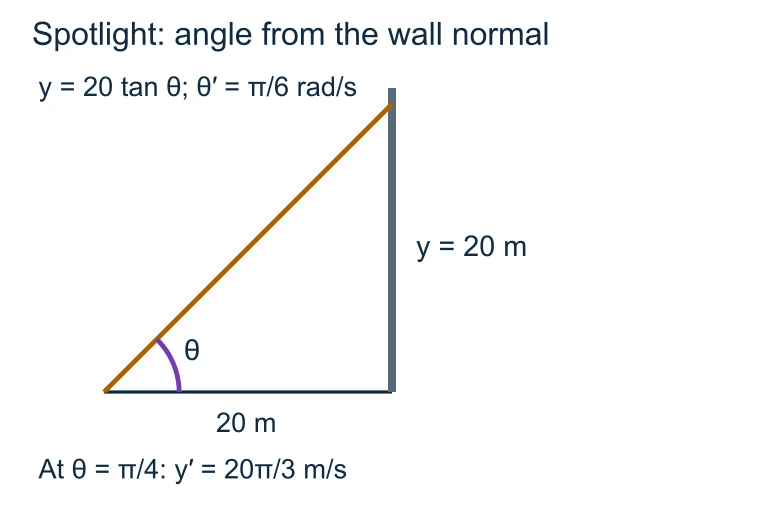 A rotating light turns angle change into motion along a wall. Differentiate the right-triangle relationship to connect the two rates.
SECTION 5
Detailed Breakdown — How the Six Derivatives Connect
The six trigonometric derivatives form an elegant web of relationships. The diagram below maps how each derivative depends on the basic building blocks of sin x and cos x, how the quotient rule generates the four new formulas, and how the Pythagorean identity provides the final simplification. Understanding this dependency structure makes memorization easier because you can always re-derive any formula you forget.
| Function f(x) | Rewritten as | f ′(x) | Sign of f ′(x) |
|---|---|---|---|
| tan x | sin x / cos x | sec²x | Always positive (≥ 1) |
| cot x | cos x / sin x | −csc²x | Always negative (≤ −1) |
| sec x | 1 / cos x | sec x tan x | Depends on quadrant |
| csc x | 1 / sin x | −csc x cot x | Depends on quadrant |
Complete summary of the four derivative formulas with their sign behavior
SECTION 6
Worked Example — Differentiating a Composite Function
Let us differentiate f(x) = 3 sec(2x) − tan²(x). This example combines the derivative of secant with the chain rule and the power rule applied to a trigonometric function, which is exactly the type of multi-step problem that appears on the AP Calculus AB exam.
Find f ′(x) where f(x) = 3 sec(2x) − tan²(x)
- 1
Step 1 — Identify the component functions
We have two terms. The first term, 3 sec(2x), is a secant function with an inner function u = 2x. The second term, tan²(x), is [tan(x)]², so we need the power rule combined with the derivative of tangent. - 2
Step 2 — Differentiate the first term using the chain rule
d/dx [3 sec(2x)] = 3 · sec(2x) tan(2x) · d/dx [2x] = 3 · sec(2x) tan(2x) · 2.= 6 sec(2x) tan(2x) - 3
Step 3 — Differentiate the second term using the power and chain rules
d/dx [tan²(x)] = 2 tan(x) · d/dx [tan(x)] = 2 tan(x) · sec²(x).= 2 tan(x) sec²(x) - 4
Step 4 — Combine the results
Subtract the derivative of the second term from the derivative of the first term.f ′(x) = 6 sec(2x) tan(2x) − 2 tan(x) sec²(x)
Common Mistake Alert
SECTION 7
Strengths, Limitations & Common Confusions
Having all six derivative formulas at your disposal is powerful, but students often encounter predictable pitfalls. The table below contrasts correct reasoning with common errors, helping you build the pattern recognition that prevents mistakes under time pressure on the AP exam.
| Correct Approach | Common Error | Why It Matters |
|---|---|---|
| d/dx [tan x] = sec²x (positive) | Writing −sec²x by falsely applying the co-function sign rule to tangent | Tangent is NOT a co-function, so it has a positive derivative. Only cos, cot, and csc carry the minus sign. |
| d/dx [sec x] = sec x · tan x | Writing sec x · sec x = sec²x by confusing with the tangent derivative | The secant derivative pairs sec with tan, not sec with sec. Mixing them up changes the answer entirely. |
| d/dx [csc(3x)] = −csc(3x) cot(3x) · 3 | Omitting the chain rule factor of 3 | Any composite trig function requires multiplying by the derivative of the inner function. This error loses points on nearly every FRQ. |
| Domain: d/dx [tan x] is undefined at x = π/2 + nπ | Claiming the derivative exists everywhere because sec²x has no obvious zero | sec²x itself is undefined at the same points where tan x has vertical asymptotes. The derivative inherits the parent function's domain restrictions. |
KEY TAKEAWAY
SECTION 8
Connection to Advanced Theory — Integration and Beyond
Mastering these derivative formulas is not merely an exercise in memorization—it lays the groundwork for the antiderivative and integration techniques you will encounter later in the AP Calculus AB curriculum. Each derivative formula, read in reverse, becomes an antiderivative formula. For instance, knowing that d/dx [tan x] = sec²x immediately tells you that ∫ sec²x dx = tan x + C. The table below previews how each derivative connects to its corresponding integral.
| Derivative (Current Topic) | Corresponding Antiderivative (Future Topic) |
|---|---|
| d/dx [tan x] = sec²x | ∫ sec²x dx = tan x + C |
| d/dx [cot x] = −csc²x | ∫ csc²x dx = −cot x + C |
| d/dx [sec x] = sec x tan x | ∫ sec x tan x dx = sec x + C |
| d/dx [csc x] = −csc x cot x | ∫ csc x cot x dx = −csc x + C |
Beyond antiderivatives, these formulas reappear when you study related rates problems involving angles (e.g., a spotlight rotating at a constant angular velocity illuminating a wall) and optimization problems where trigonometric expressions must be differentiated and set equal to zero. In multivariable calculus and differential equations, these same identities and derivative rules carry over directly, making fluency with them a long-term investment in mathematical capability.
SECTION 9
Practice Problems
Question 1: CONCEPTUAL
- A. Because tan x is always positive.
- B. Because sec²x = 1 + tan²x, which is always at least 1, so it is always positive.
- C. Because the numerator of the quotient rule result is cos²x − sin²x, which is always positive.
- D. Because tan x is defined everywhere, so its derivative cannot change sign.
- E. Because sec x is always positive, and squaring a positive number gives a positive result.
Show answer (B)
Question 2: BASIC CALCULATION
- A. −csc(5x) cot(5x)
- B. 5 csc(5x) cot(5x)
- C. −5 csc(5x) cot(5x)
- D. −5 sec(5x) tan(5x)
- E. 5 sec²(5x)
Show answer (C)
Question 3: INTERMEDIATE
- A. 2x sec²(x)
- B. 2x tan(x) + x² sec²(x)
- C. x²sec²(x) − 2x tan(x)
- D. 2x tan(x) + x² sec(x) tan(x)
- E. 2x tan(x) − x² sec²(x)
Show answer (B)
Question 4: APPLIED
5 ptsShow answer
Question 5: CRITICAL THINKING
3 ptsShow answer
SUMMARY
Lesson Summary
Summary
The derivatives of the four remaining trigonometric functions—d/dx [tan x] = sec²x, d/dx [cot x] = −csc²x, d/dx [sec x] = sec x tan x, and d/dx [csc x] = −csc x cot x—are all derived by expressing each function as a quotient of sin x and cos x and then applying the quotient rule. In each case the Pythagorean identity simplifies the result to a clean, memorizable formula.
The key memorization aid is the co-function sign rule: derivatives of cos x, cot x, and csc x all carry a negative sign, while sin x, tan x, and sec x have positive derivatives. When combined with the chain rule, these formulas enable you to differentiate any composite trigonometric expression, a skill that is essential for related rates, optimization, and the eventual study of antiderivatives later in the AP Calculus AB course.