

SECTION 1
Historical Context & Motivation
The problem of describing motion along a line is arguably the oldest in mathematical physics. Ancient Greek thinkers like Zeno of Elea posed paradoxes about moving objects that went unresolved for millennia, precisely because the language of instantaneous change did not yet exist. It was not until the seventeenth century that Isaac Newton and Gottfried Wilhelm Leibniz independently developed the calculus, giving scientists the rigorous tools to define velocity and acceleration as derivatives of position with respect to time.
~450 BC • Zeno's Paradoxes
1638 • Galileo's Kinematics
1687 • Newton's Principia
1684 • Leibniz Publishes Calculus Notation
The central question these thinkers pursued remains the one we explore in this lesson: given an object's position function s(t), how do we extract precise information about its velocity and acceleration at every instant? Answering this question is one of the most important contextual applications of the derivative on the AP Calculus AB exam.
SECTION 2
Core Principles & Definitions
Rectilinear (straight-line) motion is fully described by a single coordinate axis, usually labeled s or x, with time t as the independent variable. The relationships among position, velocity, and acceleration are built entirely on the concept of the derivative. Understanding these three quantities and their interplay is foundational to interpreting any motion problem on the AP exam.
Position s(t)
Velocity v(t) = s′(t)
Acceleration a(t) = v′(t) = s″(t)
Speed |v(t)|
KEY TAKEAWAY
SECTION 3
Visual Explanation — Position, Velocity & Acceleration Graphs
The following diagram shows a position function s(t) and its first two derivatives—velocity v(t) and acceleration a(t)—stacked vertically so that you can trace how features of one graph correspond to features of the others. Pay particular attention to how zeros of v(t) correspond to local extrema of s(t), and how zeros of a(t) correspond to inflection points of s(t) (and extrema of v(t)).
Notice the cascade of information: each derivative transfers geometric features one level down. A turning point on s(t) becomes a zero crossing on v(t). A turning point on v(t) becomes a zero crossing on a(t). Being able to read these correspondences quickly is essential for the multiple-choice section of the AP exam, where you may be given one graph and asked to identify the correct derivative graph.
 A cart can reverse direction while total distance continues to increase. Signed position changes give displacement; their absolute values give distance.
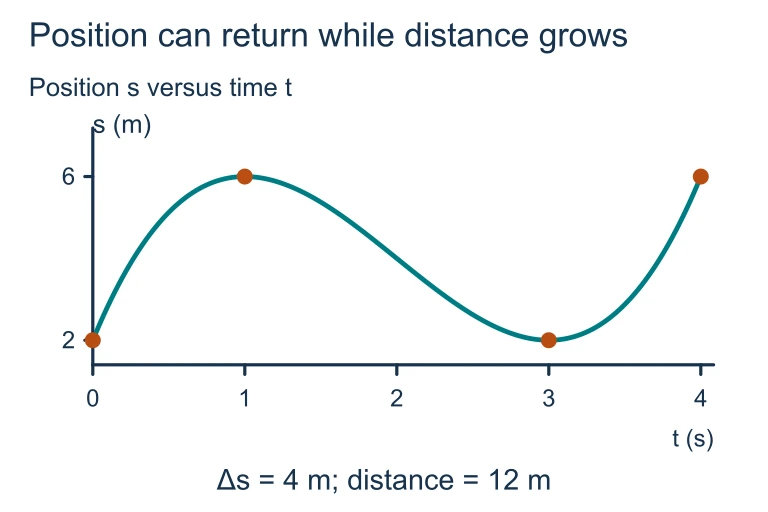 A cart can reverse direction while total distance continues to increase. Signed position changes give displacement; their absolute values give distance.
SECTION 4
Mathematical Framework
The entire theory of rectilinear motion rests on successive differentiation. Let s(t) denote the position of a particle on a number line at time t. The following equations form the backbone of every straight-line motion problem you will encounter.
VELOCITY
Velocity is the instantaneous rate of change of position with respect to time. When v(t) > 0, the particle moves in the positive direction; when v(t) < 0, it moves in the negative direction.
ACCELERATION
Acceleration is the instantaneous rate of change of velocity. It tells you whether the velocity is increasing or decreasing at a given instant.
SPEED
Speed is the magnitude of velocity. A particle speeds up when v(t) and a(t) have the same sign; it slows down when they have opposite signs.
DISPLACEMENT VS. DISTANCE
Displacement is the net change in position (signed), while total distance traveled is the integral of speed (always non-negative). On the AP exam, reading which quantity is requested is critical.
Sign Analysis — The Key to Motion Questions
SECTION 5
Sign Analysis — Speeding Up vs. Slowing Down
The most frequently tested subtlety in AP straight-line motion problems is determining when a particle is speeding up versus slowing down. Many students incorrectly assume that positive acceleration always means speeding up, but this is only true when velocity is also positive. The diagram below provides a visual decision framework that maps all four sign combinations of v(t) and a(t) to the correct motion behavior.
| Sign of v(t) | Sign of a(t) | Direction | Speeding Up / Slowing Down |
|---|---|---|---|
| v > 0 | a > 0 | Positive (right) | Speeding up |
| v > 0 | a < 0 | Positive (right) | Slowing down |
| v < 0 | a < 0 | Negative (left) | Speeding up |
| v < 0 | a > 0 | Negative (left) | Slowing down |
| v = 0 | any | At rest | Neither (instantaneous) |
Summary of all velocity–acceleration sign combinations
SECTION 6
Worked Example
A particle moves along the x-axis with position function s(t) = t³ − 6t² + 9t + 2 for t ≥ 0, where s is measured in meters and t in seconds. Find the velocity and acceleration functions, determine when the particle is at rest, identify intervals where the particle moves in the positive direction, and determine when the particle is speeding up.
Full Motion Analysis: s(t) = t³ − 6t² + 9t + 2
- 1
Step 1 — Find Velocity v(t)
Differentiate s(t) with respect to t using the power rule: v(t) = s′(t) = 3t² − 12t + 9. Factor out the common factor of 3 to simplify sign analysis.v(t) = 3(t² − 4t + 3) = 3(t − 1)(t − 3) - 2
Step 2 — Find Acceleration a(t)
Differentiate v(t) to obtain a(t) = v′(t) = 6t − 12 = 6(t − 2).a(t) = 6(t − 2) - 3
Step 3 — Determine When the Particle Is at Rest
Set v(t) = 0: 3(t − 1)(t − 3) = 0, so t = 1 and t = 3. At these instants the particle is momentarily stationary and changes direction.Particle at rest at t = 1 s and t = 3 s - 4
Step 4 — Sign Analysis for Direction of Motion
Use the factored form v(t) = 3(t − 1)(t − 3). For 0 < t < 1, both factors are negative, so v > 0 → moving right. For 1 < t < 3, (t − 1) > 0 and (t − 3) < 0, so v < 0 → moving left. For t > 3, both factors are positive, so v > 0 → moving right.Positive direction: (0, 1) ∪ (3, ∞); Negative direction: (1, 3) - 5
Step 5 — Determine When the Particle Is Speeding Up
The particle speeds up when v(t) and a(t) share the same sign. We already know v(t) changes sign at t = 1 and t = 3, and a(t) = 6(t − 2) changes sign at t = 2. Build a combined sign chart: on (0, 1), v > 0 and a < 0 → opposite signs → slowing down. On (1, 2), v < 0 and a < 0 → same sign → speeding up. On (2, 3), v < 0 and a > 0 → opposite signs → slowing down. On (3, ∞), v > 0 and a > 0 → same sign → speeding up.Speeding up on (1, 2) ∪ (3, ∞)
SECTION 7
Common Pitfalls & Clarifications
Students frequently lose points on AP free-response problems not because they cannot compute derivatives, but because they misinterpret the motion vocabulary. The table below catalogues the most common errors alongside the correct interpretation.
| Common Mistake | Why It's Wrong | Correct Approach |
|---|---|---|
| Equating velocity and speed | Velocity is signed (direction); speed is |v(t)|, always ≥ 0. | Always check whether the problem asks for velocity (signed) or speed (unsigned). |
| 'a > 0 means speeding up' | Positive acceleration means velocity is increasing, not necessarily that speed is increasing. If v < 0 while a > 0, the particle is slowing down. | Compare signs of v(t) and a(t). Same sign → speeding up; opposite → slowing down. |
| Confusing displacement and distance | Displacement s(b) − s(a) can be zero or negative even if the particle traveled a positive distance. | For total distance, integrate |v(t)| over the interval, or add the absolute values of displacements between direction changes. |
| Thinking v = 0 means the particle stops permanently | v(t) = 0 is instantaneous rest; the particle usually reverses direction if v changes sign. | Check the sign of v on both sides of the zero to determine if a direction change occurs. |
| Using s(t) values to determine direction | Position values tell you where the particle is, not which way it's heading. | Direction is determined by the sign of v(t), not s(t). |
Common motion problem mistakes on AP Calculus AB
KEY TAKEAWAY
SECTION 8
Connections to Advanced Topics
The straight-line motion framework you have learned generalizes in several powerful directions. In AP Calculus BC and beyond, you will encounter these extensions, but it is valuable even now to see where this material fits in the broader mathematical landscape.
| AP Calculus AB (This Lesson) | Extension / Advanced Topic |
|---|---|
| v(t) = s′(t), differentiation from position to velocity | Antidifferentiation: given v(t), recover s(t) using integration and initial conditions (Unit 6 of AB and throughout BC) |
| Motion along a line (one dimension) | Parametric/vector motion in 2D: x(t) and y(t) as separate components with vector velocity ⟨x′(t), y′(t)⟩ (AP Calculus BC, Unit 9) |
| Speed = |v(t)| | In 2D, speed = √[(x′(t))² + (y′(t))²], requiring the Pythagorean theorem on component velocities |
| Polynomial position functions | Differential equations modeling motion with resistance (e.g., dv/dt = −kv), solved with separation of variables |
| Total distance = ∫|v(t)| dt | Arc length in parametric form = ∫√[(dx/dt)² + (dy/dt)²] dt (BC, Unit 9) |
From AB to BC and beyond
Even within the AB curriculum, mastering straight-line motion lays essential groundwork for Unit 6 (Integration and Accumulation of Change), where you will reverse the differentiation process to recover position from velocity using the Fundamental Theorem of Calculus. The sign-analysis skills you build here will transfer directly to those accumulation problems.
SECTION 9
Practice Problems
Question 1: CONCEPTUAL
- A. The particle is moving in the positive direction and speeding up.
- B. The particle is moving in the negative direction and slowing down.
- C. The particle is moving in the negative direction and speeding up.
- D. The particle is moving in the positive direction and slowing down.
- E. The particle is at rest and about to change direction.
Show answer (C)
Question 2: BASIC CALCULATION
- A. t = 1 only
- B. t = 2 only
- C. t = 1 and t = 2
- D. t = 0 and t = 3
- E. t = 3 only
Show answer (C)
Question 3: INTERMEDIATE
- A. (0, 1) ∪ (4, ∞)
- B. (1, 4)
- C. (0, 4)
- D. (4, ∞)
- E. (0, 1)
Show answer (B)
Question 4: APPLIED
5 ptsShow answer
Question 5: CRITICAL THINKING
3 ptsShow answer
SUMMARY
Lesson Summary
Summary
Straight-line motion analysis rests on the derivative chain connecting position s(t), velocity v(t) = s′(t), and acceleration a(t) = v′(t) = s″(t). The sign of velocity determines the direction of motion, and the particle is at rest when v(t) = 0. A direction change occurs only when velocity changes sign through a zero.
The particle is speeding up when v(t) and a(t) share the same sign, and slowing down when they have opposite signs. Speed is the absolute value of velocity and is always non-negative. For total distance, integrate |v(t)| over the interval or sum the absolute displacements between each direction change. Master the two-row sign chart technique—velocity above, acceleration below—and you will be prepared for every straight-line motion question the AP exam can throw at you.