

SECTION 1
Historical Context & Motivation
Long before formal calculus existed, scholars grappled with the fundamental question of how to recover a total quantity from knowledge of its rate of change. Ancient Greek mathematicians like Archimedes computed areas under parabolas using the method of exhaustion, essentially summing infinitely many thin slices—a geometric precursor to what we now call integration. The leap from these geometric techniques to a general theory of accumulation required centuries of development, culminating in the independent work of Newton and Leibniz in the late seventeenth century. Their insight that differentiation and integration are inverse operations—the Fundamental Theorem of Calculus—transformed mathematics and science by providing a systematic way to compute accumulated quantities from rate functions.
~250 BCE • Archimedes and Exhaustion
1668 • Newton's Fluxions
1675 • Leibniz Introduces ∫
1823 • Cauchy Formalizes the Definite Integral
20th Century • Applied Accumulation Everywhere
The central question this lesson addresses is deceptively simple: if you know the rate at which a quantity changes, how do you determine the total amount accumulated over a given interval? On the AP Calculus AB exam, this idea appears in problems involving velocity and displacement, flow rates and total volume, population growth rates and net population change, and marginal cost functions. Mastering accumulation functions means learning to interpret ∫ₐᵇ f(t) dt not merely as an area computation, but as the net change of a real-world quantity from t = a to t = b.
SECTION 2
Core Principles & Definitions
Before solving applied accumulation problems, you need a precise understanding of several interconnected ideas. The concept of an accumulation function generalizes the definite integral by allowing one of its limits to vary, creating a new function whose output represents the running total of the integrand. Meanwhile, the Net Change Theorem provides the interpretive bridge between a rate function and the total change it produces. These principles form the backbone of every applied integration problem you will encounter on the AP exam.
Accumulation Function
Net Change Theorem
Initial Condition + Accumulation
Units of the Integral
Signed vs. Total Accumulation
KEY TAKEAWAY
SECTION 3
Visual Explanation: Accumulation as Area
The following diagram illustrates the core geometric interpretation of an accumulation function. The top graph shows a rate function f(t)—imagine it as a velocity in meters per second—and the shaded region represents the definite integral from a to x. The bottom graph plots the resulting accumulation function F(x) = ∫ₐˣ f(t) dt, showing how the accumulated quantity grows, shrinks, or remains constant depending on the sign of f.
Notice how the behavior of the accumulation function F mirrors the sign of the rate function f. Where f(t) > 0 on [a, c], the accumulation function F is increasing because positive area is being added. At x = c, where f crosses zero, F attains a local maximum. For t in (c, b), f(t) < 0, so F is decreasing because the integral is now subtracting area. This visual correspondence—rate function controls the slope of the accumulation function—is a direct manifestation of the Fundamental Theorem of Calculus: F'(x) = f(x). On the AP exam, you should be prepared to read graphs of rate functions and infer the behavior of the corresponding accumulated quantity, including where it is increasing, decreasing, and attaining extreme values.
SECTION 4
Mathematical Framework
The mathematical backbone of accumulation in applied contexts rests on two parts of the Fundamental Theorem of Calculus and the Net Change Theorem that follows from them. Understanding these results formally allows you to set up and interpret integrals in any applied scenario with confidence.
FUNDAMENTAL THEOREM OF CALCULUS — PART 1
If f is continuous on [a, b], then F(x) = ∫ₐˣ f(t) dt is differentiable on (a, b) and its derivative equals f(x). This means the rate of accumulation at any instant equals the integrand evaluated at that instant.
FUNDAMENTAL THEOREM OF CALCULUS — PART 2
If F is any antiderivative of f on [a, b], the definite integral equals the difference of antiderivative values at the endpoints. This provides the computational mechanism for evaluating accumulation.
NET CHANGE THEOREM
Interpreting f' as a rate of change, this states that the integral of a rate equals the net change in the original quantity. This is the most frequently tested formulation on the AP exam.
INITIAL VALUE + ACCUMULATION
Rearranging the Net Change Theorem gives the value at b in terms of the initial value at a plus the accumulated change. Use this whenever a problem gives you an initial condition and a rate function and asks for the quantity at a later time.
AP Exam Tip: Units Matter
 For net flow R(t) = 4t − t² gal/min and 10 gal initially, V(t) = 10 + 2t² − t³/3. Volume peaks at t = 4 minutes, when the net rate changes from positive to negative.
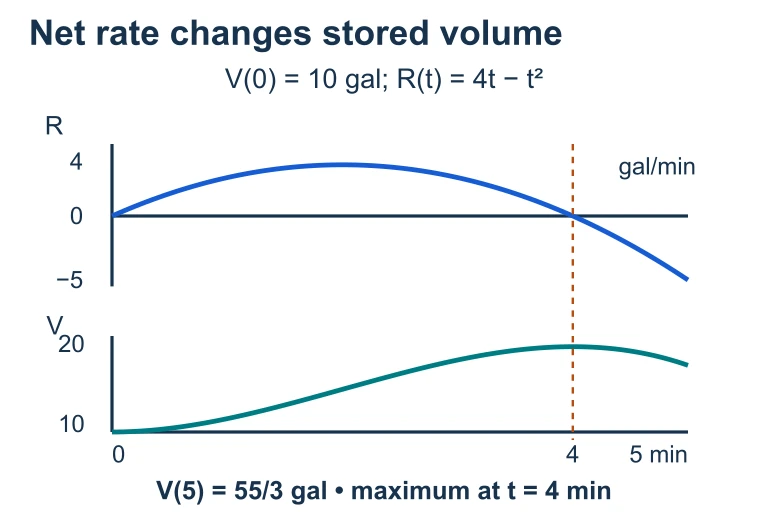 For net flow R(t) = 4t − t² gal/min and 10 gal initially, V(t) = 10 + 2t² − t³/3. Volume peaks at t = 4 minutes, when the net rate changes from positive to negative.
SECTION 5
Applied Contexts & Classification
On the AP Calculus AB exam, accumulation problems appear in a variety of real-world settings. While the underlying mathematics is always the same—integrate a rate to find a net change—recognizing the context helps you set up the problem correctly, identify what the integral represents, and state your answer with appropriate units. The following table classifies the most common applied contexts.
| Context | Rate Function f(t) | ∫ₐᵇ f(t) dt Represents | Typical Units |
|---|---|---|---|
| Motion | Velocity v(t) | Net displacement | meters |
| Motion (total) | |v(t)| (speed) | Total distance traveled | meters |
| Fluid flow | Flow rate r(t) | Total volume of fluid | liters or gallons |
| Population | Growth rate P'(t) | Net change in population | people, organisms |
| Economics | Marginal cost C'(x) | Change in total cost | dollars |
| Temperature | Rate of heating T'(t) | Net change in temperature | °C or °F |
Common applied accumulation contexts on the AP Calculus AB exam
This distinction between signed (net) accumulation and unsigned (total) accumulation is one of the most commonly tested ideas on the AP exam. When the problem asks 'how far did the particle travel,' you need the integral of |v(t)|—the total distance. When it asks 'what is the particle's position at time b,' you need the signed integral ∫ₐᵇ v(t) dt added to the initial position. Always read the question carefully to determine which version is required, and remember that total distance is always greater than or equal to the magnitude of net displacement.
 Suppose v(t) = t² − 4t + 3 on [0,5] with initial position zero. Reversals at t = 1 and 3 split the motion into signed segments: displacement is 20/3 units and distance is 28/3 units.
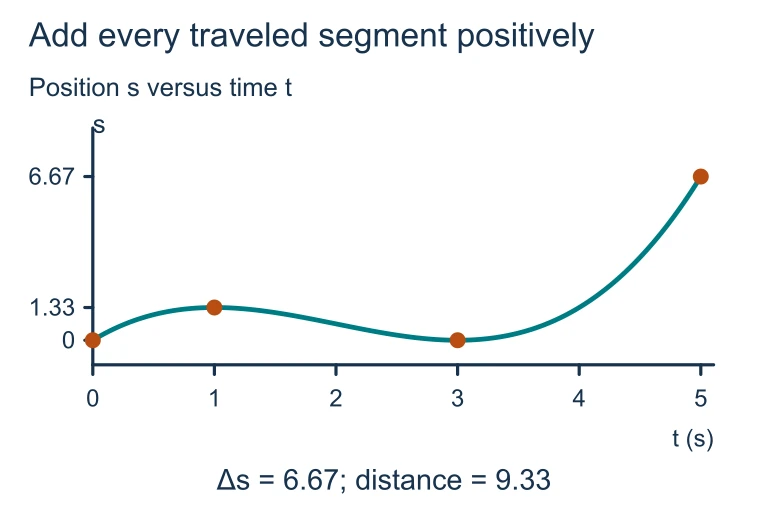 Suppose v(t) = t² − 4t + 3 on [0,5] with initial position zero. Reversals at t = 1 and 3 split the motion into signed segments: displacement is 20/3 units and distance is 28/3 units.
SECTION 6
Worked Example
Consider a typical AP-style problem: Water flows into a tank at a rate of R(t) = 4t − t² gallons per minute for 0 ≤ t ≤ 5. At time t = 0, the tank contains 10 gallons of water. Find the amount of water in the tank at t = 5, and determine at what time the tank holds the maximum amount of water.
Water Tank Accumulation Problem
- 1
Step 1 — Identify the Framework
The rate function is R(t) = 4t − t² (gallons/min), and we are given the initial condition W(0) = 10 gallons. By the initial-value accumulation formula, the water in the tank at time t is W(t) = W(0) + ∫₀ᵗ R(s) ds = 10 + ∫₀ᵗ (4s − s²) ds. - 2
Step 2 — Find the Antiderivative
Compute the antiderivative of R(t) = 4t − t². Using the power rule, ∫(4t − t²) dt = 2t² − t³/3 + C.Antiderivative: F(t) = 2t² − t³/3 - 3
Step 3 — Evaluate the Definite Integral for t = 5
Compute ∫₀⁵ (4t − t²) dt = [2t² − t³/3]₀⁵ = (2(25) − 125/3) − (0) = 50 − 125/3 = 150/3 − 125/3 = 25/3 gallons.∫₀⁵ R(t) dt = 25/3 ≈ 8.33 gallons - 4
Step 4 — Apply the Initial Condition
Using the accumulation formula: W(5) = 10 + 25/3 = 30/3 + 25/3 = 55/3 gallons.W(5) = 55/3 ≈ 18.33 gallons - 5
Step 5 — Find the Time of Maximum Water
By FTC Part 1, W'(t) = R(t) = 4t − t². The tank is at a maximum when R(t) = 0 and changes from positive to negative. Setting 4t − t² = 0 gives t(4 − t) = 0, so t = 0 or t = 4. Since R(t) > 0 on (0, 4) and R(t) < 0 on (4, 5), the accumulation function W is increasing on (0, 4) and decreasing on (4, 5).Maximum water at t = 4: W(4) = 10 + [2(16) − 64/3] = 10 + 32/3 ≈ 20.67 gallons - 6
Step 6 — Verify and Interpret
After t = 4, the rate R(t) becomes negative, meaning water is flowing out faster than it is flowing in (or the model yields a negative net flow). The tank level decreases from W(4) = 62/3 to W(5) = 55/3, losing 7/3 gallons in the final minute. The integral from 4 to 5 confirms this: ∫₄⁵ (4t − t²) dt = [2t² − t³/3]₄⁵ = (25/3) − (32/3) = −7/3 gallons. This is consistent with our accumulation framework.
SECTION 7
Common Pitfalls & Exam Strategies
Applied accumulation problems are conceptually rich, and the AP exam is designed to exploit several common misunderstandings. The following table categorizes the most frequent errors alongside corrective strategies.
| Common Pitfall | Why It's Wrong | Correct Approach |
|---|---|---|
| Using the integral alone without adding the initial value | ∫ₐᵇ f'(t) dt gives the change, not the final value | f(b) = f(a) + ∫ₐᵇ f'(t) dt — always add the initial condition |
| Confusing displacement with total distance | ∫ₐᵇ v(t) dt can be negative; total distance is always ≥ 0 | For total distance, integrate |v(t)|; split at zeros of v |
| Ignoring units in the final answer | AP rubrics award points for correct units separately | Units of ∫ f(t) dt = (units of f) × (units of t) |
| Misidentifying when f vs. f' is the integrand | Integrating f when you should integrate f' (or vice versa) | Identify what the given function represents: is it a rate or a quantity? |
| Using calculator decimal where exact answer is expected | Non-calculator section requires exact arithmetic | Leave answers as fractions unless told to round |
Common pitfalls in accumulation problems
EXAM STRATEGY
 Separated measurements leave the behavior between samples undetermined. Two differentiable curves can pass through the same readings while having different derivatives between them.
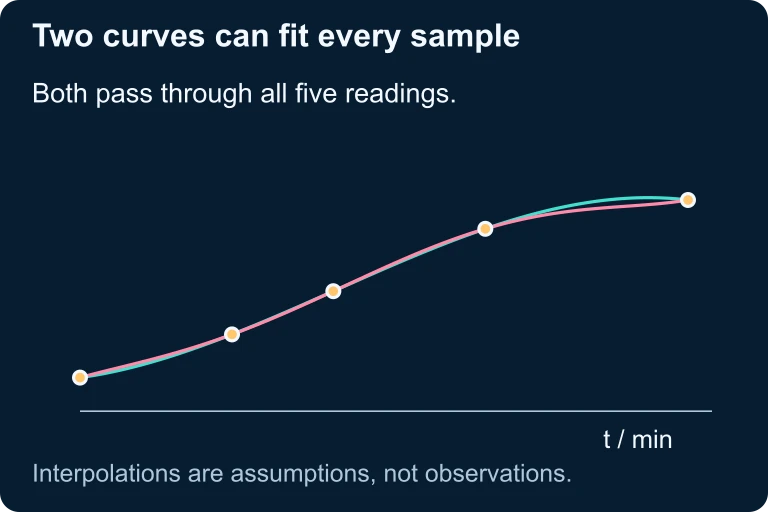 Separated measurements leave the behavior between samples undetermined. Two differentiable curves can pass through the same readings while having different derivatives between them.
SECTION 8
Connections to Advanced Topics
The accumulation-function framework you've learned in AP Calculus AB serves as a foundation for more advanced mathematical ideas. Understanding how these topics extend will both deepen your current understanding and prepare you for what lies ahead in Calculus BC and beyond.
| AP Calculus AB Concept | Advanced Extension | Key Difference |
|---|---|---|
| ∫ₐᵇ f(t) dt as net change | Differential equations: dy/dx = f(x), y(a) = y₀ | DE problems encode the rate and initial condition together; you solve for y(x) rather than just computing a single integral |
| Accumulation function F(x) = ∫ₐˣ f(t) dt | Improper integrals: F(∞) = lim as b→∞ of ∫ₐᵇ f(t) dt | When the upper bound extends to infinity, convergence analysis is required—not all rate functions yield finite accumulations |
| Single-variable accumulation | Multivariable: line integrals and surface integrals | Accumulation along curves and over surfaces requires parameterization and vector calculus |
| Numerical integration (tables, Riemann sums) | Euler's method for differential equations | Euler's method approximates the accumulation function step-by-step using the rate at each point—a natural extension of left Riemann sums |
How AB accumulation concepts connect to advanced topics
Perhaps the most important connection within the AB curriculum itself is between accumulation functions and differential equations with initial conditions. When an AP free-response question says 'dy/dt = f(t) and y(0) = 5, find y(3),' you are essentially being asked to evaluate an accumulation: y(3) = 5 + ∫₀³ f(t) dt. Recognizing this connection allows you to apply your accumulation toolkit even when the problem is dressed up in differential equation language. Conversely, every accumulation function F(x) = ∫ₐˣ f(t) dt satisfies the differential equation F'(x) = f(x) with initial condition F(a) = 0, which is simply FTC Part 1 rewritten in differential equation form.
SECTION 9
Practice Problems
Question 1: CONCEPTUAL
- A. F is increasing on (2, 8)
- B. F is decreasing on (2, 8)
- C. F has an absolute maximum at x = 5
- D. F has an absolute minimum at x = 5
- E. F(8) must be negative
Show answer (C)
Question 2: BASIC CALCULATION
- A. 0
- B. 4
- C. 8
- D. −4
- E. 13
Show answer (B)
Question 3: INTERMEDIATE
- A. L(4) − L(0)
- B. ∫₀⁴ dt
- C. (1/4)∫₀⁴ dt
- D.
- E. d/dt[] evaluated at t = 4
Show answer (B)
Question 4: APPLIED
5 ptsShow answer
Question 5: CRITICAL THINKING
3 ptsShow answer
SUMMARY
Summary & Key Takeaways
Summary
The accumulation function F(x) = ∫ₐˣ f(t) dt transforms a rate function into a running total whose derivative equals f(x) by the Fundamental Theorem of Calculus, Part 1. The Net Change Theorem states that ∫ₐᵇ f'(t) dt = f(b) − f(a), meaning the integral of a rate over an interval gives the net change in the original quantity. When a problem provides an initial condition, use f(b) = f(a) + ∫ₐᵇ f'(t) dt to find the actual quantity, not just the change.
In applied contexts, always distinguish between signed accumulation (net displacement, net population change) and total accumulation (total distance, total volume), which requires integrating the absolute value of the rate function. Pay careful attention to units—the integral's units are (units of f) × (units of t)—and always read the question to determine whether you need the net change, the total accumulation, or the actual value of the quantity at a specific time.