01 / 21

Translation
From mRNA to Protein

Explore how ribosomes read messenger RNA codons and assemble amino acids into functional polypeptide chains: the final step of the central dogma.

AP Biology

What Is Translation?

Translation is the process by which the genetic information encoded in mRNA is decoded to produce a specific sequence of amino acids in a polypeptide chain. It takes place on ribosomes in the cytoplasm (or on the rough endoplasmic reticulum) of the cell.

The Central Dogma of Molecular Biology

DNA Transcription mRNA Translation Protein

The central dogma describes the flow of genetic information: DNA is transcribed into mRNA, which is then translated into a protein. Translation is where the nucleotide language of nucleic acids is converted into the amino acid language of proteins.

Key Molecular Players
mRNA
Carries the genetic code from the nucleus as a sequence of codons (three-nucleotide units).
tRNA
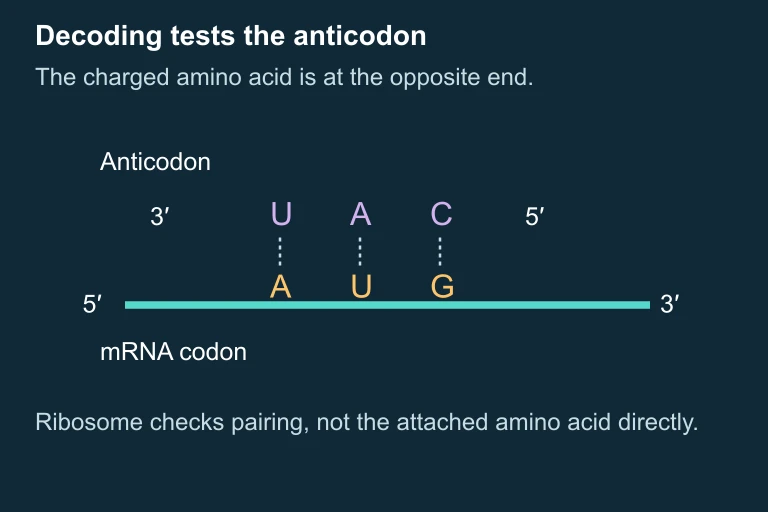
Adapter molecule with an anticodon on one end and an amino acid on the other.
Ribosome
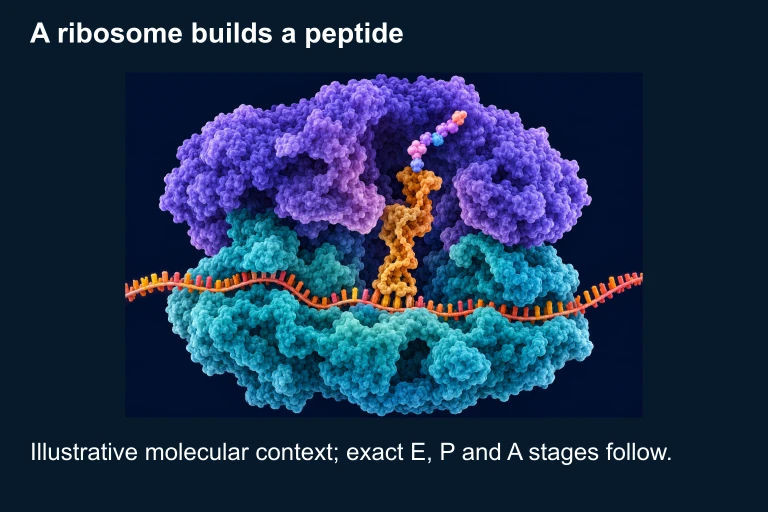
The molecular machine (rRNA + proteins) with A, P, and E sites that catalyzes peptide bond formation.
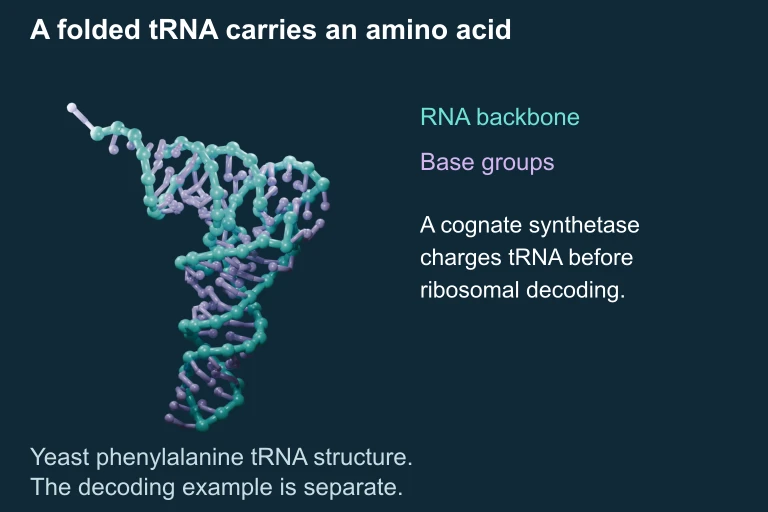
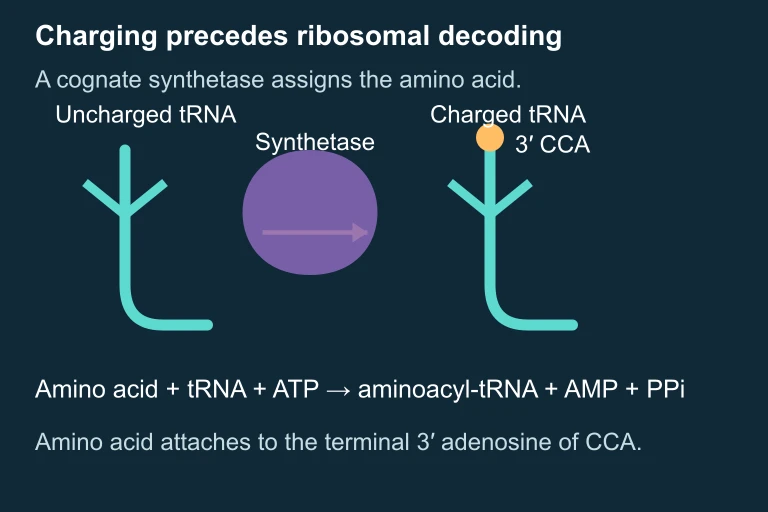
Synthetase charging and ATP consumption.
Separate AUG codon and UAC anticodon example.
A dimensional model of folded yeast phenylalanine tRNA shows its RNA backbone and base groups; separate diagrams explain charging and an independently specified decoding example.
Folded yeast phenylalanine tRNA, shown as a simplified coordinate-based backbone and base representation. The AUG decoding example is a separate lesson example, not the sequence of this structure.

The Genetic Code: Codons

Each codon is a sequence of three mRNA nucleotides that specifies one amino acid (or a stop signal). With 4 bases taken 3 at a time, there are \( 4^3 = 64 \) possible codons encoding only 20 amino acids: the code is therefore degenerate (redundant).

AUG
Start codon: codes for methionine (Met) and signals the beginning of translation.
UAA, UAG, UGA
Stop codons: do not code for any amino acid. They signal the ribosome to release the polypeptide.

Ribosome Structure and Sites

Large Subunit (60S / 50S) Small Subunit (40S / 30S) mRNA E Exit P Peptidyl A Aminoacyl 5' → 3' direction of reading

Three Stages of Translation

1. Initiation Small subunit binds mRNA at AUG. Initiator tRNA joins. Large subunit docks. 2. Elongation tRNA brings amino acid to A site. Peptide bond forms. Ribosome translocates one codon. 3. Termination Stop codon reached. Release factor binds. Polypeptide freed. Ribosome dissociates.

Stage 1: Initiation

1
Small ribosomal subunit binds to the 5' cap of the mRNA and scans downstream until it finds the start codon AUG.
2
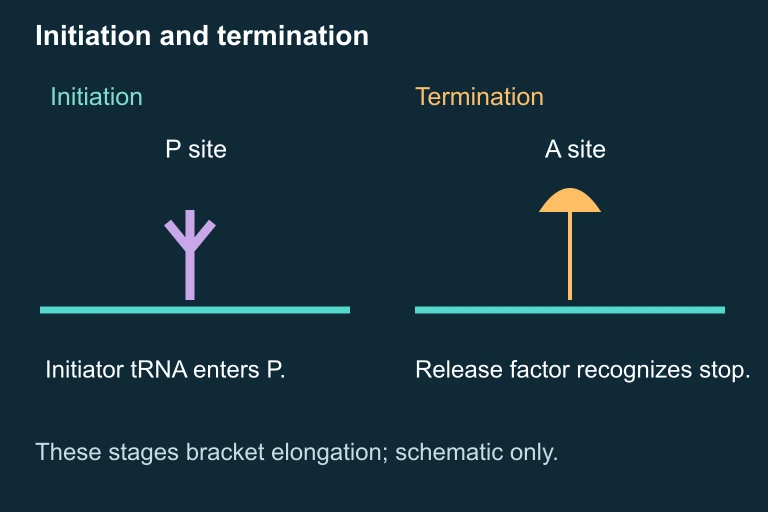
Initiator tRNA (carrying methionine) base-pairs with AUG at the P site. Its anticodon is UAC.
3
Large ribosomal subunit joins the complex, powered by GTP hydrolysis. The complete ribosome now has functional A, P, and E sites.

Stage 2: Elongation

1
Codon recognition: An aminoacyl-tRNA enters the A site, matching its anticodon to the mRNA codon (requires GTP).
2
Peptide bond formation: The ribosome's peptidyl transferase (a ribozyme in the large subunit) catalyzes the bond between the amino acid at the A site and the growing polypeptide at the P site.
3
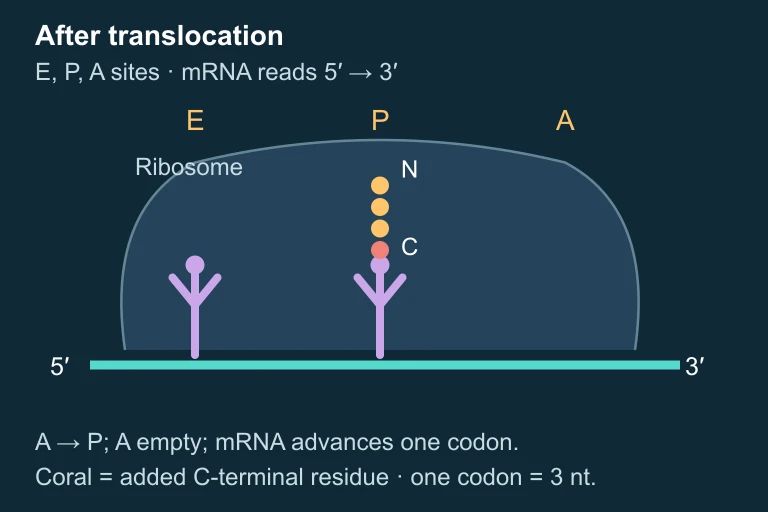
Translocation: The ribosome shifts one codon in the 5' → 3' direction. The tRNA in the A site moves to P, P moves to E, and E site tRNA is ejected (requires GTP).
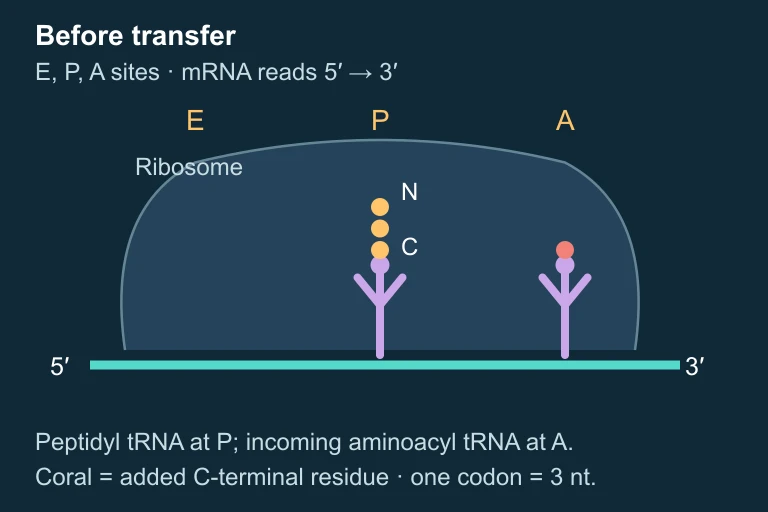
Before peptide transfer.
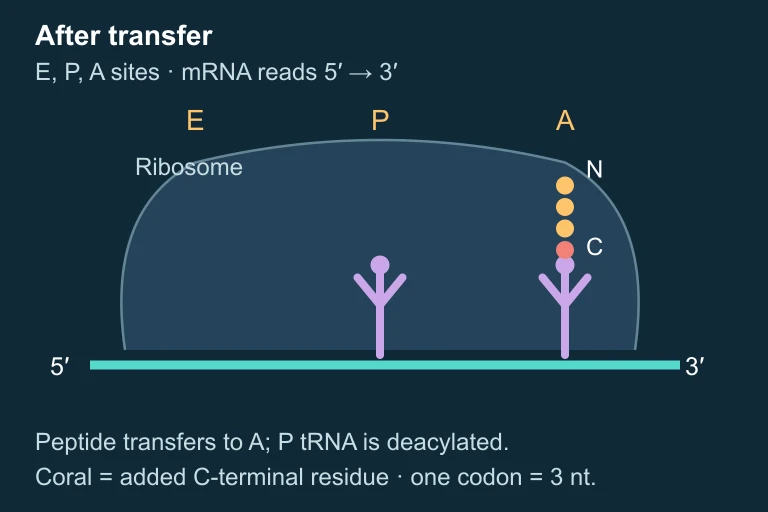
After peptide transfer.
After translocation.
Initiation and termination.
Three ribosomal stages show transfer of a three-residue peptide to the incoming amino acid at the A site and translocation of the four-residue peptidyl tRNA to P.
During elongation, a peptide of three gold residues transfers to an incoming coral amino acid in the A site, adding that residue at its C terminus. After translocation the four-residue peptidyl-tRNA occupies P; E may contain deacylated tRNA and A is empty. One codon corresponds to three nucleotides.

Stage 3: Termination

1
A stop codon (UAA, UAG, or UGA) enters the A site. No tRNA has a complementary anticodon.
2
A release factor protein binds to the stop codon in the A site, mimicking tRNA shape.
3
The release factor triggers hydrolysis of the bond between the polypeptide and the tRNA in the P site. The completed polypeptide is released.
4
The ribosome dissociates into its large and small subunits, ready to translate another mRNA.

Transcription vs Translation

Transcription Translation
Template DNA (template strand) mRNA
Product mRNA Polypeptide (protein)
Location Nucleus (eukaryotes) Cytoplasm / Rough ER
Key enzyme RNA Polymerase Ribosome (ribozyme)
Monomer Nucleotides Amino acids
Energy source NTPs (ATP, GTP, etc.) GTP + ATP (charging tRNA)

How to Decode a Codon Sequence

1
Identify the reading frame: find the AUG start codon on the mRNA sequence.
2
Group nucleotides into triplets starting from AUG (do not overlap or skip bases).
3
Look up each codon in the codon table to find the corresponding amino acid.
4
Stop at a stop codon (UAA, UAG, or UGA): this amino acid sequence is your polypeptide.

Example 1: Simple mRNA Decoding

mRNA 5' AUG GCU UAC AAA UAA 3' Met Ala Tyr Lys STOP Polypeptide: Met - Ala - Tyr - Lys

Example 2: DNA to Protein

DNA template 3' TAC CGA ATG TTT ATT 5' Transcription ↓ mRNA 5' AUG GCU UAC AAA UAA 3' Translation ↓ Amino acids: Met Ala Tyr Lys STOP Polypeptide: Met - Ala - Tyr - Lys

Polyribosomes and Beyond

Multiple ribosomes can translate the same mRNA simultaneously, forming a polyribosome (polysome). This increases the rate of protein production from a single mRNA molecule.

Polysomes
Multiple ribosomes on one mRNA, each producing a copy of the same polypeptide at different stages of completion.
Post-Translational
Proteins are folded by chaperones, may be cleaved, and can receive chemical modifications (phosphorylation, glycosylation) to become functional.

Common Mistakes

✕ Confusing Template and Coding Strands
mRNA is complementary to the template strand (3' → 5'), not the coding strand. Using the wrong strand flips every base.
✕ Forgetting Start Codon
Translation always begins at AUG. If you start reading from a random point, the reading frame shifts and every amino acid will be wrong.
✕ Confusing Anticodon Direction
The anticodon on tRNA is antiparallel to the codon on mRNA. If the codon is 5'-AUG-3', the anticodon is 3'-UAC-5' (written 5'-CAU-3').

Question 1 of 5

Which of the following correctly describes the role of tRNA during translation?

Question 2 of 5

Given the mRNA sequence 5'-AUGCCCUUUGAG-3', how many amino acids will be in the polypeptide (assuming no stop codon is shown)?

Question 3 of 5

During elongation, where does the incoming aminoacyl-tRNA first bind on the ribosome?

Question 4 of 5

What happens when a stop codon enters the A site of the ribosome?

Question 5 of 5

If a DNA template strand reads 3'-TACGCAATT-5', what is the resulting mRNA sequence?