01 / 21

Transcription &
RNA Processing

Discover how cells read DNA blueprints and produce mature mRNA ready for translation through a carefully regulated multi-step process.

AP Biology

What Is Transcription?

Transcription is the process by which a segment of DNA is copied into a complementary strand of messenger RNA (mRNA) by the enzyme RNA polymerase. It is the first step of gene expression: converting the genetic code into a functional product.

Key Players in Transcription

RNA Polymerase
Enzyme that reads the template strand and synthesizes mRNA in the \(5' \to 3'\) direction
Promoter
DNA sequence (e.g., TATA box) where RNA polymerase binds to begin transcription
Template Strand
The \(3' \to 5'\) DNA strand read by RNA polymerase; also called the antisense strand

Why Transcription Matters

Every protein in your body begins as an mRNA transcript. Gene regulation at the transcription level determines which proteins are made, when, and in what quantities. Errors in transcription or its regulation can lead to cancer, genetic disorders, and developmental defects.

Cell Differentiation
Different genes are transcribed in different cell types, creating diverse tissues from one genome
Disease Connection
Mutations in promoter regions or splicing signals cause diseases like beta-thalassemia

The Three Stages of Transcription

Initiation TFs bind promoter RNA Pol II recruited DNA unwinds TATA Box RNA Pol II Elongation
RNA Pol reads \(3'\to5'\)
mRNA built \(5'\to3'\)
A-U, T-A, C-G, G-C
5' --- mRNA --- 3' 3' --- Template --- 5' Termination Terminator signal RNA Pol detaches pre-mRNA released STOP pre-mRNA

Base Pairing in Transcription

During transcription, RNA polymerase matches ribonucleotides to the DNA template strand using complementary base pairing. Note: RNA uses uracil (U) instead of thymine (T).

DNA Template (\(3'\to5'\)) mRNA Product (\(5'\to3'\))
A (Adenine)U (Uracil)
T (Thymine)A (Adenine)
C (Cytosine)G (Guanine)
G (Guanine)C (Cytosine)

DNA vs RNA: Key Differences

DNA RNA
SugarDeoxyriboseRibose
StrandsDouble-strandedSingle-stranded
BasesA, T, C, GA, U, C, G
LocationNucleus (euk.)Nucleus \(\to\) Cytoplasm
FunctionLong-term storageTemporary message
StabilityVery stableShort-lived

RNA Processing in Eukaryotes

In eukaryotes, the initial transcript (pre-mRNA) must undergo three major modifications before it can leave the nucleus and be translated into protein.

\(5'\) Cap
A modified guanine nucleotide added to the \(5'\) end; protects mRNA from degradation and aids ribosome binding
\(3'\) Poly-A Tail
100-250 adenine nucleotides added to the \(3'\) end; increases stability and aids nuclear export
RNA Splicing
Introns (non-coding) are removed; exons (coding) are joined together by the spliceosome

From pre-mRNA to Mature mRNA

pre-mRNA Exon 1 Intron 1 Exon 2 Intron 2 Exon 3 ✕ ✕ Splicing removes introns Mature mRNA 5' Cap Exon 1 Exon 2 Exon 3 AAAA...A Poly-A Tail Protects 5' end Only exons remain (coding sequences) Protects 3' end Exported to cytoplasm

Exons vs Introns

Exons
Expressed sequences that remain in the mature mRNA and are translated into protein. Think: "Exons exit the nucleus."
Introns
Intervening sequences that are removed (spliced out) during RNA processing. Think: "Introns stay in the nucleus."

How to Trace Transcription

1
Identify the template strand. It runs \(3' \to 5'\) and is read by RNA polymerase.
2
Apply base pairing rules. \(\text{A}\to\text{U}\), \(\text{T}\to\text{A}\), \(\text{C}\to\text{G}\), \(\text{G}\to\text{C}\). Remember: RNA uses uracil, not thymine.
3
Write mRNA \(5' \to 3'\). This is the direction of synthesis and the direction ribosomes will read it.
4
Process the pre-mRNA. Add the \(5'\) cap, poly-A tail, and remove introns via splicing.
5
Verify. The mature mRNA sequence should match the coding strand (with \(\text{U}\) replacing \(\text{T}\)).

Example 1: Basic Transcription

Given: Template strand reads \(3'\text{-TACGGCATC-}5'\). What is the mRNA sequence?

3' T A C G G C A T C 5' Template 5' A U G C C G U A G 3' mRNA Start codon (AUG)

Example 2: Coding Strand Shortcut

Given: The coding (sense) strand reads \(5'\text{-ATGCCGTAG-}3'\). What is the mRNA?

5' A T G C C G T A G 3' Coding Replace T → U 5' A U G C C G U A G 3' mRNA

Example 3: Splicing Challenge

A pre-mRNA contains: Exon 1 (120 nt) | Intron (500 nt) | Exon 2 (80 nt) | Intron (300 nt) | Exon 3 (200 nt). After splicing, what is the length of the mature mRNA coding region?

1
Identify exons: Exon 1 = 120 nt, Exon 2 = 80 nt, Exon 3 = 200 nt
2
Remove introns: Intron 1 (500 nt) and Intron 2 (300 nt) are spliced out
3
Sum exon lengths: \(120 + 80 + 200 =\) 400 nucleotides

Common Mistakes

✕ Using \(\text{T}\) in mRNA
RNA uses uracil (\(\text{U}\)), not thymine (\(\text{T}\)). Writing ATGC instead of AUGC in mRNA is a frequent error.
✕ Wrong Strand
Transcribing the coding strand instead of the template strand gives you the complement of the correct mRNA.
✕ Direction Confusion
RNA polymerase reads \(3'\to5'\) but builds mRNA \(5'\to3'\). Mixing up these directions reverses the sequence.

Prokaryotic vs Eukaryotic Transcription

Prokaryotes Eukaryotes
RNA PolymeraseOne typeThree types (I, II, III)
Promoter\(-10, -35\) regionsTATA box + enhancers
Transcription Factors\(\text{Sigma factor } (\sigma)\)Many general + specific TFs
RNA ProcessingNone (no introns)\(5'\) cap, poly-A, splicing
LocationCytoplasmNucleus
Coupled Translation?Yes (simultaneous)No (sequential)
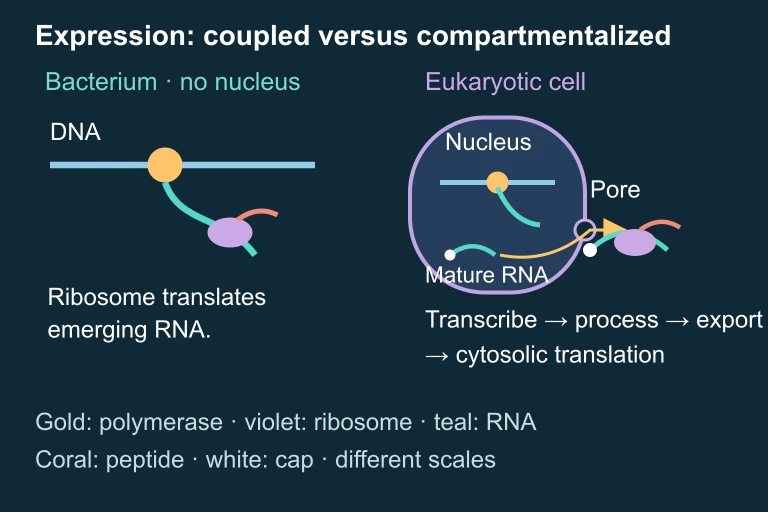
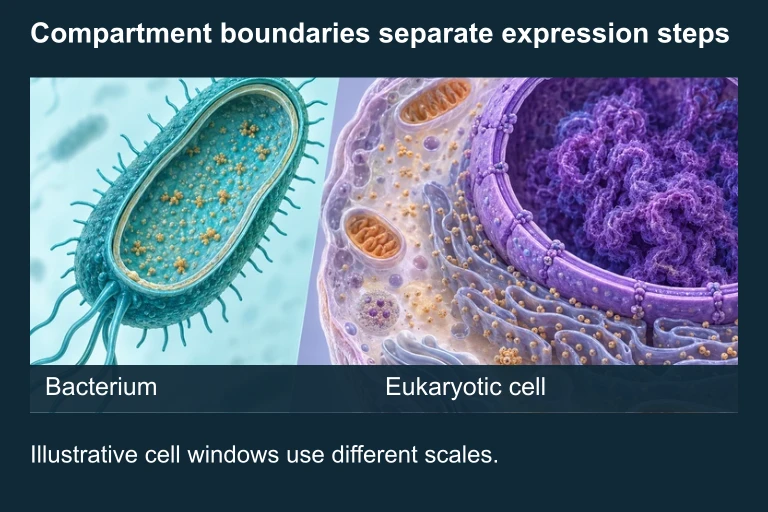
Coupled and compartmentalized expression.
The bacterial example couples translation to emerging RNA. In the eukaryotic example, nuclear transcription and processing precede RNA export and cytosolic translation.
The selected bacterial model couples transcription with translation on emerging RNA. The eukaryotic comparison places transcription and processing inside a nucleus and translation after pore-mediated export to cytosol; the two cell windows use different schematic scales.

Question 1 of 5

If the DNA template strand reads \(3'\text{-AATCGGTAC-}5'\), what is the resulting mRNA sequence?

Question 2 of 5

Which of the following is NOT a post-transcriptional modification in eukaryotes?

Question 3 of 5

A gene has 4 exons and 3 introns. Through alternative splicing, which outcome is possible?

Question 4 of 5

In prokaryotes, transcription and translation can occur simultaneously. Why is this not possible in eukaryotes?

Question 5 of 5

A mutation destroys the poly-A signal sequence at the \(3'\) end of a eukaryotic gene. What is the most likely consequence?