Tonicity &
Osmoregulation
How cells manage water balance across selectively permeable membranes: from the physics of osmotic pressure to the biology of survival.
What Is Osmosis?
Osmosis is the net movement of water across a selectively permeable membrane from a region of lower solute concentration to a region of higher solute concentration. Water moves down its own concentration gradient: it travels toward the side where water is relatively less abundant.
Understanding Water Potential \( \Psi \)
Water potential (\( \Psi \)) predicts the direction of water flow. It has two components:
The Solute Potential Equation
The solute potential is calculated using the equation:
Defining Tonicity
Tonicity describes the relative solute concentration of an external solution compared to the cell's internal environment. It determines the direction and extent of water movement across the cell membrane.
Tonicity in Animal Cells
Tonicity in Plant Cells
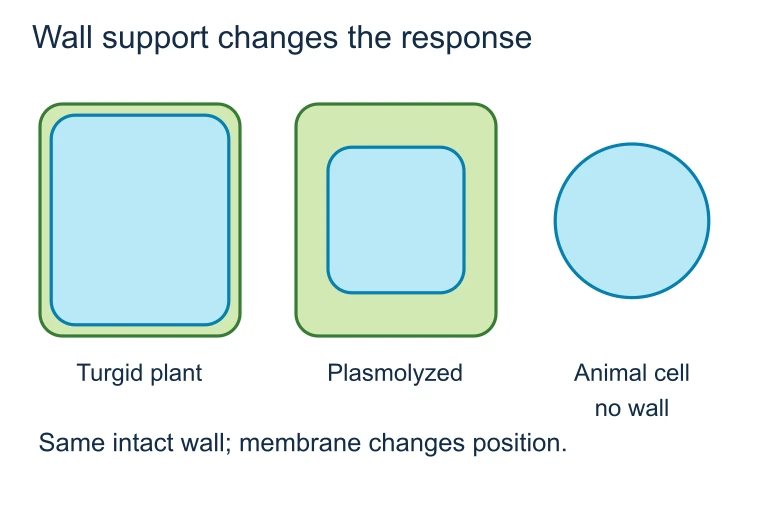
A plant cell presses against a wall while an animal cell changes shape
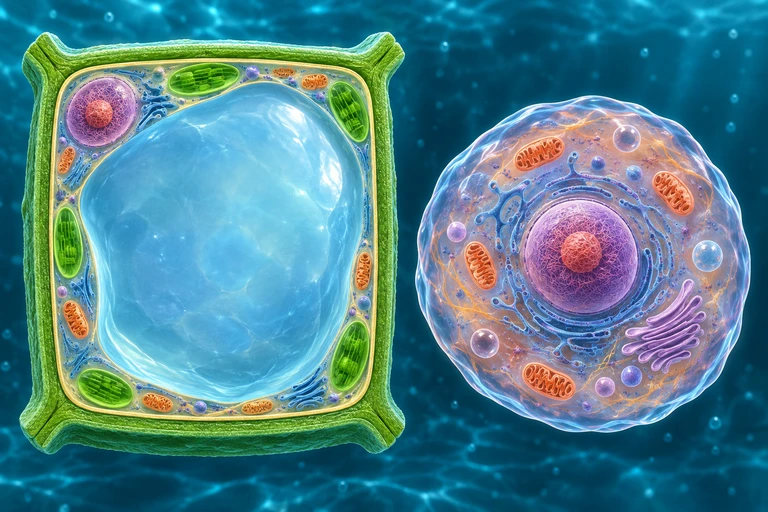
For nonpenetrating solutes, a plant wall limits expansion as water enters. Water loss retracts the protoplast from the wall during plasmolysis; animal cells lack this rigid wall.Wall support changes the response
For nonpenetrating solutes, a plant wall limits expansion as water enters. Water loss retracts the protoplast from the wall during plasmolysis; animal cells lack this rigid wall.Osmolarity vs Tonicity
| Osmolarity | Tonicity | |
|---|---|---|
| Measures | Total solute concentration | Effect on cell volume |
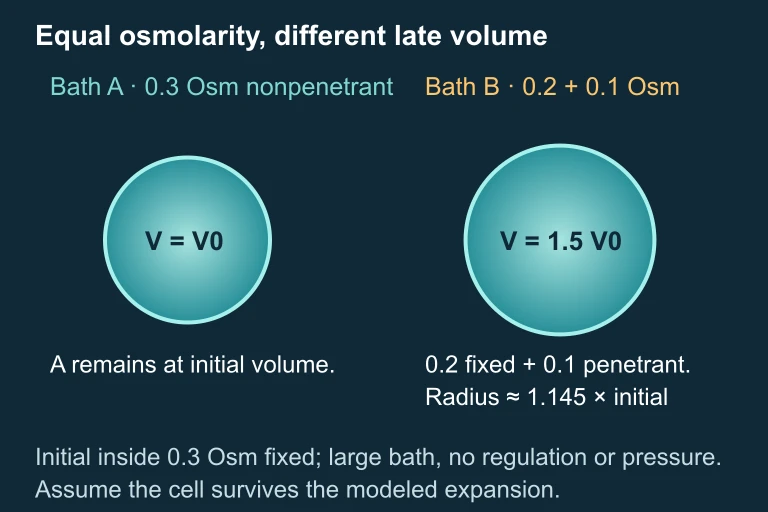
| Considers | All solutes (penetrating + non-penetrating) | Only non-penetrating solutes |
| Predicts | Initial direction of water flow | Final steady-state cell volume |
| Example | Urea crosses membranes: iso-osmolar but hypotonic | NaCl stays outside: iso-osmolar and isotonic |


What Is Osmoregulation?
Osmoregulation is the active regulation of osmotic pressure in an organism's body fluids to maintain homeostasis of water content. Organisms must balance water gain and loss to keep their cells functioning properly.
Strategies for Water Balance
A fish balances water and ions through different routes
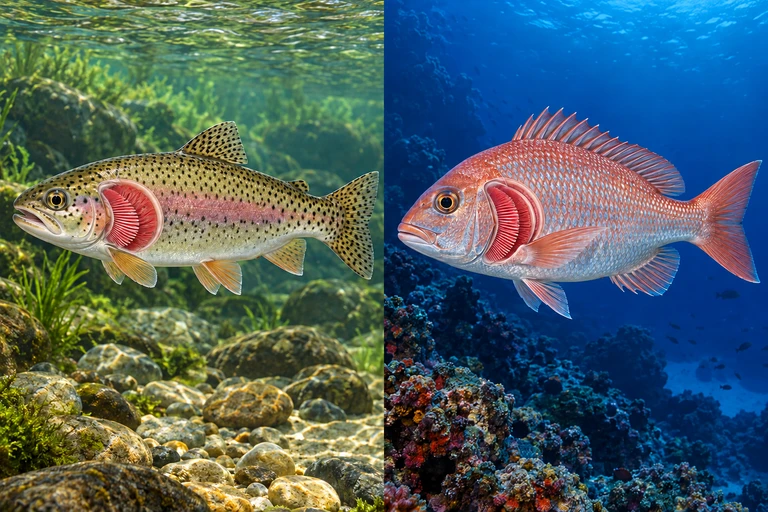
Representative freshwater bony fish gain water, actively take up salts and produce large volumes of dilute urine. Marine bony fish lose water, drink seawater and secrete excess salts at their gills.Two environments, different net challenges
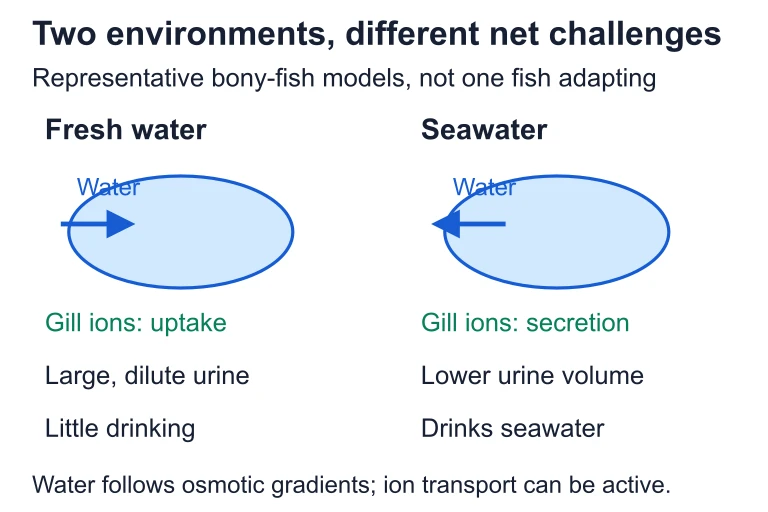
Representative freshwater bony fish gain water, actively take up salts and produce large volumes of dilute urine. Marine bony fish lose water, drink seawater and secrete excess salts at their gills.Solving Water Potential Problems
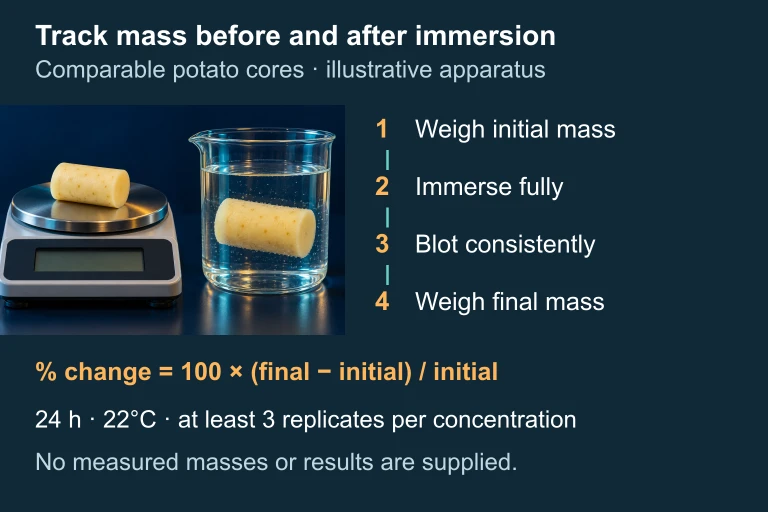
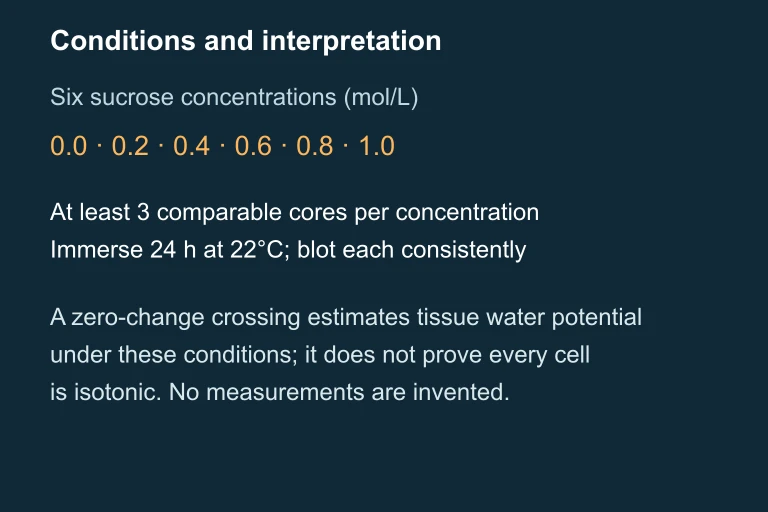
Explain why zero mass change estimates a tissue water-potential condition.
Use comparable potato cores, the same 24-hour immersion at 22 °C, and at least three replicates per sucrose concentration: 0.0, 0.2, 0.4, 0.6, 0.8 and 1.0 M. Blot consistently before final weighing. Percent mass change is 100(final−initial)/initial. An interpolated zero mass change estimates tissue water potential under these conditions; it does not prove every cell is isotonic. No experimental results are supplied.
Example 1: Open Beaker
A 0.5 M sucrose solution sits in an open beaker at \( 25^\circ\text{C} \). What is the water potential?
Example 2: Plant Cell at Equilibrium
A plant cell is placed in a 0.3 M NaCl solution at \( 22^\circ\text{C} \). At equilibrium, the cell's \( \Psi_p = 3.5 \; \text{bars} \). Find the cell's \( \Psi \).
Example 3: Predicting Water Flow
Side A has \( \Psi = -5 \; \text{bars} \). Side B has \( \Psi = -12 \; \text{bars} \). A selectively permeable membrane separates them. Which way does water flow?
Common Mistakes
Summary Table
| Hypotonic | Isotonic | Hypertonic | |
|---|---|---|---|
| Solute outside | Less than cell | Equal to cell | More than cell |
| Water moves | Into cell | No net flow | Out of cell |
| Animal cell | Lysis | Normal | Crenation |
| Plant cell | Turgid | Flaccid | Plasmolyzed |
| \( \Psi \) comparison | \( \Psi_{\text{out}} > \Psi_{\text{cell}} \) | \( \Psi_{\text{out}} = \Psi_{\text{cell}} \) | \( \Psi_{\text{out}} < \Psi_{\text{cell}} \) |
Question 1 of 5
A red blood cell is placed in a hypertonic solution. What will happen to the cell?
Question 2 of 5
What is the solute potential of a 0.2 M NaCl solution at \( 20^\circ\text{C} \)?
(\( R = 0.0831 \; \text{L} \cdot \text{bar/mol} \cdot \text{K} \))
Question 3 of 5
A plant cell with \( \Psi_s = -8 \; \text{bars} \) and \( \Psi_p = 3 \; \text{bars} \) is placed in pure water (\( \Psi = 0 \)). What will happen?
Question 4 of 5
A freshwater fish constantly faces the problem of water entering its body by osmosis. Which adaptation helps it maintain water balance?
Question 5 of 5
Two solutions are separated by a selectively permeable membrane. Solution X contains 0.4 M urea (which freely crosses membranes). Solution Y contains 0.4 M sucrose (which cannot cross). Which statement is correct?