01 / 24

Structure of Water
& Hydrogen Bonding

Explore how water's polar covalent bonds and hydrogen bonds give rise to the unique properties that make life possible.

AP Biology

Why Water Is the Molecule of Life

Water makes up 60-70% of every living cell. Its unique molecular structure gives it emergent properties: cohesion, adhesion, high specific heat, and solvent versatility. Understanding water is the foundation of biochemistry.

The \( \mathrm{H_2O} \) Molecule

O \( \delta^- \) H \( \delta^+ \) H \( \delta^+ \) \( 104.5^\circ \) Polar Covalent Bonds

Electronegativity Creates Polarity

Oxygen
Electronegativity: 3.44. Strongly attracts shared electrons, gaining a partial negative charge (\( \delta^- \)).
Hydrogen
Electronegativity: 2.20. Electrons are pulled away, leaving a partial positive charge (\( \delta^+ \)).

What Is a Hydrogen Bond?

O \( \delta^- \) H H O \( \delta^- \) H \( \delta^+ \) H H-bond Intermolecular Attraction

Covalent vs Hydrogen Bonds

Covalent Bond (O−H) Hydrogen Bond
Type Intramolecular Intermolecular
Strength Strong (~460 kJ/mol) Weak (~20 kJ/mol)
Involves Shared electrons Electrostatic attraction
Broken by Chemical reaction Heat, molecular motion
In water Holds H to O within molecule Links adjacent molecules

Emergent Properties of Water

Cohesion
Water molecules stick to each other via hydrogen bonds, creating surface tension.
Adhesion
Water clings to other polar surfaces, driving capillary action in plants.
High Specific Heat
H-bonds absorb heat energy, stabilizing temperatures in organisms and ecosystems.
Universal Solvent
Polarity lets water dissolve ionic and polar substances for biological reactions.

Cohesion and Surface Tension

No H-bonds above Pulled inward AIR WATER

Adhesion and Capillary Action

Adhesion (water to glass) Cohesion (water to water) Rise

Adhesion is water's attraction to other polar surfaces. In a narrow tube, adhesion pulls water up the glass wall while cohesion drags the rest of the column along. In plants, evaporation from leaves generates tension transmitted through cohesive xylem water; adhesion helps water wet xylem walls.

Cohesion transmits transpiration tension through xylem
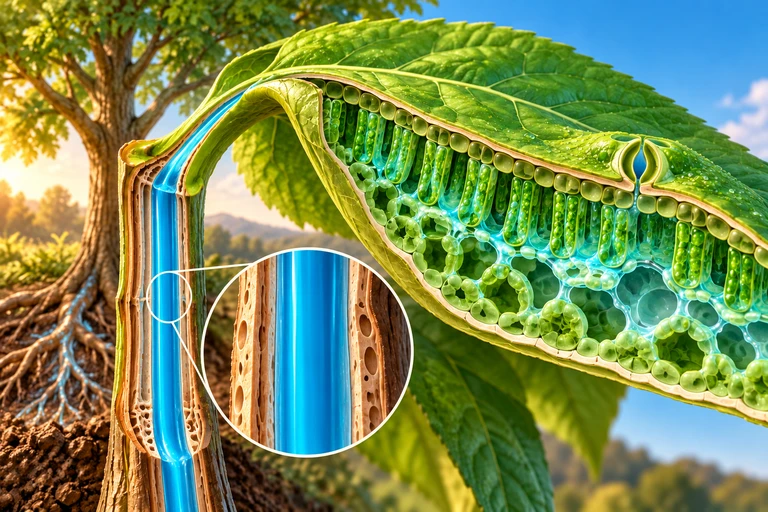
A tree and cutaway leaf connected by a cyan xylem pathway, with a magnified continuous liquid column.Evaporation from moist mesophyll walls creates tension transmitted through cohesive liquid water in xylem. Water vapor then exits through stomata; adhesion helps maintain contact with xylem walls.

Evaporation pulls a connected column
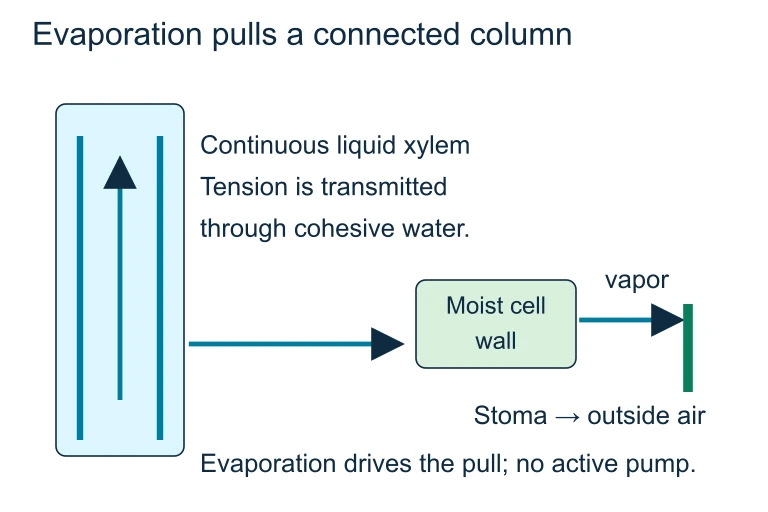
Evaporation pulls a connected column. Evaporation from moist mesophyll walls creates tension transmitted through cohesive liquid water in xylem. Water vapor then exits through stomata; adhesion helps maintain contact with xylem walls.Evaporation from moist mesophyll walls creates tension transmitted through cohesive liquid water in xylem. Water vapor then exits through stomata; adhesion helps maintain contact with xylem walls.

Cohesion acts between water molecules
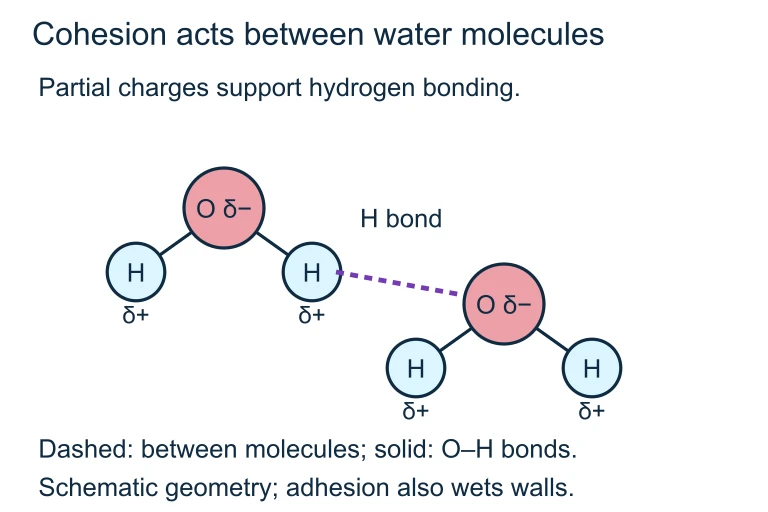
Cohesion acts between water molecules. Hydrogen bonds connect the partially positive hydrogen of one water molecule with the partially negative oxygen of another; covalent O–H bonds remain within each molecule.Hydrogen bonds connect the partially positive hydrogen of one water molecule with the partially negative oxygen of another; covalent O–H bonds remain within each molecule.

High Specific Heat of Water

Water's specific heat is \(4.184 \;\text{J/g}\cdot^\circ\text{C}\): it takes a large amount of energy to change its temperature. Added energy changes both the hydrogen-bond network and molecular motion, so a relatively large energy input is needed for a given temperature rise.

Temperature Buffering
Organisms maintain stable internal temperatures even when external conditions change rapidly.
Climate Regulation
Coastal regions have milder climates because oceans absorb and release heat slowly.

Water absorbs heat and carries energy away during evaporation
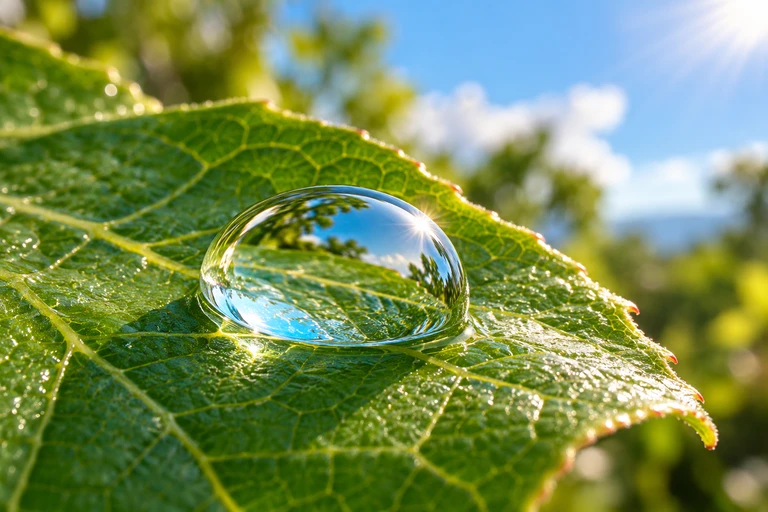
A transparent liquid droplet rests on a veined leaf, exposed to surrounding air, without steam or boiling bubbles.Water can evaporate below its boiling point. Escaping molecules carry energy away and can cool the remaining liquid; sensible heating instead follows Q = mcΔT.

Evaporation carries energy away
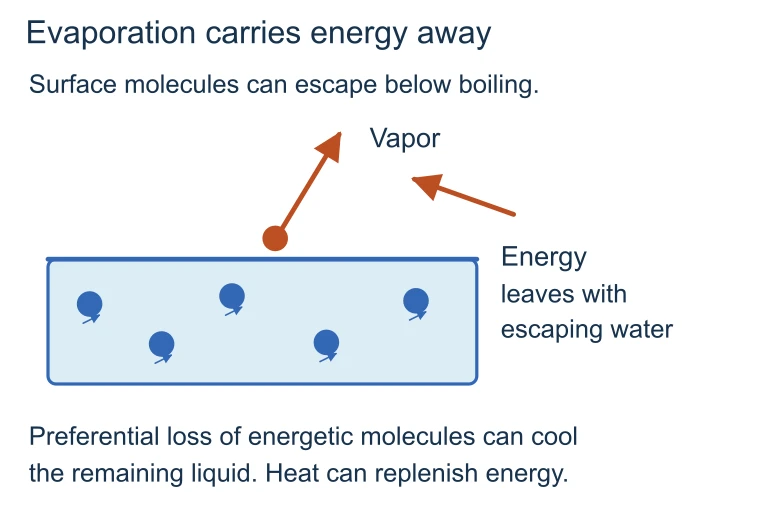
Evaporation carries energy away. Water can evaporate below its boiling point. Escaping molecules carry energy away and can cool the remaining liquid; sensible heating instead follows Q = mcΔT.Water can evaporate below its boiling point. Escaping molecules carry energy away and can cool the remaining liquid; sensible heating instead follows Q = mcΔT.

Heating and evaporation are different
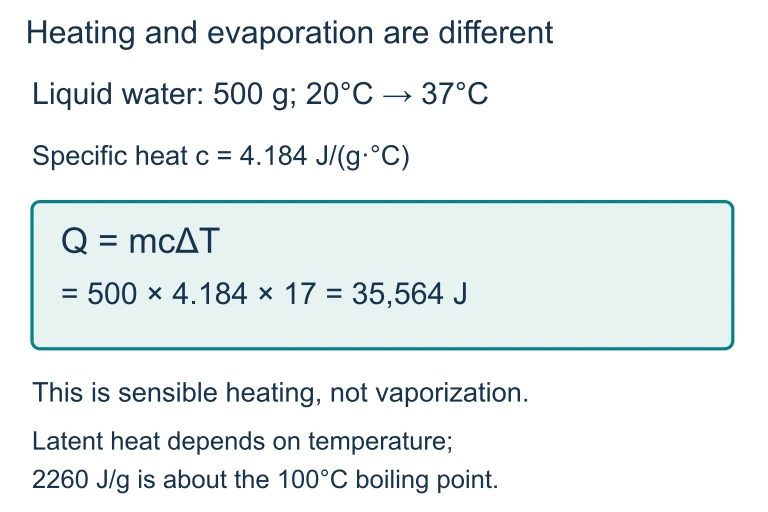
Heating and evaporation are different. Heating 500 g of liquid water from 20 °C to 37 °C requires 35,564 J using c = 4.184 J/(g·°C). Vaporization uses a temperature-dependent latent heat instead.Heating 500 g of liquid water from 20 °C to 37 °C requires 35,564 J using c = 4.184 J/(g·°C). Vaporization uses a temperature-dependent latent heat instead.
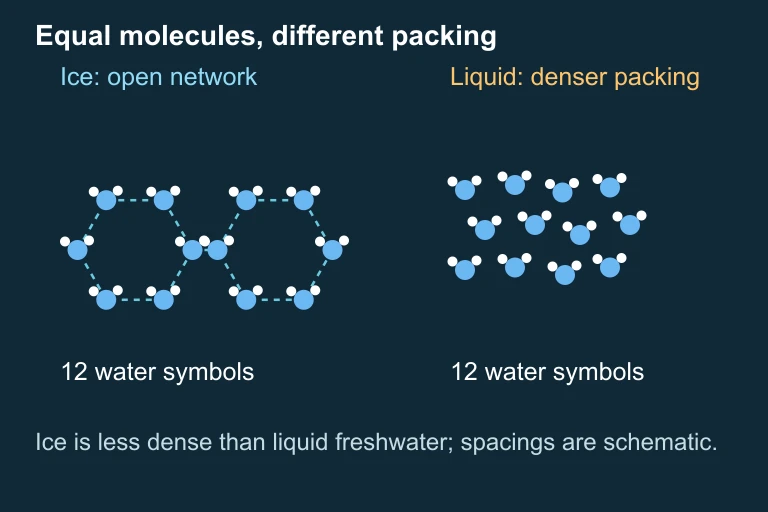
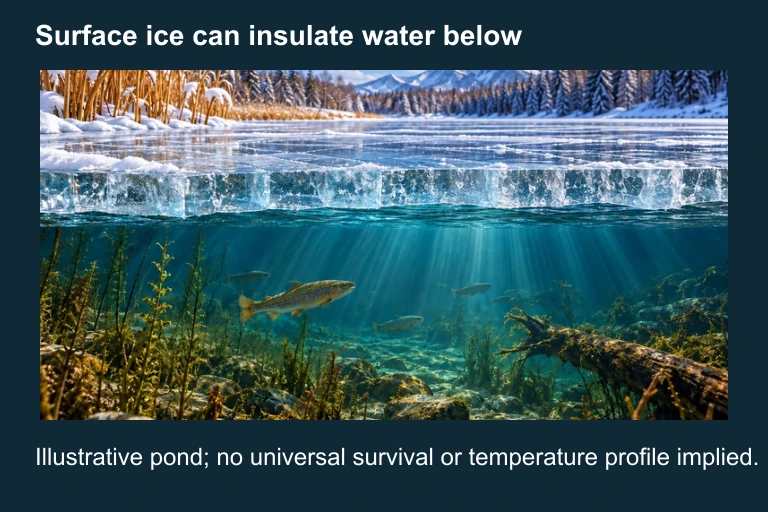
Ice Floats: The Density Anomaly

Liquid Water Close, moving freely Ice (Solid) Spaced apart, locked lattice
Equal counts of twelve water symbols compare open ice packing with more compact liquid packing. A separate pond scene shows surface ice above liquid water.
Ordinary freshwater ice is less dense than liquid water and can float above an insulated liquid habitat. Equal-count molecular symbols compare an explicitly projected open network with less ordered liquid packing; they do not provide calibrated volumes or a universal pond temperature profile.
Illustrative pond context.

Open ice lattice and transient liquid network explain density
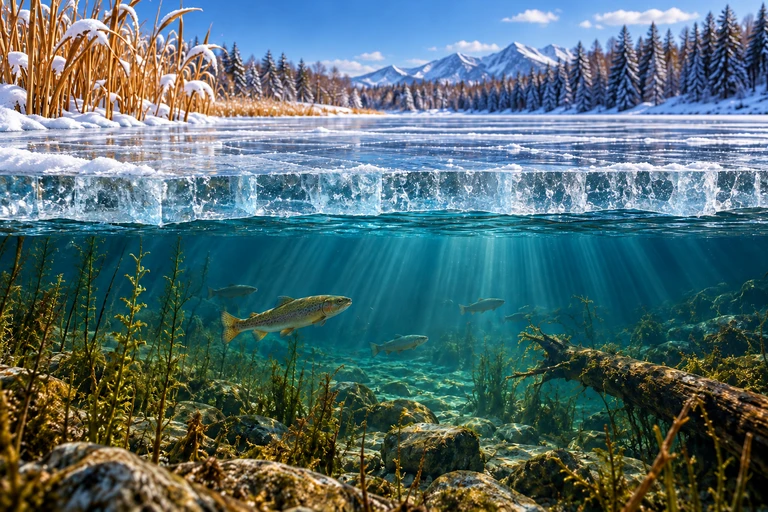
Surface ice floats above liquid lake water containing fish and aquatic plants.Near 0 °C and 1 atm, 18 g of ordinary ice Ih occupies about 19.63 mL, compared with 18.00 mL for liquid water. The more open ice structure produces about 9% greater volume at equal mass.

Equal water mass, different volume
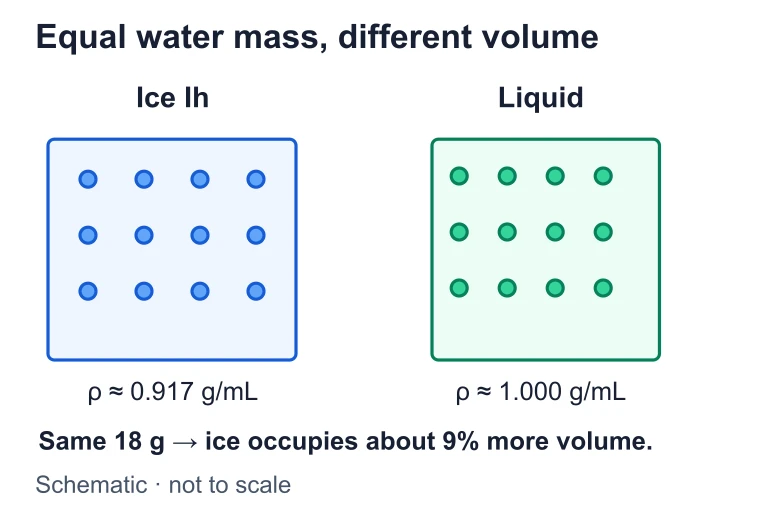
Equal water mass, different volume. Near 0 °C and 1 atm, 18 g of ordinary ice Ih occupies about 19.63 mL, compared with 18.00 mL for liquid water. The more open ice structure produces about 9% greater volume at equal mass.Near 0 °C and 1 atm, 18 g of ordinary ice Ih occupies about 19.63 mL, compared with 18.00 mL for liquid water. The more open ice structure produces about 9% greater volume at equal mass.
Water: The Universal Solvent

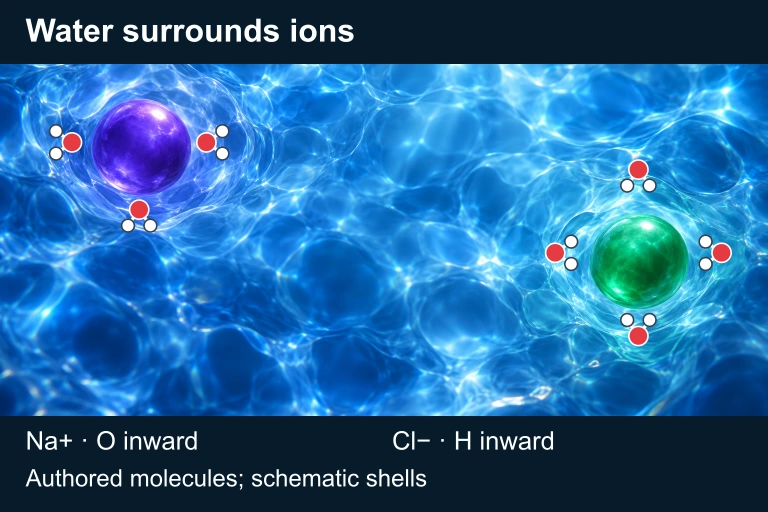
\( \mathrm{Na}^+ \) O O O O \( \delta^- \) oxygens face cation \( \mathrm{Cl}^- \) H H H H \( \delta^+ \) hydrogens face anion

Hydrophilic vs Hydrophobic

Hydrophilic
"Water-loving": polar or charged molecules that dissolve readily in water. Examples: sugars, salts, amino acids with polar R-groups.
Hydrophobic
"Water-fearing": nonpolar molecules that are excluded from water. Examples: fats, oils, hydrocarbon chains in cell membranes.

pH and Water Dissociation

Water molecules can spontaneously dissociate into ions:

1
Acidic solutions have \( [\mathrm{H}^+] > 10^{-7}\;\mathrm{M} \) and \( \mathrm{pH} < 7 \).
2
Basic solutions have \( [\mathrm{OH}^-] > 10^{-7}\;\mathrm{M} \) and \( \mathrm{pH} > 7 \).
3
Buffers resist pH changes by absorbing excess \( \mathrm{H}^+ \) or \( \mathrm{OH}^- \), critical for maintaining homeostasis.

Identifying H-Bond Donors & Acceptors

1
Find electronegative atoms (O, N, F) bonded to hydrogen. The H attached to these atoms can donate an H-bond.
2
Identify lone pairs on electronegative atoms (O, N, F). These lone pairs accept H-bonds from nearby \( \delta^+ \) hydrogens.
3
Check directionality: H-bonds are strongest when the donor−H···acceptor atoms are roughly linear (\( 180^\circ \)).
4
Count maximum H-bonds: Each water molecule can form up to 4 hydrogen bonds (2 donated via H atoms, 2 accepted via lone pairs on O).

Example: H-Bonds in DNA Base Pairing

Adenine (A) N−H donor N acceptor Thymine (T) C=O acceptor N−H donor H-bond H-bond A−T: 2 hydrogen bonds

Example: Why Does NaCl Dissolve but Oil Does Not?

1
NaCl is ionic. Water's polar molecules surround \( \mathrm{Na}^+ \) and \( \mathrm{Cl}^- \) ions, forming hydration shells. The energy of ion-dipole interactions overcomes the lattice energy.
2
Oil is nonpolar. Oil molecules cannot form hydrogen bonds or ion-dipole interactions with water. Water molecules prefer bonding to each other, excluding the oil.
3
"Like dissolves like": Polar solvents dissolve polar/ionic solutes. Nonpolar solvents dissolve nonpolar solutes.
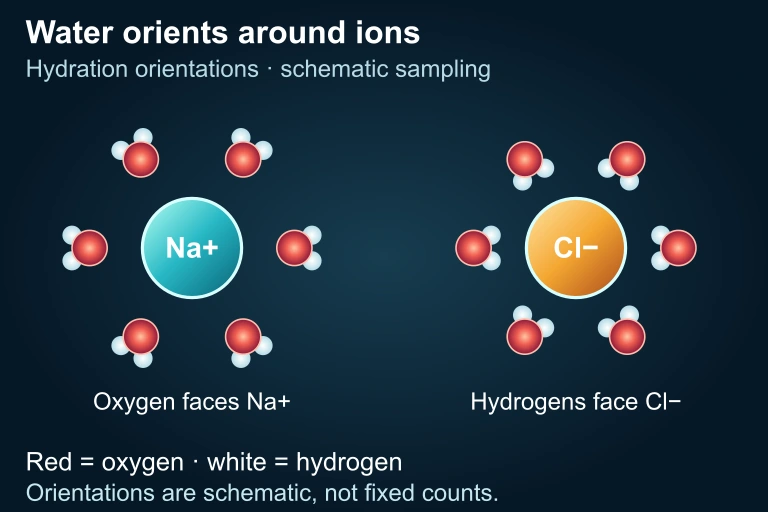
Authored ion hydration orientations
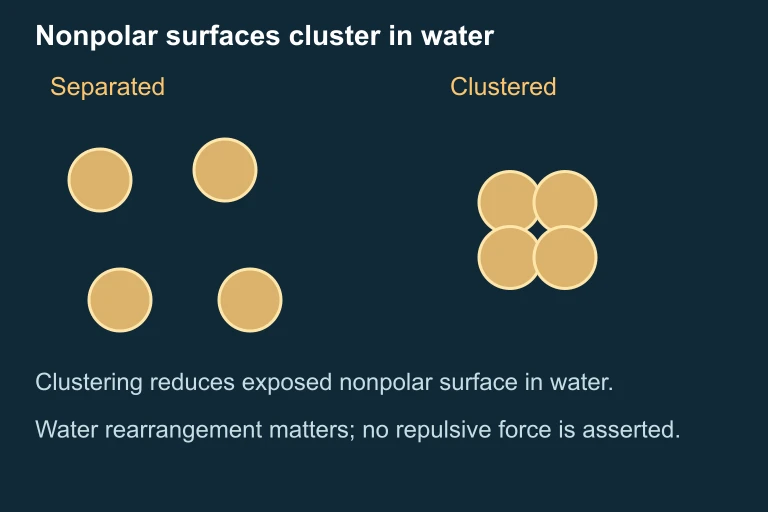
Water orientation around ions is schematic, not a fixed hydration-number claim. The nonpolar companion shows four separated schematic objects and the same four objects clustered, reducing exposed nonpolar surface. This illustrates the hydrophobic effect, not a special repulsive bond.
Four separate schematic nonpolar objects become the same four objects clustered, with less exposed nonpolar surface.
Water orientation around ions is schematic, not a fixed hydration-number claim. The nonpolar companion shows four separated schematic objects and the same four objects clustered, reducing exposed nonpolar surface. This illustrates the hydrophobic effect, not a special repulsive bond.
Schematic water orientations around Na+ and Cl−: oxygen ends face sodium and hydrogen ends face chloride. A separate panel illustrates nonpolar aggregation and reduced water-contact surface.
Water orientation around ions is schematic, not a fixed hydration-number claim. The nonpolar companion shows four separated schematic objects and the same four objects clustered, reducing exposed nonpolar surface. This illustrates the hydrophobic effect, not a special repulsive bond.

Common Mistakes

✕ H-bonds are covalent
Hydrogen bonds are intermolecular attractions, NOT covalent bonds. The O−H bond inside the molecule is covalent.
✕ Any H can H-bond
Only H atoms bonded to O, N, or F are \( \delta^+ \) enough to participate in hydrogen bonding. C−H bonds are too nonpolar.
✕ Ice sinks
Ice is less dense than liquid water because the crystalline lattice spaces molecules apart. Ice floats, not sinks.

Summary: Properties of Water

Property Cause Biological Significance
Cohesion H-bonds between water molecules Surface tension, water transport in plants
Adhesion H-bonds to polar surfaces Capillary action in xylem
High Specific Heat Energy absorbed by breaking H-bonds Temperature buffering in organisms
Ice Density Crystalline H-bond lattice Ice insulates aquatic ecosystems
Solvent Properties Polarity and H-bonding Dissolves ions and polar molecules
Evaporative Cooling Fast molecules escape as vapor Sweating, transpiration cool organisms

Question 1 of 5

What causes water to be a polar molecule?

Question 2 of 5

How many hydrogen bonds can a single water molecule form at most?

Question 3 of 5

Why does ice float on liquid water?

Question 4 of 5

A student adds NaCl to water and it dissolves. Which description best explains the molecular interactions?

Question 5 of 5

Water has a high specific heat because: