Speciation
The Origin of New Species
Explore how populations diverge to form new species through geographic isolation, reproductive barriers, and natural selection.
What Is a Species?
Before we can understand how new species form, we need to define what a species actually is. The most widely used definition in biology is the Biological Species Concept.
This concept was articulated by Ernst Mayr and emphasizes reproductive isolation as the key criterion separating one species from another.
What Is Speciation?
Speciation is the evolutionary process by which populations evolve to become distinct species. It is the mechanism responsible for the incredible biodiversity of life on Earth.
Why Does Speciation Matter?
Two Main Modes of Speciation
Allopatric Speciation
Allopatric speciation (from Greek allos = "other" + patra = "homeland") occurs when a population is geographically divided. Each subpopulation then evolves independently.
Sympatric Speciation
Sympatric speciation (from Greek sym = "together") occurs without geographic separation. It is driven by factors that reduce gene flow within a single population.
Reproductive Barriers
Reproductive isolation is maintained by prezygotic and postzygotic barriers. These barriers prevent gene flow between species.
Allopatric vs Sympatric
| Allopatric | Sympatric | |
|---|---|---|
| Geographic separation | Yes: physical barrier | No: same area |
| Primary mechanism | Natural selection + drift | Polyploidy, niche shifts |
| Prevalence | Most common mode | Less common; plants > animals |
| Gene flow disrupted by | Physical barrier | Behavioral or genetic change |
| Classic example | Darwin's finches | Apple maggot fly |
| Speed | Typically gradual | Can be rapid (polyploidy) |
Geographic context changes gene-flow opportunities
 Geographic barriers, shared habitat and adjacent ranges create different opportunities for gene flow. Reproductive isolation must be tested separately from geographic separation.
Geography changes gene flow
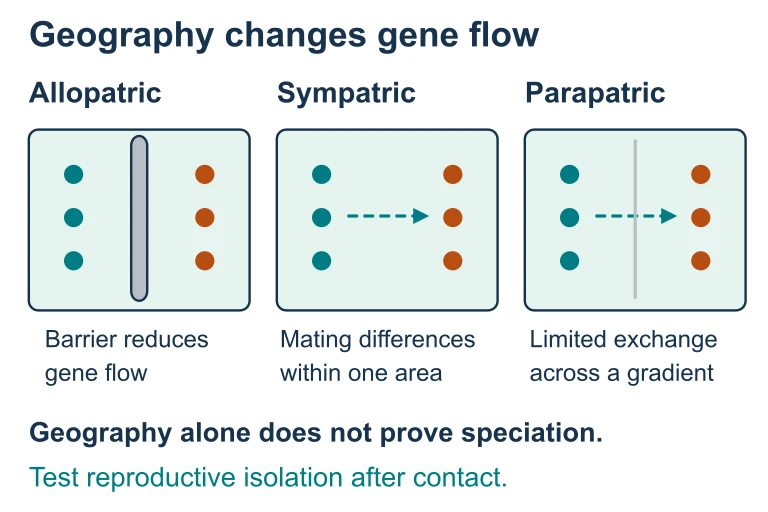 Geographic barriers, shared habitat and adjacent ranges create different opportunities for gene flow. Reproductive isolation must be tested separately from geographic separation.
Hybrid Zones and Reinforcement
When partially diverged populations come back into contact, a hybrid zone may form. Three outcomes are possible:
How to Identify the Type
Example: Darwin's Finches
Example: Apple Maggot Fly
The apple maggot fly (Rhagoletis pomonella) is a classic case of sympatric speciation in progress in North America.
Example: Polyploidy in Plants
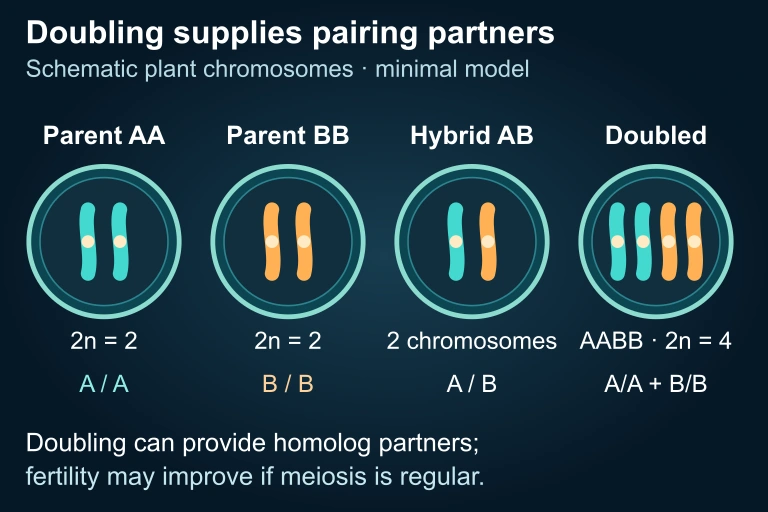
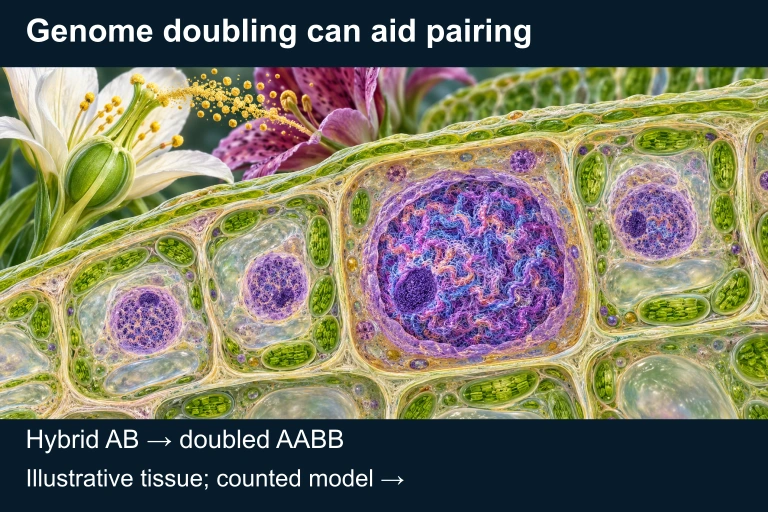
Rates of Speciation
Common Mistakes
Question 1 of 5
A river forms and divides a population of lizards into two groups. Over thousands of years, the groups evolve different body sizes and mating calls. What type of speciation is this?
Question 2 of 5
A plant species undergoes an error in meiosis, producing offspring with four sets of chromosomes (\(4n\)) instead of two (\(2n\)). These \(4n\) offspring can reproduce with each other but not with \(2n\) plants. This is an example of:
Question 3 of 5
Two closely related bird species live in the same forest. Species A feeds in the canopy and sings at dawn, while Species B feeds on the ground and sings at dusk. They do not interbreed. Which prezygotic barriers are maintaining their reproductive isolation?
Question 4 of 5
A horse and a donkey can mate to produce a mule, but mules are sterile. What type of reproductive barrier does this represent?
Question 5 of 5
Two partially diverged populations of frogs come back into contact. Hybrids between them have lower survival rates than non-hybrids. Over time, the frogs evolve stronger mating call preferences, reducing interbreeding. This process is called: