Explore how organisms detect, process, and respond to changes in their surroundings: from signal transduction to behavioral adaptations.
AP Biology
What Are Environmental Responses?
All living organisms must constantly monitor and respond to changes in their environment to maintain homeostasis and survive. These responses range from molecular-level signal transduction events to complex behavioral changes involving entire organisms.
Stimulus
A detectable change in the internal or external environment
Receptor
A protein or cell that detects the stimulus signal
Response
The action or change the organism makes in reaction
The Signal Transduction Pathway
Signal transduction converts an extracellular signal into an intracellular response through a three-step process. This is the universal mechanism cells use to respond to their environment.
Levels of Organismal Response
Organisms respond at multiple scales: from molecular events inside single cells to physiological changes involving organ systems, to behavioral responses of the whole organism.
Physiological: Organ-level adjustments like increased heart rate, hormone secretion, or immune activation.
3
Behavioral: Whole-organism actions such as migration, hibernation, tropisms, or fight-or-flight responses.
Feedback Loops Maintain Homeostasis
Feedback mechanisms are the core regulatory strategy organisms use to maintain stable internal conditions despite environmental fluctuations.
Taxis vs. Kinesis
Both are movement responses to stimuli, but they differ fundamentally in directionality. This distinction appears frequently on the AP exam.
Taxis
Directed movement toward or away from a stimulus. Movement is biased toward or away from a stimulus; organisms may use spatial or temporal sensing.
Kinesis
Undirected change in movement rate or turning frequency. Speed or randomness changes, but not direction.
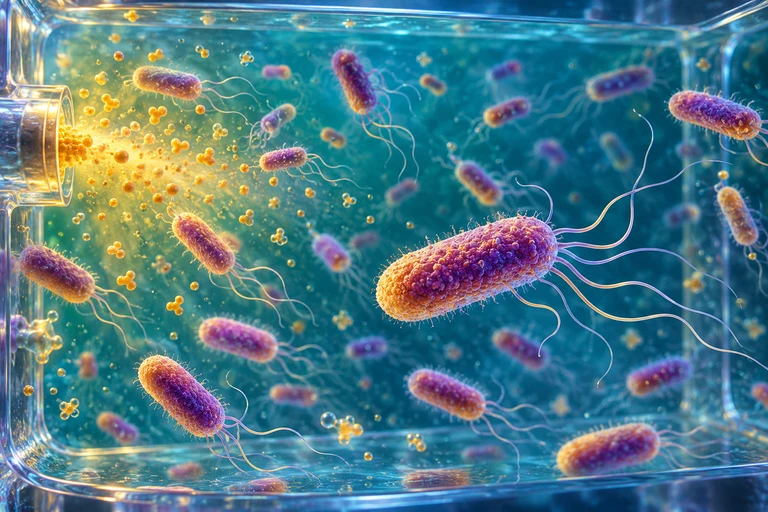
Bacteria explore a chemical landscape by biased runs
E. coli biases its run-and-tumble movement through temporal sensing. A favorable change reduces CheY phosphorylation and tumbling probability; tumbles reorient cells rather than steering them directly toward food.
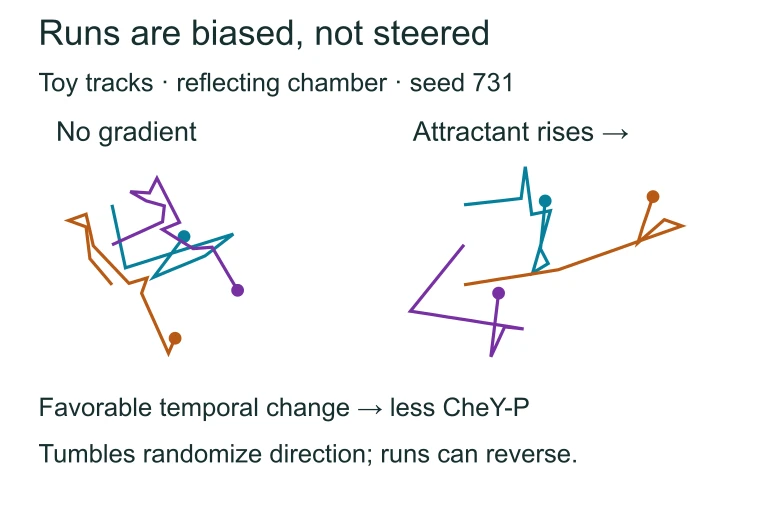
Runs are biased, not steered
E. coli biases its run-and-tumble movement through temporal sensing. A favorable change reduces CheY phosphorylation and tumbling probability; tumbles reorient cells rather than steering them directly toward food.
Plant Tropisms and Hormones
Plants respond to environmental stimuli through tropisms: directional growth responses mediated by plant hormones, especially auxin.
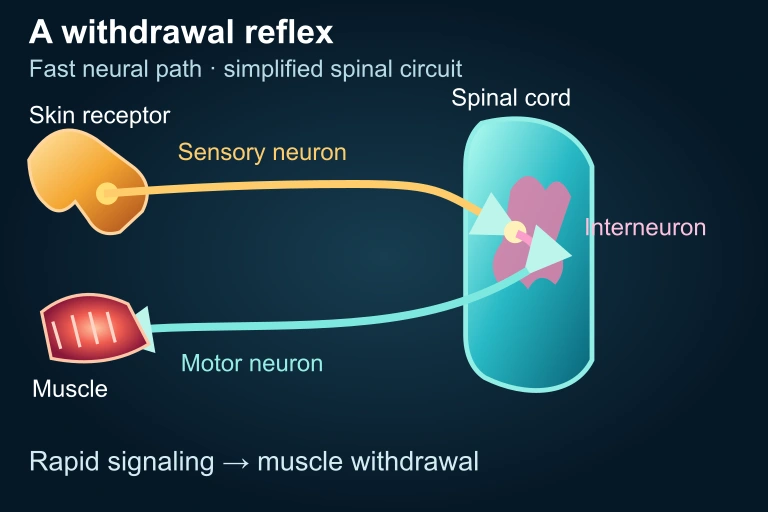
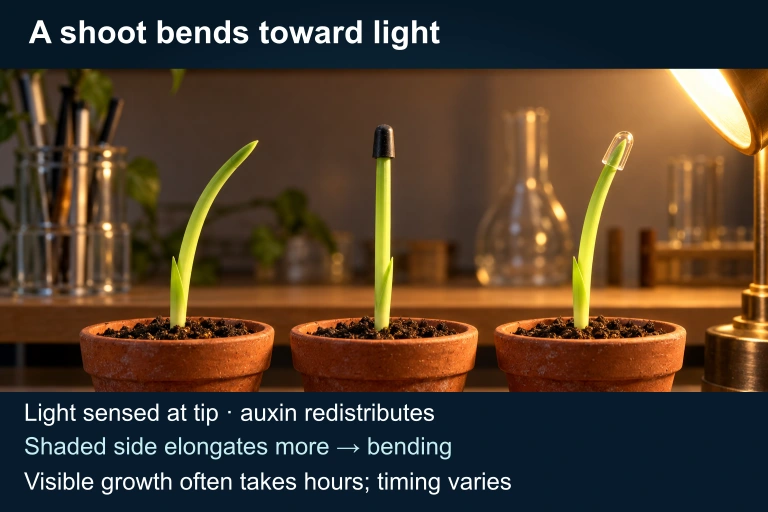
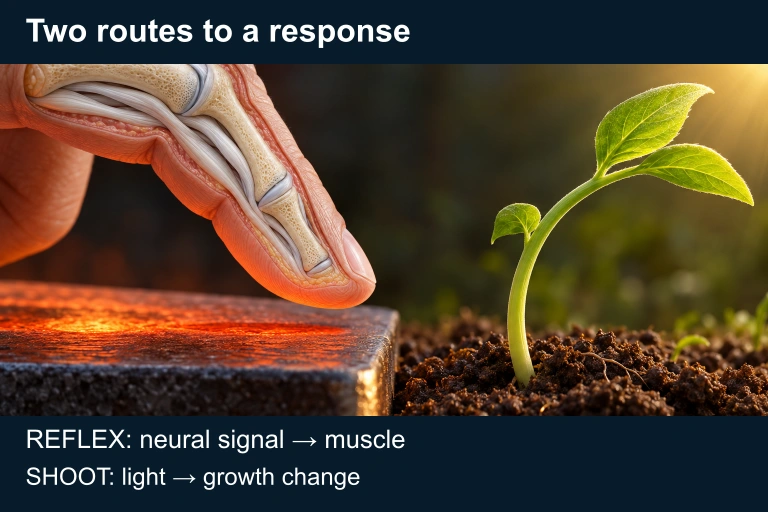
Spinal withdrawal reflex pathwayShoot phototropismRelative cell elongationA reflex uses neural signaling and muscle action; coleoptile phototropism uses signaling that changes growth. Illustration is schematic where scale or molecular structure is simplified.
ABA closes stomata by changing guard-cell solutes and turgor
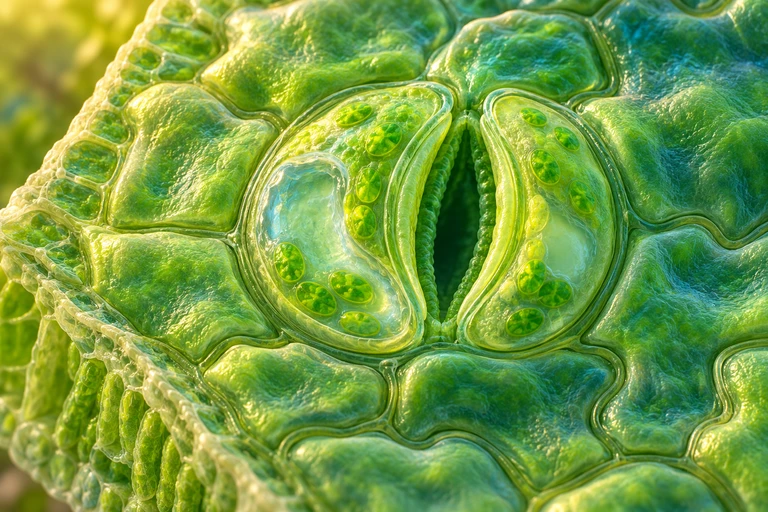
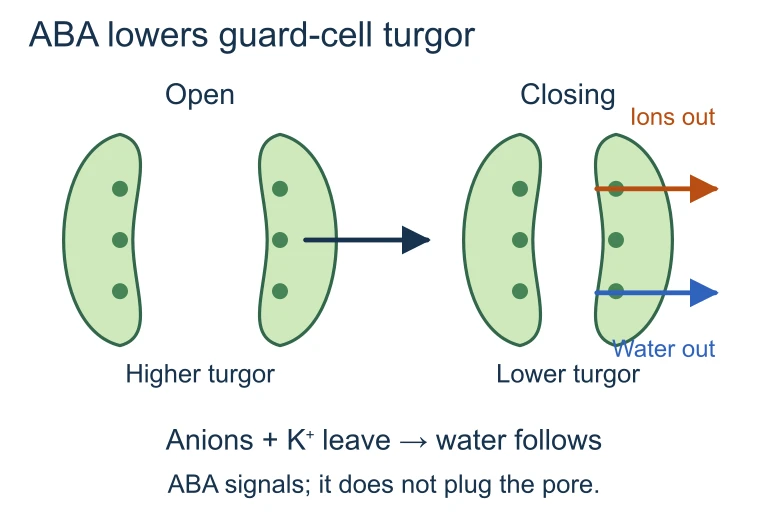
ABA signaling promotes anion and potassium efflux from guard cells. Water follows osmotically, turgor falls and the stomatal pore narrows.
ABA lowers guard-cell turgor
ABA signaling promotes anion and potassium efflux from guard cells. Water follows osmotically, turgor falls and the stomatal pore narrows.
Innate vs. Learned Behavior
Innate Behavior
Learned Behavior
Genetic basis
Hardwired, genetically programmed
Modified by experience
Variation
Identical across species members
Differs among individuals
Examples
Fixed action patterns, reflexes
Imprinting, conditioning, habituation
Flexibility
Cannot be modified
Can change over time
AP example
Egg-rolling in geese
Bird song learning
How to Analyze a Response
When the AP exam presents a scenario involving an organism responding to its environment, follow this systematic approach:
1
Identify the stimulus: What environmental change triggers the response? (Light, temperature, chemical, predator, etc.)
2
Determine the receptor: What detects the stimulus? (Receptor protein, sensory neuron, photoreceptor cell, etc.)
3
Trace the signaling pathway: How is the signal transduced? Look for second messengers, phosphorylation cascades, or hormonal pathways.
4
Identify the effector and response: What changes? Gene expression, enzyme activity, behavior, or growth pattern?
5
Classify the feedback: Does the response reverse the stimulus (negative) or amplify it (positive)?
Example 1: Thermoregulation
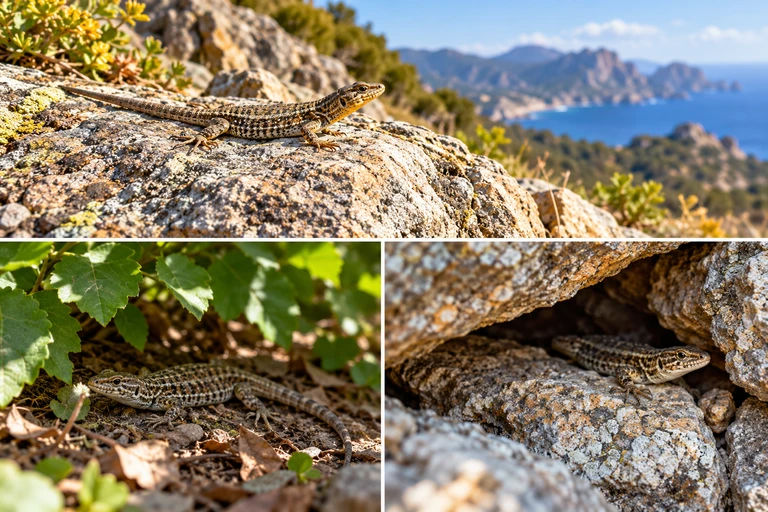
Shade and sun alter body temperature without changing heat source
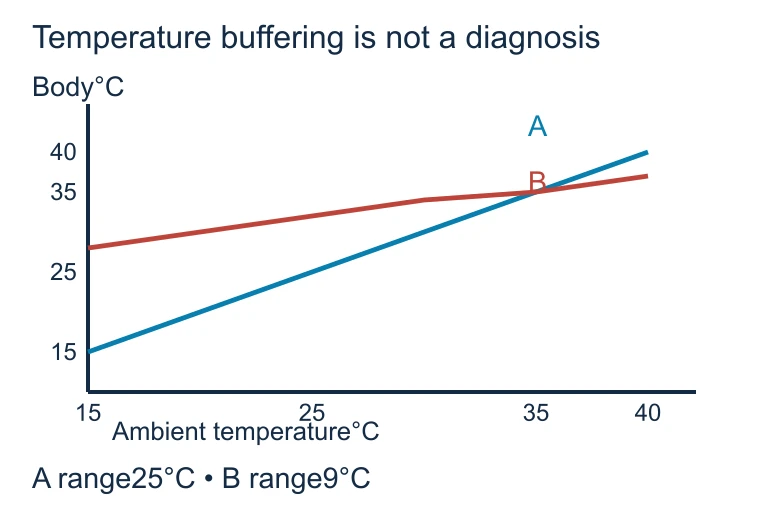
Behavioral use of sun, shade or shelter can buffer body temperature. The two series span 25 °C and 9 °C, but temperature range alone does not identify the source of metabolic heat.
Temperature buffering is not a diagnosis
Behavioral use of sun, shade or shelter can buffer body temperature. The two series span 25 °C and 9 °C, but temperature range alone does not identify the source of metabolic heat.
Example 2: Auxin and Cell Elongation
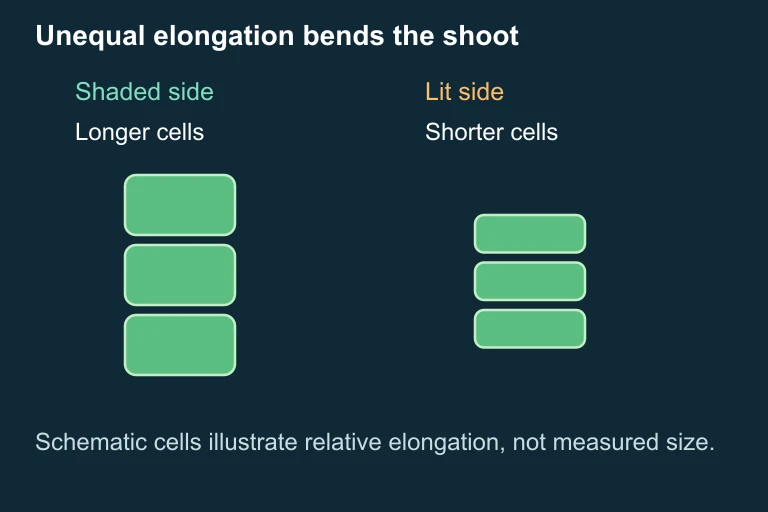
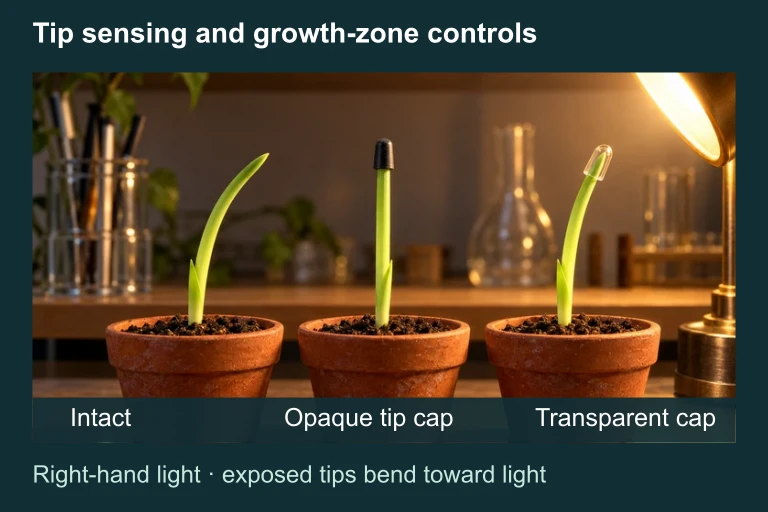
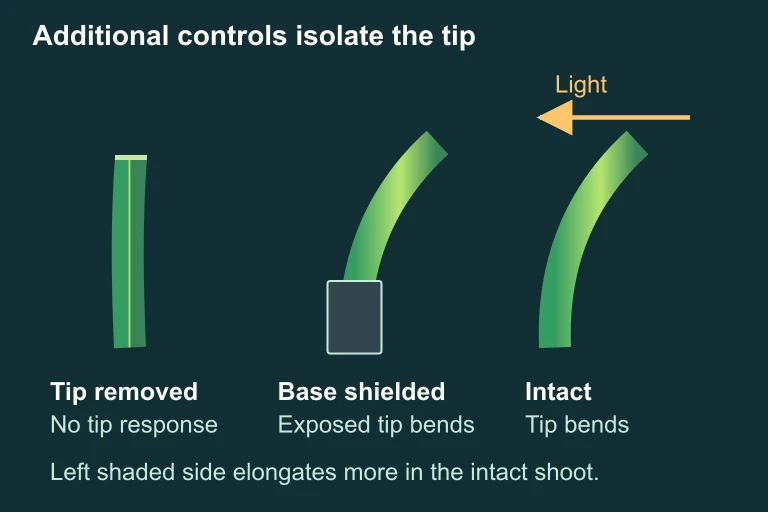
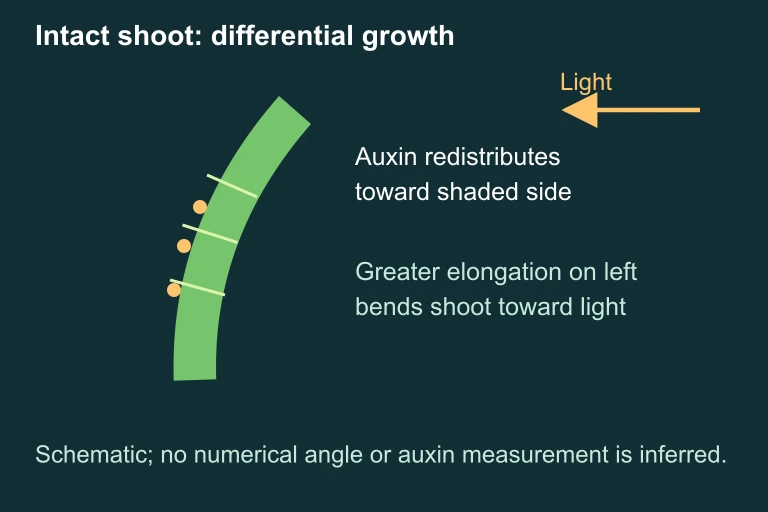
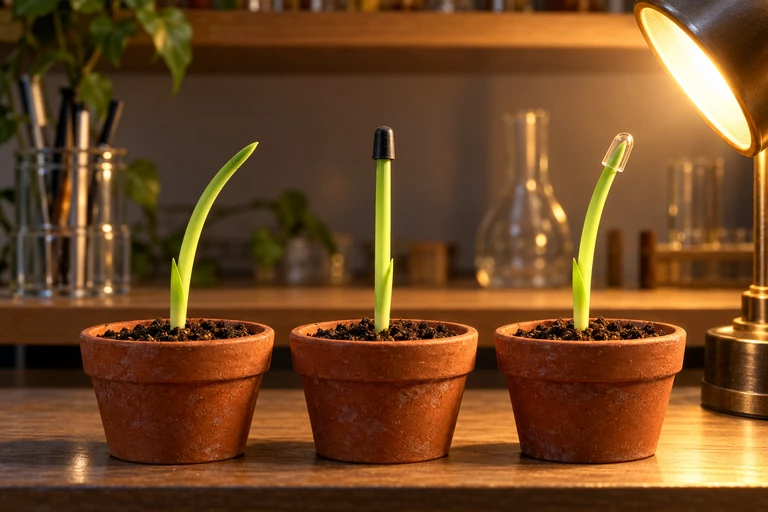
Illuminated tip-cap controls separate light sensing at the tip from growth lower in a coleoptile. The additional controls keep the exposed tip separate from a shielded base or removed tip. In the selected intact shoot, auxin redistribution supports greater elongation on the shaded left side, bending toward right-hand light; no numerical bending angle is inferred.Additional tip-removed and base-shielded controls.Intact shoot: differential elongation.
Spatially separated light reception and growth cause phototropism
Unilateral light received near a shoot tip promotes auxin redistribution toward the shaded side. Greater elongation there bends the shoot toward the light.
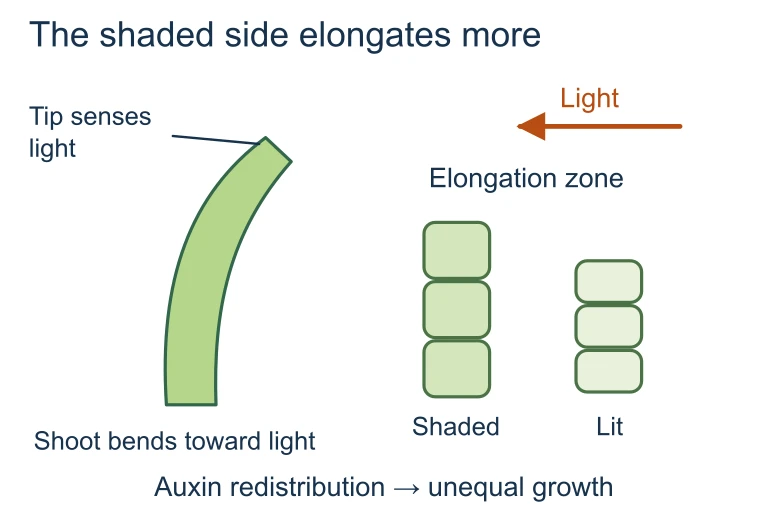
The shaded side elongates more
Unilateral light received near a shoot tip promotes auxin redistribution toward the shaded side. Greater elongation there bends the shoot toward the light.
Example 3: Immune Response Cascade
Photoperiodism and Biological Clocks
Many organisms use day length (photoperiod) as an environmental cue to time seasonal activities. This is controlled by an internal circadian rhythm synchronized to the light-dark cycle.
Short-day plants
Flower when nights are long (e.g., chrysanthemums, poinsettias). Actually respond to long uninterrupted dark periods.
Long-day plants
Flower when nights are short (e.g., spinach, lettuce). Require short dark periods to initiate flowering.
Communication Between Organisms
Organisms also respond to signals from other organisms. These communication methods are key examples of environmental responses in ecology.
Pheromones
Chemical signals released into the environment that affect behavior of the same species (e.g., ant trails, moth mating)
Quorum sensing
Bacteria detect population density via signaling molecules, triggering group behaviors like biofilm formation
Symbiotic signals
Cross-species molecular dialogue, such as Rhizobium bacteria and legume root nodule formation
Common Mistakes to Avoid
✕ Confusing taxis and kinesis
Taxis is directional (toward/away). Kinesis is a change in rate or turning frequency without direction. If the organism "aims" at the stimulus, it is taxis.
✕ 'Positive' Means 'Beneficial'
"Positive" does not mean beneficial. Positive feedback amplifies the stimulus. It can be dangerous (e.g., fever spiraling) or functional (e.g., blood clotting).
✕ Plants measure day length
Plants measure dark period length, not light. A brief flash of light during the dark period can reset the phytochrome and prevent flowering.
Summary: Types of Responses
Response Type
Mechanism
Example
Organism
Taxis
Directed movement
Swim toward light
Euglena
Kinesis
Change in speed/turning
Move faster in dry areas
Woodlice
Tropism
Directional growth
Stem bends toward light
Plants
Negative feedback
Opposes stimulus
Thermoregulation
Mammals
Positive feedback
Amplifies stimulus
Oxytocin in labor
Mammals
Immune response
Recognition + defense
Antibody production
Vertebrates
Question 1 of 5
A woodlouse placed in a dry environment moves rapidly in random directions. When it reaches a moist area, its movement slows significantly. This behavior is best described as:
The woodlouse changes its rate of movement (fast in dry, slow in moist) without directional orientation toward the stimulus. This undirected change in activity level defines kinesis, not taxis (which requires directional movement).
Question 2 of 5
During thermoregulation, the hypothalamus detects a rise in blood temperature and triggers sweating and vasodilation. This is an example of:
The response (sweating, vasodilation) acts to lower the elevated body temperature, opposing the original stimulus. This is the hallmark of negative feedback: the effector reverses the deviation from the set point.
Question 3 of 5
A researcher exposes a growing plant to unilateral light. The stem bends toward the light. Which statement best explains this response?
Light causes lateral redistribution of auxin from the illuminated side to the shaded side. Higher auxin concentration on the shaded side promotes greater cell elongation there, bending the stem toward the light. Auxin is not destroyed; it is redistributed.
Question 4 of 5
A chrysanthemum (short-day plant) is exposed to 10 hours of light and 14 hours of darkness. A brief flash of red light is given in the middle of the dark period. What is the most likely result?
Short-day plants require a continuous dark period exceeding a critical length. A flash of red light converts phytochrome Pr to Pfr, effectively "resetting" the dark-period timer. The interrupted dark period is now perceived as two short dark periods, and the plant fails to flower.
Question 5 of 5
In quorum sensing, bacteria release and detect signaling molecules called autoinducers. When the concentration of autoinducers reaches a threshold, bacteria collectively change gene expression. This is most analogous to which process in multicellular organisms?
Quorum sensing involves signaling molecules that diffuse locally and are detected by neighboring cells of the same population. This is most analogous to paracrine signaling, where signals act on nearby cells. It differs from endocrine (long-distance), synaptic (requires synapse), and autocrine (self-only).
 E. coli biases its run-and-tumble movement through temporal sensing. A favorable change reduces CheY phosphorylation and tumbling probability; tumbles reorient cells rather than steering them directly toward food.
 E. coli biases its run-and-tumble movement through temporal sensing. A favorable change reduces CheY phosphorylation and tumbling probability; tumbles reorient cells rather than steering them directly toward food.
 ABA signaling promotes anion and potassium efflux from guard cells. Water follows osmotically, turgor falls and the stomatal pore narrows.
 ABA signaling promotes anion and potassium efflux from guard cells. Water follows osmotically, turgor falls and the stomatal pore narrows.
 Behavioral use of sun, shade or shelter can buffer body temperature. The two series span 25 °C and 9 °C, but temperature range alone does not identify the source of metabolic heat.
 Behavioral use of sun, shade or shelter can buffer body temperature. The two series span 25 °C and 9 °C, but temperature range alone does not identify the source of metabolic heat.
 Unilateral light received near a shoot tip promotes auxin redistribution toward the shaded side. Greater elongation there bends the shoot toward the light.
 Unilateral light received near a shoot tip promotes auxin redistribution toward the shaded side. Greater elongation there bends the shoot toward the light.