01 / 23

Regulation of
Gene Transcription

Learn how cells control when, where, and how much of a gene's mRNA is produced: from promoters and transcription factors to operons and epigenetics.

AP Biology

What Is Gene Regulation?

Every cell in your body carries the same DNA, yet a neuron looks and functions completely differently from a muscle cell. The difference lies in which genes are expressed and which are silenced. Gene regulation refers to the mechanisms that control the rate of transcription of DNA into mRNA.

Core Vocabulary

Promoter
A DNA sequence upstream of a gene where RNA polymerase binds to begin transcription.
Transcription Factor
A protein that binds DNA to activate or repress transcription of a target gene.
Enhancer
A distant DNA element that increases transcription when bound by activator proteins.
Silencer
A distant DNA element that decreases transcription when bound by repressor proteins.

Levels of Regulation

Epigenetic / Chromatin Transcriptional Post-transcriptional Translational Post-translational DNA methylation, histone mod. TFs, enhancers, operons mRNA splicing, stability, miRNA Initiation factors, ribosome ctrl Ubiquitination, phosphorylation THIS LESSON

The Promoter and RNA Polymerase

Promoter Gene (coding region) TATA box RNA Polymerase +1 (TSS) Upstream Downstream Transcription direction

Transcription Factors: Activators and Repressors

Activators
Bind to enhancer elements and increase the rate of transcription by helping recruit RNA polymerase to the promoter via the Mediator complex.
Repressors
Bind to silencer elements or the operator (prokaryotes) and decrease transcription by blocking RNA polymerase or preventing activator binding.

Prokaryotic Regulation: The Operon Model

Reg. Gene Promoter Operator Gene A Gene B Gene C Repressor Operon Polycistronic mRNA

The lac Operon: Inducible System

1
No lactose present: The lac repressor binds the operator and blocks transcription of lactose-digesting enzymes.
2
Lactose present: Allolactose (a lactose isomer) binds the repressor, changing its shape so it falls off the operator.
3
Transcription proceeds: RNA polymerase can now move through the operator and transcribe lacZ, lacY, and lacA.
4
Bonus control: High glucose lowers cAMP, reducing CAP activation: even with lactose, transcription remains low (catabolite repression).

The trp Operon: Repressible System

1
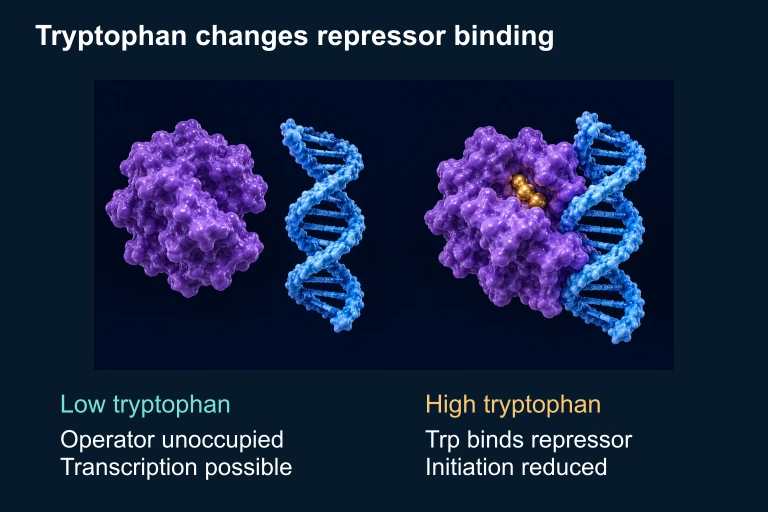
Low tryptophan: The repressor is inactive (cannot bind operator). Transcription is ON: the cell synthesizes tryptophan.
2
High tryptophan: Tryptophan acts as a corepressor, binding the repressor and activating it.
3
Repressor binds operator: RNA polymerase is blocked. Transcription is OFF: no more tryptophan enzymes are made.
Two schematics compare low tryptophan with an unbound repressor and high tryptophan with a corepressor-bound repressor occupying the operator.
Tryptophan acts as a corepressor, promoting repressor binding to the operator and reducing transcription. Illustration is schematic where scale or molecular structure is simplified.

Inducible vs. Repressible

lac (Inducible) trp (Repressible)
Default state OFF ON
Inducer / Corepressor Allolactose (inducer) Tryptophan (corepressor)
Effect of small molecule Inactivates repressor Activates repressor
Pathway type Catabolic (breaks down) Anabolic (builds up)
Regulation type Negative (repressor-based) Negative (repressor-based)

Eukaryotic Transcription Regulation

Eukaryotes face a greater regulatory challenge than prokaryotes: their DNA is wrapped around histones in nucleosomes, and genes may be regulated by elements thousands of base pairs away. Multiple mechanisms work in concert.

Chromatin Remodeling
Histone acetylation loosens chromatin (euchromatin), enabling transcription. Deacetylation condenses it (heterochromatin).
DNA Methylation
Adding methyl groups to cytosines silences genes. Heavily methylated promoters cannot bind transcription factors.
Enhancers / Silencers
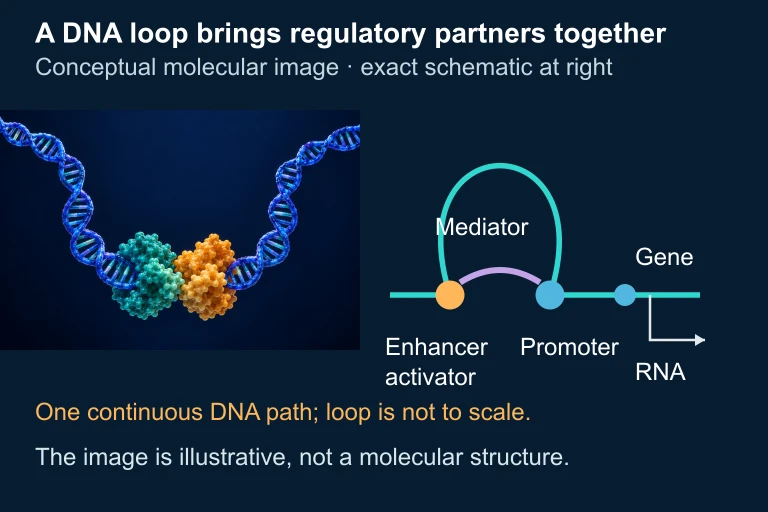
Distant regulatory elements bound by activators or repressors that loop to contact the promoter via Mediator.

Chromatin: Open vs. Closed

Heterochromatin (Condensed: Gene OFF) H H H H H M M Methylated + Deacetylated Euchromatin (Relaxed: Gene ON) H H H Ac Ac Ac RNA Pol mRNA Acetylated + Unmethylated = Methyl group = Acetyl group H = Histone

Enhancers and DNA Looping

Enhancer Promoter Gene Thousands of bp apart DNA Loop Activator Mediator RNA Pol II Transcription Activated
A conceptual molecular illustration is paired with an authored diagram in which one continuous DNA strand loops to bring an enhancer-bound activator near promoter machinery via a mediator bridge. RNA output is downstream.
DNA looping can bring an enhancer-bound activator near the promoter machinery without removing intervening DNA. Illustration is schematic where scale or molecular structure is simplified.

How to Analyze Gene Regulation

1
Identify the organism: Is it prokaryotic (operon model) or eukaryotic (chromatin + enhancers)?
2
Determine the default state: Is the gene normally ON (repressible) or OFF (inducible)?
3
Identify the regulatory molecule: What small molecule (inducer, corepressor, hormone) triggers the change?
4
Trace the signal: Does the molecule activate or deactivate a transcription factor or repressor?
5
Predict the outcome: Will transcription increase, decrease, or remain unchanged?

Example 1: lac Operon Scenario

1
Lactose present: Allolactose inactivates the repressor, so the operator is free.
2
Glucose also present: Glucose keeps cAMP levels low.
3
Low cAMP: CAP cannot bind the promoter, so RNA polymerase binds weakly.
4
Result: Transcription occurs at a very low level. The cell preferentially uses glucose first.

Example 2: Eukaryotic Gene Silencing

DNA Methylation
The promoter of Gene X may be heavily methylated in skin cells, preventing transcription factor binding.
Histone Deacetylation
Histones near Gene X in skin cells may be deacetylated, creating condensed heterochromatin.
Tissue-specific TFs
Liver cells may produce specific activator proteins that are absent in skin cells.

Common Mistakes

✕ Confusing Operator and Promoter
The promoter is where RNA polymerase binds. The operator is where the repressor binds. They are adjacent but distinct.
✕ Mixing Up Inducible and Repressible
Inducible operons are normally OFF (like lac). Repressible operons are normally ON (like trp). Do not reverse them.
✕ Thinking Methylation Activates Genes
DNA methylation generally silences genes. Acetylation of histones activates genes. Students often swap these.

Summary: Regulatory Mechanisms

Mechanism Where Effect Example
Operon (repressor) Operator Blocks transcription lac, trp
CAP activation Promoter Enhances RNAP binding lac + low glucose
Histone acetylation Chromatin Opens DNA access Euchromatin
DNA methylation Promoter CpGs Silences gene X-inactivation
Enhancer + Activator Distant element Boosts transcription Tissue-specific genes
Silencer + Repressor Distant element Reduces transcription Neural REST/NRSF

Question 1 of 5

In the lac operon, what happens when lactose is absent and glucose is present?

Question 2 of 5

Which of the following best describes the role of histone acetylation in gene regulation?

Question 3 of 5

The trp operon in E. coli is a repressible operon. Which statement correctly describes its behavior?

Question 4 of 5

A mutation causes an enhancer element to be deleted from a eukaryotic gene. What is the most likely effect?

Question 5 of 5

A cell is treated with a drug that inhibits DNA methyltransferase (the enzyme that methylates DNA). What outcome would you predict?