Regulation of the
Cell Cycle
Explore how cyclins, CDKs, and checkpoints coordinate cell division: the molecular brakes and accelerators that prevent uncontrolled growth.
What Is the Cell Cycle?
The cell cycle is the ordered series of events that a cell undergoes from its formation to the moment it divides into two daughter cells. It consists of two major phases:
Phases of the Cell Cycle
Why Regulation Matters
Without proper regulation, cells can divide uncontrollably, leading to cancer. The cell cycle control system works like a series of molecular switches that ensure:
Cyclins and CDKs: The Core Machinery
The cell cycle is driven by two families of proteins working together. Neither functions alone: they must form a complex to activate cell-cycle progression.
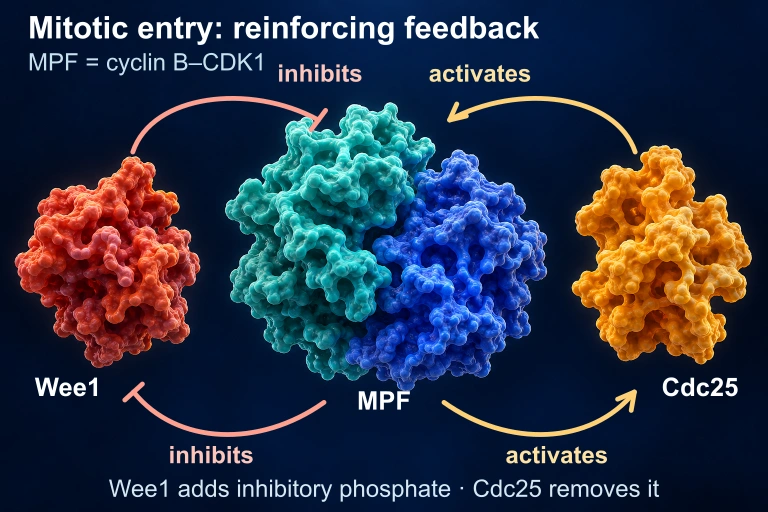
Predict the effect of constitutively active Wee1.
Active MPF activates Cdc25 and inhibits Wee1, reinforcing CDK1 activation. Wee1 adds an inhibitory phosphate to CDK1; Cdc25 removes it. Constitutively active Wee1 disrupts this loop; arrest is a prediction of the selected dominant-Wee1 model, not an unconditional outcome for every cell. Protein forms are generic illustrations, not measured structures or a molecular simulation; the circuit is independently authored.
Cyclin Levels Across the Cycle
The Three Major Checkpoints
Brakes vs. Accelerators
Two classes of genes regulate the cell cycle in opposing ways. When either class is mutated, the balance is disrupted:
| Tumor Suppressors | Proto-Oncogenes | |
|---|---|---|
| Role | Slow or stop cell division | Promote cell division |
| Analogy | Brakes on a car | Gas pedal on a car |
| Examples | p53, Rb | Ras, Myc |
| Cancer mutation | Loss of function | Gain of function (becomes oncogene) |
| Alleles needed | Both copies must be lost | One mutant copy is sufficient |
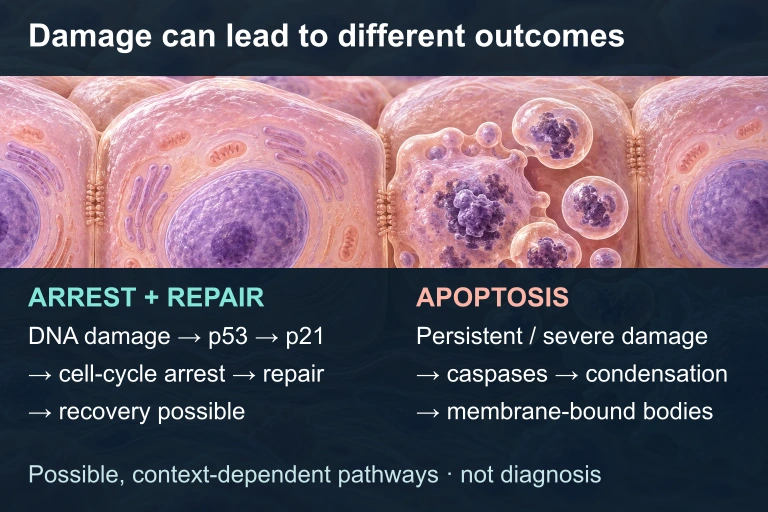
p53: Guardian of the Genome
Growth Factors and External Signals
Cells don't decide to divide on their own. They require external growth factors: signaling molecules that bind to cell-surface receptors and trigger a signal transduction pathway, ultimately pushing the cell past the G1 checkpoint.
G0 vs. Active Division
Not all cells are constantly dividing. Cells that exit the cell cycle enter a resting state called G0. Understanding when cells divide and when they don't is essential:
| G0 (Quiescent) | Actively Dividing | |
|---|---|---|
| Status | Exited the cell cycle | Cycling through G1 → S → G2 → M |
| Examples | Neurons, muscle cells | Skin cells, gut epithelium |
| Reversibility | Some can re-enter (liver cells) | Continue cycling with growth signals |
| Cyclin levels | Very low | Oscillating: rise and fall per phase |
How to Analyze a Cell Cycle Problem
Example 1: Cyclin D Overexpression
A researcher observes that a cell line produces excessive cyclin D even without growth factor stimulation. What would happen?
Example 2: p53 Mutation
A cell is exposed to UV radiation that damages its DNA. However, both copies of the p53 gene are mutated. Trace the consequences:
Example 3: MPF and Mitotic Entry
MPF (Maturation-Promoting Factor) is the cyclin B-CDK1 complex that triggers entry into mitosis. A drug blocks cyclin B degradation after anaphase. What happens?
Common Mistakes
Summary: Key Regulators
| Regulator | Role | Phase | Cancer Link |
|---|---|---|---|
| Cyclin D-CDK4/6 | Phosphorylates Rb | G1 | Overexpression → oncogene |
| p53 | Arrests cycle or triggers apoptosis | G1/G2 | Loss → checkpoint failure |
| Rb | Blocks E2F transcription factor | G1 | Loss → uncontrolled S phase entry |
| MPF (Cyclin B-CDK1) | Triggers mitosis | M | Dysregulation → mitotic errors |
| APC/C | Degrades cyclin B, separase activation | M → G1 | Failure → M-phase arrest |
Question 1 of 5
Which of the following best describes the role of cyclin-dependent kinases (CDKs) in cell cycle regulation?
Question 2 of 5
A cell with a mutation that causes constitutive activation of the Ras protein would most likely:
Question 3 of 5
A researcher adds a drug that prevents the APC/C complex from functioning. At which stage would cells most likely arrest?
Question 4 of 5
Li-Fraumeni syndrome is caused by inheriting one mutant copy of the p53 gene. Why does cancer develop when the second copy is also lost?
Question 5 of 5
A cell has normal levels of cyclin B but a mutation that makes CDK1 constitutively active (active even without cyclin binding). What is the most likely consequence?