01 / 20

Phylogeny
Tree of Life

Discover how biologists reconstruct evolutionary relationships using phylogenetic trees, shared derived characters, and molecular evidence.

AP Biology

What is Phylogeny?

Phylogeny is the study of the evolutionary history and relationships among organisms or groups of organisms. It answers the fundamental question: How are living things related to one another?

Phylogenetics connects to every major topic in biology: it explains why organisms share traits, predicts characteristics of undiscovered species, and helps us understand the mechanisms of evolution.

Essential Vocabulary

Clade
A group consisting of an ancestor and all of its descendants: a single "branch" on the tree of life.
Node
A branching point representing the most recent common ancestor (MRCA) of the taxa that diverge from it.
Taxon
Any named group of organisms (species, genus, family, etc.) that appears as a tip or internal branch on a tree.
Outgroup
A distantly related taxon used to root the tree, establishing the direction of evolutionary change.
Synapomorphy
A shared derived character: a trait that evolved in the ancestor of a clade and is shared by all its members.

Anatomy of a Phylogenetic Tree

Species A Species B Species C Species D E Outgroup (E) Root Node (MRCA) Branch Clade 1 Sister Taxa Key Terms Root: common ancestor Node: divergence point Branch: lineage Tips: extant taxa Outgroup: roots tree

How Are Trees Constructed?

Biologists build phylogenetic trees using two main categories of evidence. The goal is to identify homologous traits: features shared due to common ancestry, not convergent evolution.

Morphological Data
Compare physical structures like bone anatomy, flower structure, or embryonic development. Homologous structures (e.g., forelimbs of mammals) indicate shared ancestry.
Molecular Data
Compare DNA, RNA, or protein sequences. More similar sequences indicate closer relatedness. This is the most powerful modern method.

Building Trees: Parsimony vs. Maximum Likelihood

With multiple possible tree topologies, biologists need a principle to choose the best one. Two major approaches dominate:

Maximum Parsimony
Select the tree that requires the fewest evolutionary changes. Based on Occam's Razor: the simplest explanation is preferred.
Maximum Likelihood
Select the tree that has the highest probability of producing the observed data, given a model of sequence evolution.

Homology vs. Analogy

A critical distinction in phylogenetics: not all similar traits indicate common ancestry. You must distinguish homologous from analogous structures.

Homology Analogy
Definition Similarity due to shared ancestry Similarity due to convergent evolution
Example Human arm and bat wing Bird wing and insect wing
Underlying structure Same bone arrangement Different structure
Useful for phylogeny? Yes No: misleading
Also called Homologous structures Analogous / Convergent
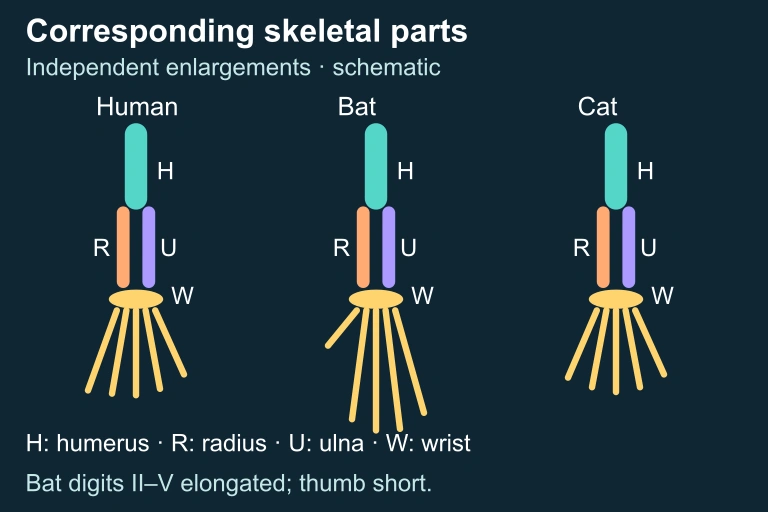
Corresponding skeletal parts
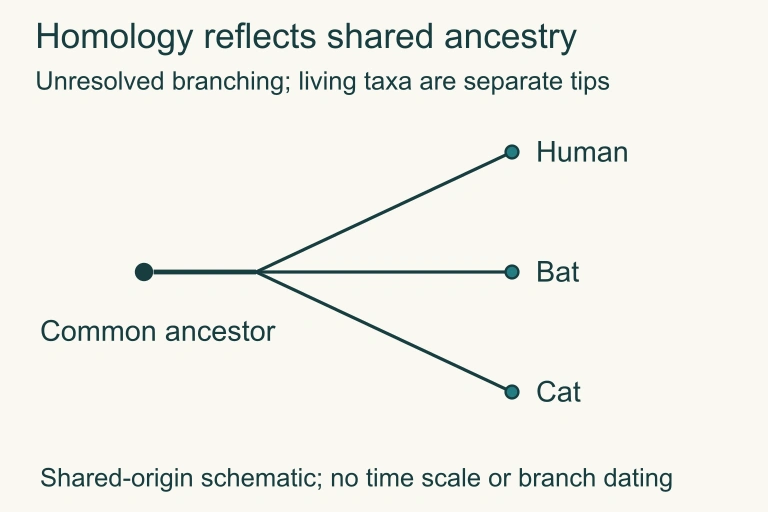
Shared origin schematic
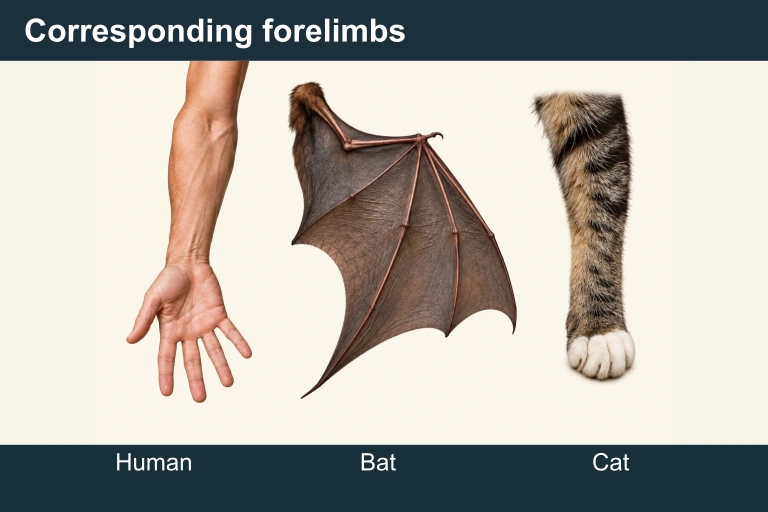
Human, bat and cat forelimb illustrations are compared. A separate schematic marks corresponding humerus, radius, ulna, wrist and five digits, with elongated bat digits and short thumb. An unresolved shared-ancestry companion has three living tips.
These independently enlarged forelimb topology schematics identify corresponding humerus, radius, ulna, wrist and five digits. They compare homology rather than exact bone shapes or proportions, and do not make living species ancestors of one another.

Homologous forelimbs versus analogous wings
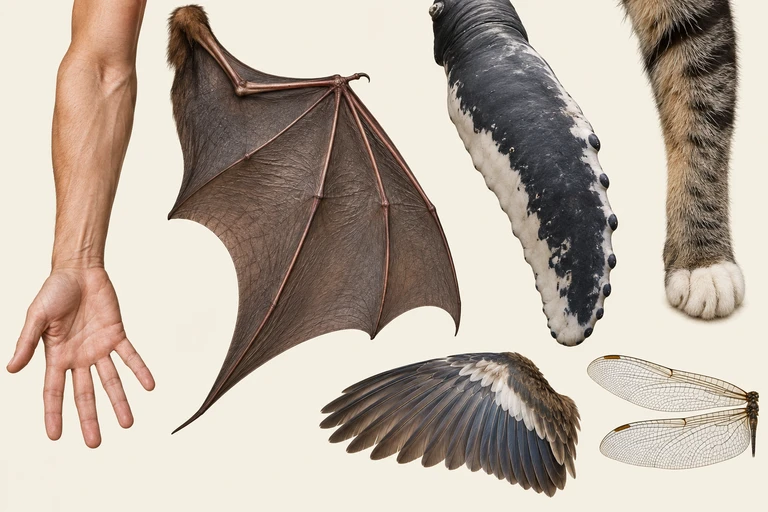
Human arm, bat wing, whale flipper and cat foreleg specimens accompany an authored proximal-to-distal skeletal correspondence diagram.Corresponding forelimb bones reflect shared ancestry despite different functions. Bird and bat forelimb bones are homologous, while bird and insect flight surfaces are analogous.

Same skeletal plan, different uses
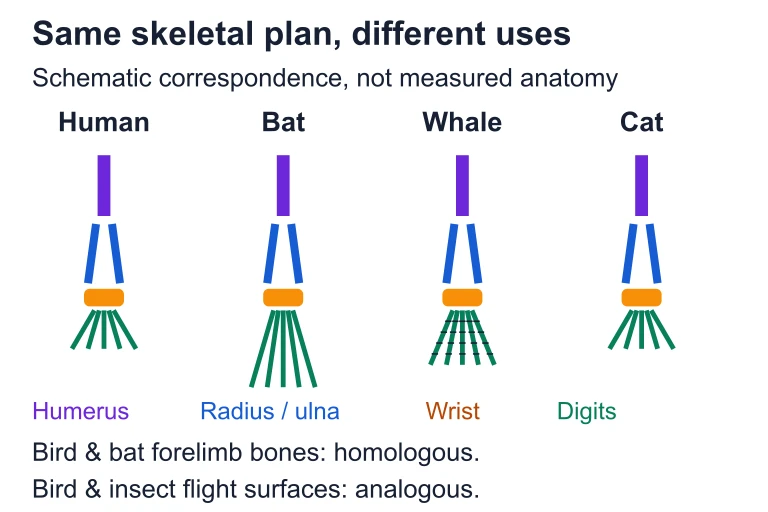
Same skeletal plan, different uses. Corresponding forelimb bones reflect shared ancestry despite different functions. Bird and bat forelimb bones are homologous, while bird and insect flight surfaces are analogous.Corresponding forelimb bones reflect shared ancestry despite different functions. Bird and bat forelimb bones are homologous, while bird and insect flight surfaces are analogous.

Types of Groupings

Monophyletic
An ancestor and all of its descendants. This is a true clade and the only valid grouping in cladistics.
Paraphyletic
An ancestor and some but not all of its descendants. Example: "Reptilia" excluding birds.
Polyphyletic
A group that does not include the most recent common ancestor. Grouped by convergent traits, not ancestry.
Monophyletic A B C D Paraphyletic A B C D Polyphyletic A B C D

Shared Derived Characters

Phylogenetic trees are built on the principle of shared derived characters (synapomorphies). Understanding the difference between ancestral and derived characters is essential.

Ancestral Character
A trait that was present in the common ancestor of the group being studied. Example: vertebrae in all vertebrates.
Derived Character
A trait that evolved after divergence from the ancestor. Example: hair in mammals (not found in other vertebrates).

How to Read a Phylogenetic Tree

1
Identify the root. The root is the common ancestor of all taxa on the tree. It establishes the direction of evolution (bottom to top, or left to right).
2
Find the nodes. Each internal node represents a speciation event where one lineage split into two. The node is the most recent common ancestor (MRCA) of the taxa above it.
3
Trace shared ancestry. Two taxa are more closely related if they share a more recent common ancestor. Follow branches back to find their MRCA.
4
Ignore tip order. Branches can rotate around any node without changing relationships. What matters is the branching pattern, not the left-right position of taxa.
5
Identify the outgroup. The taxon that branches off first (closest to the root) is the outgroup and is the most distantly related to the other taxa.

Example: Reading a Vertebrate Tree

Fish Amphibians Mammals Reptiles Birds Jaws Four limbs Amniotic egg Hair / mammary glands Feathers

Example: Molecular Phylogeny

Scientists compare DNA sequences to determine relatedness. Fewer differences in sequence = more recent divergence.

Species Pair DNA Differences (per 1000 bp) Inferred Relatedness
Human vs. Chimpanzee 12 Very close
Human vs. Gorilla 18 Close
Human vs. Orangutan 35 Moderate
Human vs. Lemur 82 Distant

Example: Character Matrix to Tree

A character matrix lists which taxa possess which derived characters. Use it to build a cladogram step by step.

Taxon Hair Amniotic Egg Four Limbs Jaws
Lamprey (outgroup) - - - -
Salamander - - + +
Lizard - + + +
Cat + + + +

Common Mistakes

✕ Reading Tip Proximity
Students assume taxa next to each other on the tips are most closely related. Only the branching pattern matters, not the left-right order of tips.
✕ Counting Branch Steps
Relatedness is NOT determined by counting branches between tips. Trace back to the most recent common ancestor instead.
✕ Confusing Analogy with Homology
Using convergently evolved traits (like wings in bats and birds) to infer close relatedness. Always check if the underlying structure is the same.
✕ "More Evolved" Fallacy
Thinking some organisms are "more evolved" than others. All living species have been evolving for the same amount of time since their common ancestor.
✕ Ignoring the Outgroup
Failing to identify the outgroup, which roots the tree and establishes the direction of character evolution (ancestral vs. derived).

Summary of Key Concepts

Concept Definition AP Exam Significance
Clade Ancestor + all descendants Must identify on trees
Synapomorphy Shared derived character Basis of cladistic grouping
Outgroup Distantly related taxon Roots the tree
Parsimony Fewest evolutionary changes Know the principle
Molecular clock Mutation rate estimates time Divergence time estimation
Monophyletic Valid clade (all descendants) Only valid grouping
Homology Similarity from ancestry Useful for phylogeny
Analogy Similarity from convergence Misleading: avoid

Question 1 of 5

On a phylogenetic tree, what does a node represent?

Question 2 of 5

A group that includes an ancestor and all of its descendants is called:

Question 3 of 5

Wings in birds and wings in insects are an example of:

Question 4 of 5

When comparing DNA sequences between species, a scientist finds 15 differences between Species X and Species Y, but 45 differences between Species X and Species Z. What can be inferred?

Question 5 of 5

The principle of maximum parsimony in phylogenetics states that: