Photosynthesis
Energy from Light
Explore how plants convert light energy into chemical energy, powering virtually all life on Earth through the elegant chemistry of \( 6\text{CO}_2 + 6\text{H}_2\text{O} \xrightarrow{\text{light}} \text{C}_6\text{H}_{12}\text{O}_6 + 6\text{O}_2 \).
What Is Photosynthesis?
Photosynthesis is the process by which autotrophs (primarily plants, algae, and cyanobacteria) capture light energy and convert it into chemical energy stored in glucose. This process is the foundation of nearly every food web on Earth.
Key Molecules in Photosynthesis
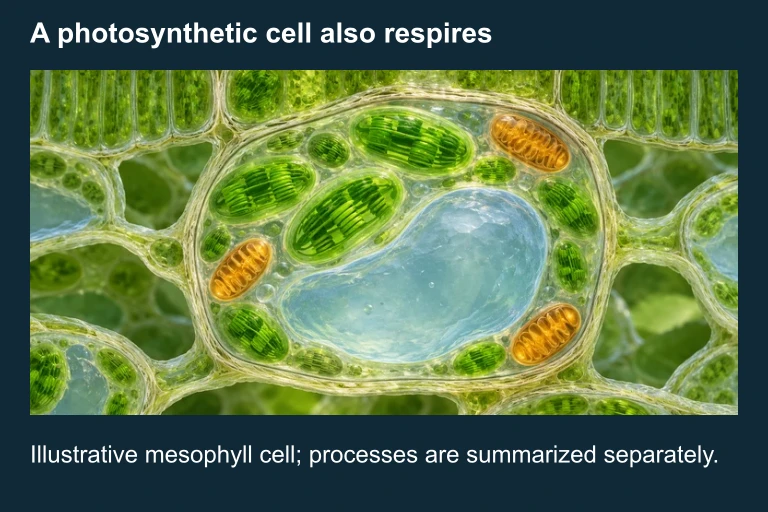
Inside the Chloroplast
Two Stages: Light and Dark Reactions
The Light Reactions in Detail
Thylakoid membrane couples electron flow to proton gradient
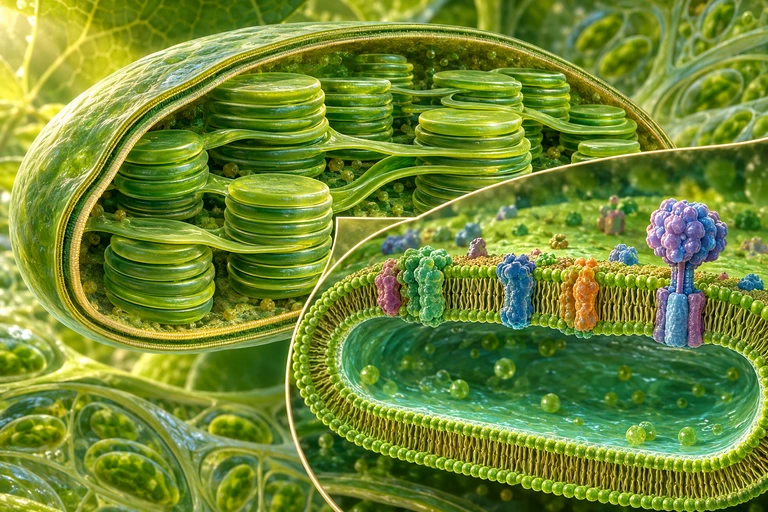 Water supplies electrons to the light reactions. Electron transport builds a proton gradient, and proton return from the thylakoid lumen to the stroma through ATP synthase powers ATP production.
Thylakoid: gradient to ATP
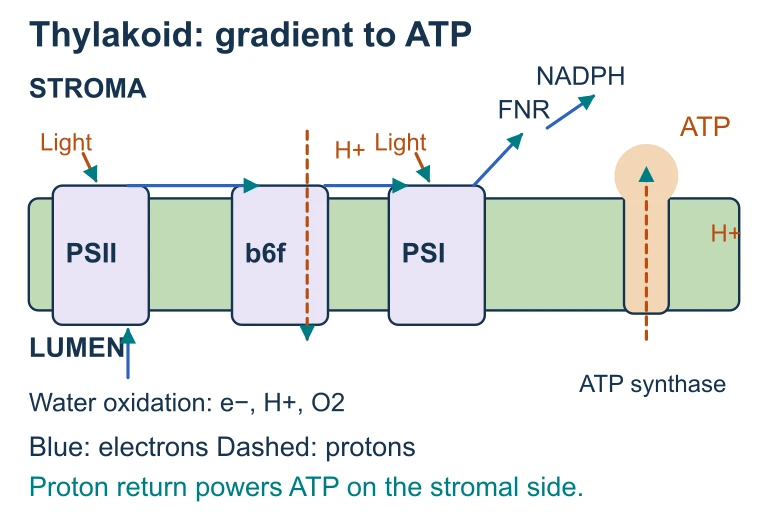 Water supplies electrons to the light reactions. Electron transport builds a proton gradient, and proton return from the thylakoid lumen to the stroma through ATP synthase powers ATP production.
The Calvin Cycle (Light-Independent)
The Overall Equation Decoded
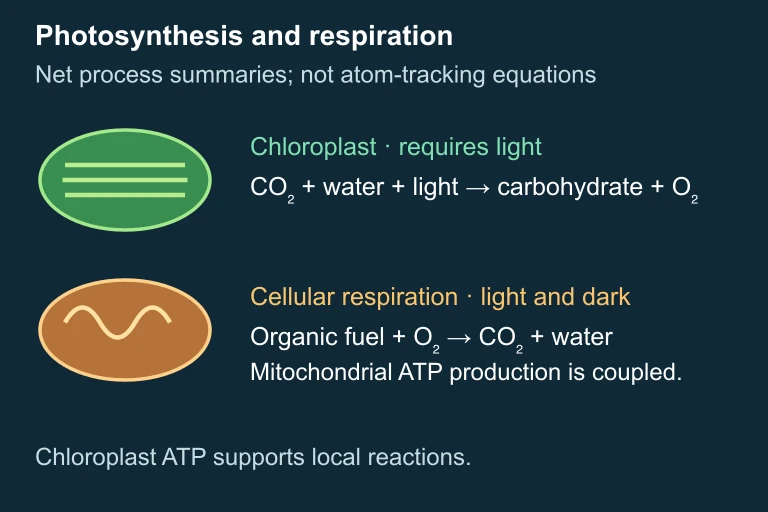
Photosynthesis vs. Cellular Respiration
| Photosynthesis | Cellular Respiration | |
|---|---|---|
| Location | Chloroplasts | Mitochondria |
| Reactants | \(\text{CO}_2 + \text{H}_2\text{O}\) | \(\text{C}_6\text{H}_{12}\text{O}_6 + \text{O}_2\) |
| Products | \(\text{C}_6\text{H}_{12}\text{O}_6 + \text{O}_2\) | \(\text{CO}_2 + \text{H}_2\text{O}\) |
| Energy | Light energy stored | Chemical energy released |
| Organisms | Autotrophs only | All living cells |
| When? | Requires light | Occurs continuously |
Light Absorption and Pigments
Factors Affecting Rate
Photorespiration and Adaptations
When \( \text{O}_2 \) concentration is high relative to \( \text{CO}_2 \), RuBisCO binds \( \text{O}_2 \) instead of \( \text{CO}_2 \), producing a toxic 2-carbon compound. This wasteful process is called photorespiration: it consumes ATP without producing sugar.
C4 and CAM separate initial fixation from Calvin chemistry
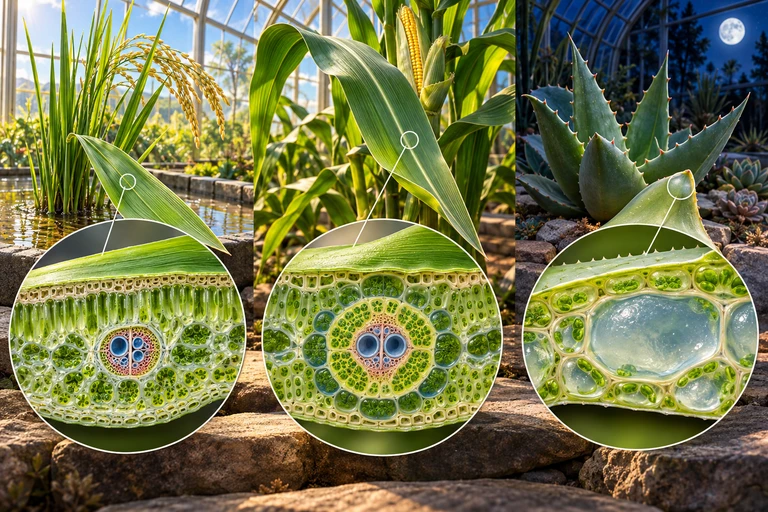 C₄ plants separate initial carbon fixation and the Calvin cycle between cell types. CAM plants separate them between night and day. Both concentrate carbon dioxide while retaining Calvin-cycle chemistry.
Three routes to carbon fixation
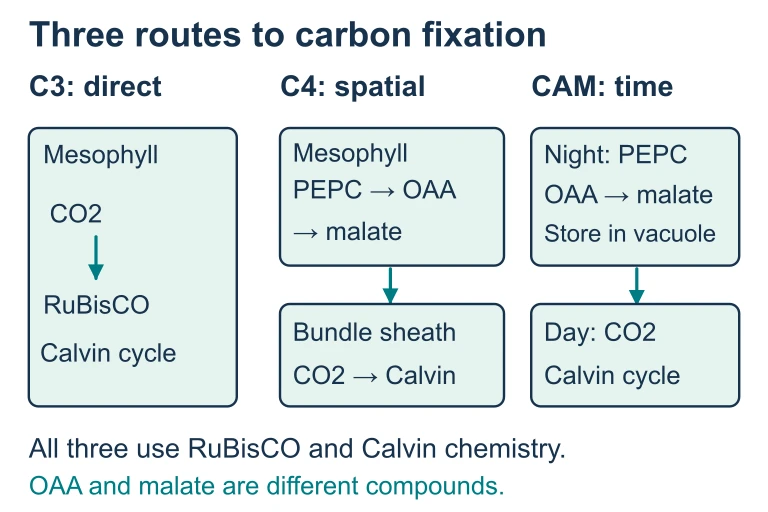 C₄ plants separate initial carbon fixation and the Calvin cycle between cell types. CAM plants separate them between night and day. Both concentrate carbon dioxide while retaining Calvin-cycle chemistry.
How to Trace Atoms Through Photosynthesis
Example: Counting ATP and NADPH
Question: How many ATP and NADPH molecules are consumed to produce one molecule of glucose via the Calvin cycle?
Example: Isotope Tracing with \( ^{18}\text{O} \)
Question: If you supply a plant with water labeled \( \text{H}_2{^{18}\text{O}} \), where does the \( ^{18}\text{O} \) end up: in glucose or in \( \text{O}_2 \)?
Common Mistakes
Question 1 of 5
In the light reactions, which molecule is the primary electron donor that replaces electrons lost by Photosystem II?
Question 2 of 5
Where does the Calvin cycle take place within the chloroplast?
Question 3 of 5
A plant is supplied with water labeled \( \text{H}_2{^{18}\text{O}} \). Where will the \( ^{18}\text{O} \) isotope primarily appear?
Question 4 of 5
C4 plants minimize photorespiration by:
Question 5 of 5
How many molecules of ATP and NADPH are consumed by the Calvin cycle to produce one molecule of glucose?