01 / 22

Origins of Life
on Earth

Explore how simple molecules became the first living cells: from the primordial atmosphere to abiogenesis, endosymbiosis, and the evidence that connects it all.

AP Biology

What Is Abiogenesis?

Abiogenesis is the natural process by which life arose from non-living matter: simple organic compounds formed, assembled into polymers, and eventually became self-replicating systems enclosed in membranes. It is distinct from biogenesis (life from existing life).

Earth's Early Conditions

Reducing Atmosphere
Little to no free \( \text{O}_2 \). Rich in \( \text{CH}_4 \), \( \text{NH}_3 \), \( \text{H}_2\text{O} \), and \( \text{H}_2 \).
Energy Sources
UV radiation, lightning, volcanic heat, and hydrothermal vents supplied energy for reactions.
Liquid Water
Oceans condensed after the surface cooled below \( 100\,{}^\circ\text{C} \), providing a solvent for chemistry.

Timeline: From Chemistry to Cells

~4.6 Bya
Earth Forms
Accretion of the solar nebula; molten surface, no oceans yet.
~4.0 Bya
Oceans Condense
Surface cools; liquid water accumulates; reducing atmosphere in place.
~3.8 Bya
Earliest Chemical Fossils
Carbon isotope ratios in Greenland rocks suggest biological activity.
~3.5 Bya
Stromatolites
Layered microbial mat fossils: the oldest macroscopic evidence of life.
~2.7 Bya
Cyanobacteria / \( \text{O}_2 \) Production
Oxygenic photosynthesis begins; oxygen slowly accumulates.
~2.0 Bya
First Eukaryotes
Endosymbiosis produces cells with membrane-bound organelles.

The Miller-Urey Experiment

\( \text{H}_2\text{O} \) (heated)
steam Gas Chamber
\( \text{CH}_4, \text{NH}_3, \text{H}_2, \text{H}_2\text{O} \)
Spark (lightning) condenser Collection Trap Amino acids found! ~ heat

Miller-Urey apparatus tests abiotic synthesis
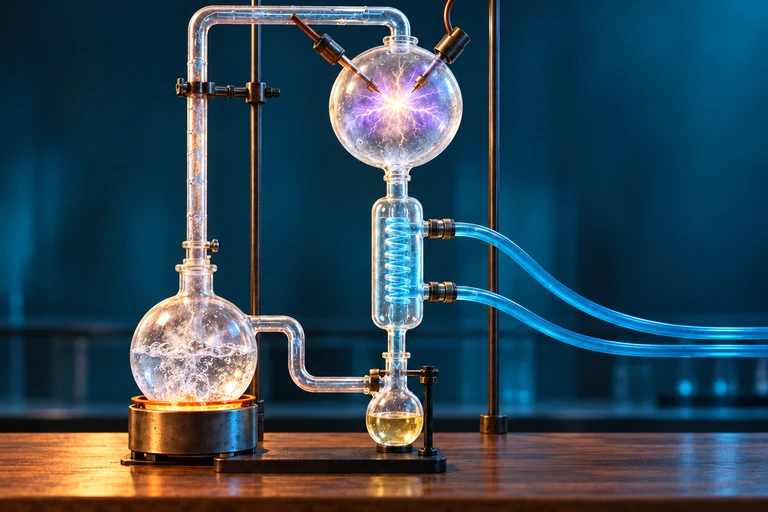
Selected v2 removes the invented spectra, molecular forms and volcanic landscape. Closed glassware links heated flask, spark chamber, condenser and trap; not an engineering validation.The Miller–Urey apparatus tests organic synthesis under a specified gas mixture and energy input. Heated water, a spark chamber, a condenser and a collection trap form the experimental loop.

Tested abiotic-synthesis loop
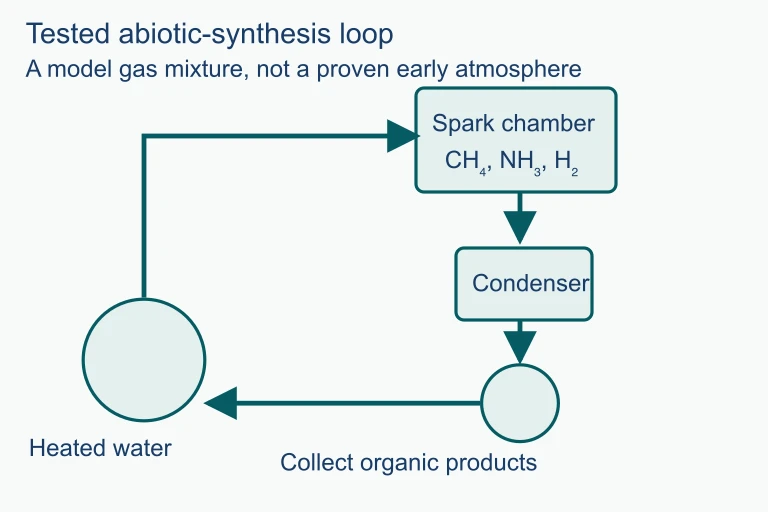
Tested abiotic-synthesis loop. The Miller–Urey apparatus tests organic synthesis under a specified gas mixture and energy input. Heated water, a spark chamber, a condenser and a collection trap form the experimental loop.The Miller–Urey apparatus tests organic synthesis under a specified gas mixture and energy input. Heated water, a spark chamber, a condenser and a collection trap form the experimental loop.

Four Stages of Abiogenesis

1
Abiotic synthesis of monomers. Simple organic molecules (amino acids, nucleotides, simple sugars) form from inorganic precursors using energy from lightning, UV light, or hydrothermal vents.
2
Polymerization. Monomers join into polymers (polypeptides, polynucleotides) on mineral surfaces like clay, which act as catalysts.
3
Self-replicating molecules. RNA molecules capable of catalysis and self-replication emerge: the RNA World hypothesis.
4
Membrane enclosure. Lipid bilayers spontaneously form vesicles (protobionts), enclosing replicating molecules and creating the first protocells.

The RNA World Hypothesis

Before DNA and proteins existed, RNA may have served as both the genetic material and the catalyst for early life. RNA can store information (like DNA) and catalyze reactions (like protein enzymes). These catalytic RNA molecules are called ribozymes.
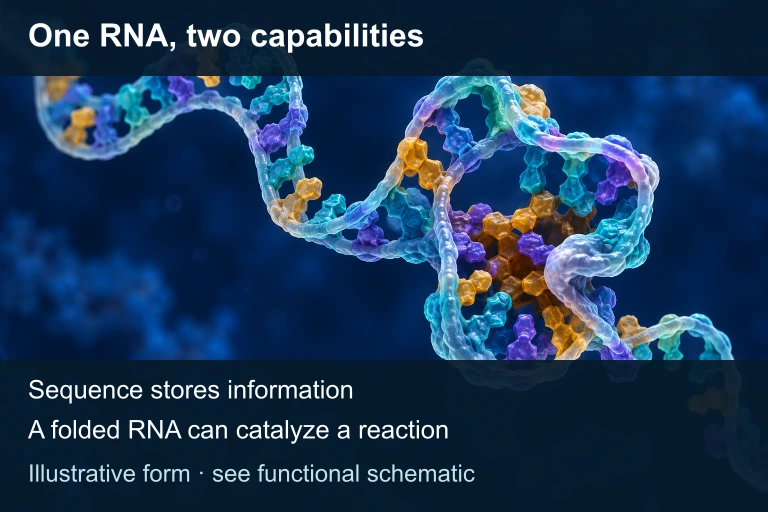
RNA stores info + catalyzes DNA stores info evolved later Protein catalyzes evolved later Ribozymes: RNA enzymes e.g., ribosomal RNA catalyzes peptide bonds today
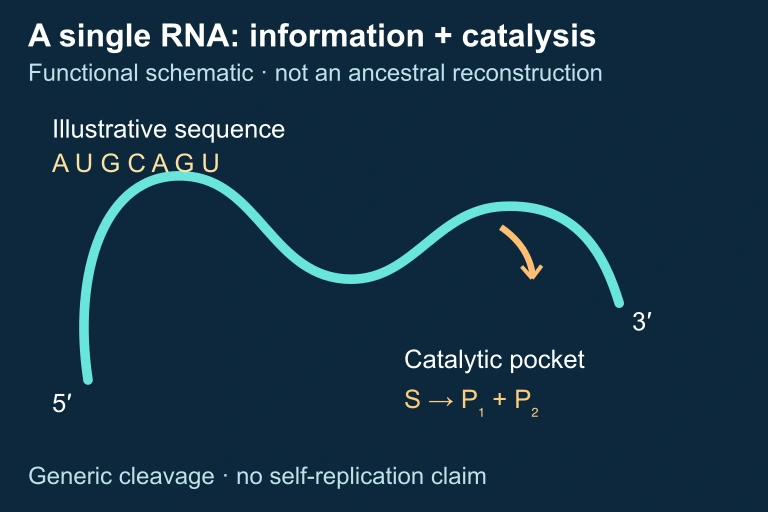
One strand: sequence and abstract catalysis
A conceptual folded RNA image is accompanied by an independently authored single strand labeled 5′ and 3′, a symbolic sequence and a generic substrate cleavage S to P1 and P2.
RNA can carry sequence information and catalyze a reaction. This invented functional example illustrates an abstract cleavage, not a specific ancestral molecule, atomic mechanism or self-replication demonstration. Molecular form is illustrative.

Protobionts and Protocells

Liposomes
Lipid bilayer vesicles that form spontaneously in water. Can grow, split, and maintain internal chemistry distinct from surroundings.
Coacervates
Droplets of organic molecules held together by hydrophobic interactions. Can absorb substances and carry out simple reactions.

Chemical vs. Biological Evolution

Chemical Evolution Biological Evolution
Driven by Physical/chemical laws Natural selection + mutation
Units Molecules and polymers Populations of organisms
Replication Template-based RNA copying DNA replication with enzymes
Heredity Inexact, error-prone High fidelity with variation
Time frame ~4.0 to 3.5 Bya ~3.5 Bya to present

The Endosymbiotic Theory

Proposed by Lynn Margulis: mitochondria and chloroplasts originated as free-living prokaryotes that were engulfed by a larger host cell. Instead of being digested, they formed a mutualistic relationship.

Ancestral Eukaryote aerobic engulfed mito Double membrane mito chloro Plant / Algal cell photosyn. engulfed

Evidence for Endosymbiosis

1
Double membranes. Mitochondria and chloroplasts have two membranes: the inner one from the original prokaryote, the outer from the host's engulfing vesicle.
2
Own circular DNA. Both organelles carry their own small, circular genome, similar to bacterial chromosomes.
3
70S ribosomes. They have prokaryote-sized ribosomes, not the 80S ribosomes found elsewhere in eukaryotic cells.
4
Binary fission. They replicate by dividing in two, independent of the cell cycle: just like bacteria.
5
Phylogenetic similarity. rRNA sequences of mitochondria match alpha-proteobacteria; chloroplast rRNA matches cyanobacteria.

Hydrothermal Vent Hypothesis

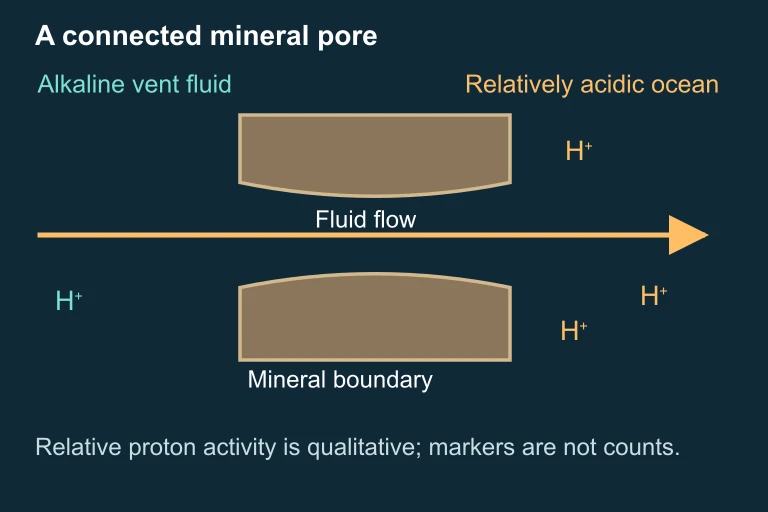
An alternative to the "warm little pond" model: life may have originated at deep-sea hydrothermal vents, where mineral-rich, superheated water meets cold ocean water. Alkaline vents (like Lost City) provide chemical gradients (pH, temperature) and mineral catalysts (iron-sulfur clusters).
Energy Gradient
pH difference between alkaline vent fluid and acidic ocean mirrors the proton gradient used by cells for ATP synthesis.
Mineral Catalysts
Iron-sulfur minerals in vent chimneys can catalyze organic reactions, similar to enzyme active sites today.
Qualitative connected pore.
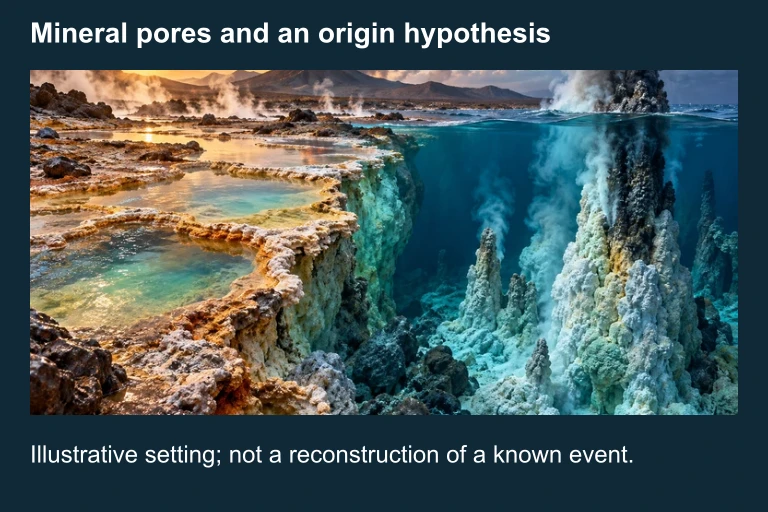
An illustrative hydrothermal setting accompanies a schematic connected mineral pore separating alkaline vent fluid from relatively acidic ocean water; proton markers are qualitative.
A conceptual landscape combines shoreline pools and submerged chimneys as broad environmental context, not one reconstructed alkaline vent. The exact pore panel selects only a qualitative proton-activity difference between fluid regions; symbol counts are not measured concentrations. Redox pathways and the origin-of-life setting remain outside this selected view.

Origin models involve overlapping uncertain transitions
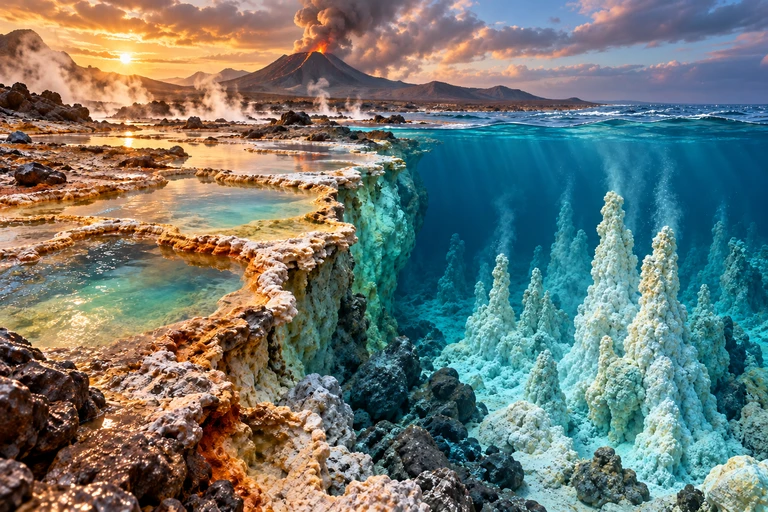
A reconstructed early-Earth coast with shallow mineral pools and submerged pale vent chimneys accompanies a dashed network of chemical transitions.Origin-of-life models connect monomer supply, energy coupling, polymer formation, compartments and replication. These processes may interact rather than follow one established historical sequence.

Origin models connect open questions
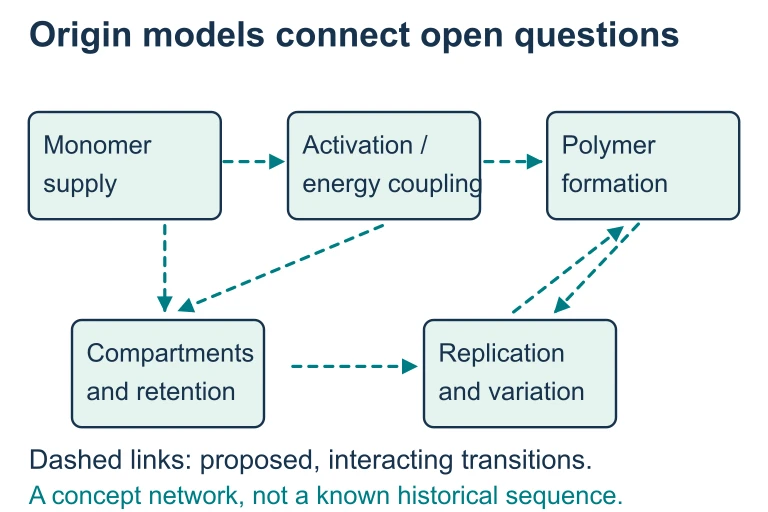
Origin models connect open questions. Origin-of-life models connect monomer supply, energy coupling, polymer formation, compartments and replication. These processes may interact rather than follow one established historical sequence.Origin-of-life models connect monomer supply, energy coupling, polymer formation, compartments and replication. These processes may interact rather than follow one established historical sequence.

How to Reason About Origins

1
Identify the conditions. What was the atmosphere, temperature, and energy source? A reducing atmosphere with abundant energy favors abiotic synthesis.
2
Follow the monomers to polymers path. Which molecules formed first? How did they polymerize? Look for surfaces (clay) or environments (vents) that concentrate and catalyze.
3
Check for self-replication. Can the system copy itself? RNA is the leading candidate because it is both an information carrier and a catalyst.
4
Add compartmentalization. Without a membrane, there is no "self" for natural selection to act on. Lipid vesicles solve this.
5
Look for modern echoes. Does a modern organelle, molecule, or mechanism reflect an ancient origin? (e.g., ribozymes, double membranes, chemiosmosis.)

Example: Linking Evidence to Hypotheses

Scenario: Scientists discover that a newly sequenced mitochondrial gene is 87% identical to a gene in a modern alpha-proteobacterium. What does this support?

1
Identify the claim. Endosymbiotic theory predicts that mitochondria descended from engulfed alpha-proteobacteria.
2
Connect the evidence. High sequence similarity between mitochondrial and bacterial DNA indicates shared ancestry.
3
Conclusion: This supports endosymbiotic theory. The more similar the sequences, the more recent the divergence from a common ancestor.

Example: Interpreting Experimental Results

Scenario: A researcher repeats the Miller-Urey experiment but uses a gas mixture with \( \text{CO}_2 \) and \( \text{N}_2 \) instead of \( \text{CH}_4 \) and \( \text{NH}_3 \). Fewer amino acids are produced. Why?

Common Mistakes

✕ "Miller-Urey created life"
They synthesized amino acids, not living organisms. Abiotic synthesis of monomers is only Step 1 of abiogenesis.
✕ Confusing endosymbiosis with abiogenesis
Endosymbiosis explains the origin of eukaryotic organelles, not the origin of life itself. Prokaryotes already existed.
✕ "RNA World means no DNA ever existed"
RNA World proposes RNA came first. DNA evolved later as a more stable storage molecule; the transition was gradual.

Summary: Key Hypotheses Compared

Primordial Soup Hydrothermal Vents RNA World
Explains Monomer synthesis Energy + monomer synthesis Self-replication origin
Energy source Lightning, UV Chemical gradients Catalytic RNA
Key evidence Miller-Urey experiment Universal chemiosmosis Ribozymes, ribosome
Weakness Atmosphere debate Hard to test in lab How did RNA form?

Question 1 of 5

The Miller-Urey experiment demonstrated that:

Question 2 of 5

Which of the following is not evidence supporting the endosymbiotic theory?

Question 3 of 5

The RNA World hypothesis proposes that RNA served as both:

Question 4 of 5

Protobionts are significant in the study of abiogenesis because they demonstrate that:

Question 5 of 5

The hydrothermal vent hypothesis for the origin of life is supported by the observation that: