01 / 21

Origins of Cell
Compartmentalization

Explore how eukaryotic cells evolved internal membrane-bound organelles, creating specialized compartments that drive the complexity of life.

AP Biology

What Is Compartmentalization?

Compartmentalization is the organization of a cell into distinct membrane-bound regions, each maintaining unique chemical environments. Instead of one large cytoplasmic soup, eukaryotic cells partition reactions into specialized organelles.

Cell compartments as distinct chemical environments
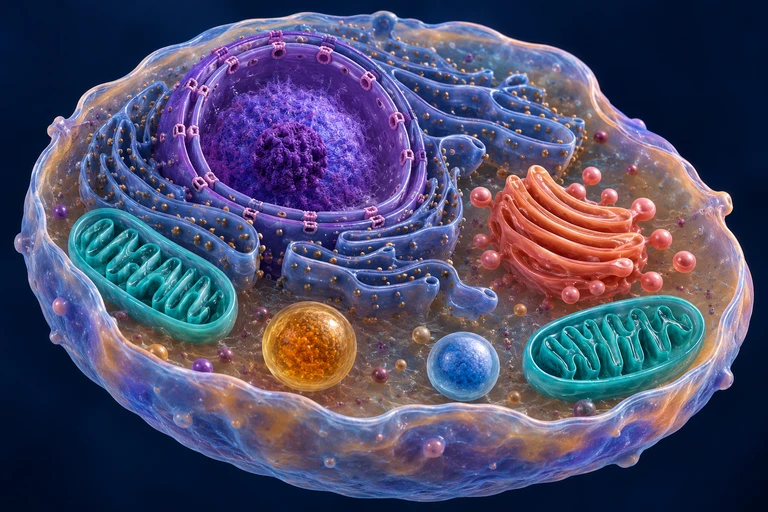
Animal-cell cutaway with purple nucleus and ER, coral Golgi, amber lysosome, blue peroxisome and teal mitochondria.Membranes separate cytosol from organelle lumens and maintain distinct chemical environments. The nuclear outer membrane connects with the endoplasmic reticulum; mitochondrial and peroxisomal protein import follows routes distinct from ER–Golgi vesicle traffic.

Boundaries maintain different spaces
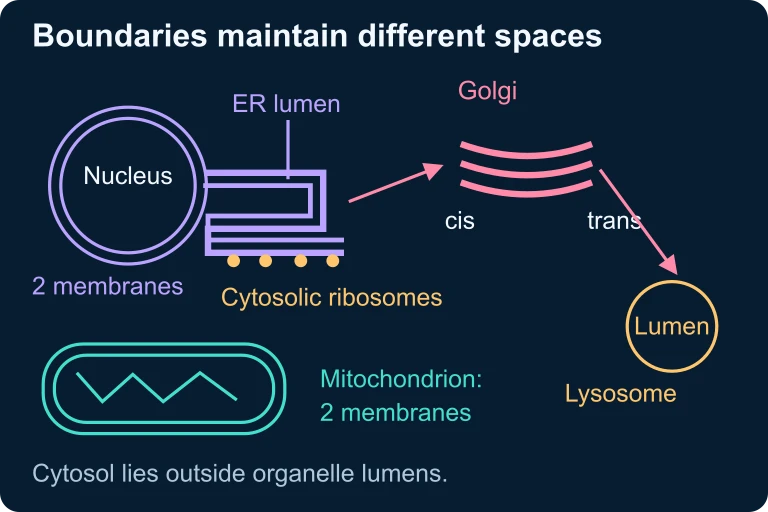
Boundaries maintain different spaces. Membranes separate cytosol from organelle lumens and maintain distinct chemical environments. The nuclear outer membrane connects with the endoplasmic reticulum; mitochondrial and peroxisomal protein import follows routes distinct from ER–Golgi vesicle traffic.Membranes separate cytosol from organelle lumens and maintain distinct chemical environments. The nuclear outer membrane connects with the endoplasmic reticulum; mitochondrial and peroxisomal protein import follows routes distinct from ER–Golgi vesicle traffic.

Vesicles and direct import are different routes
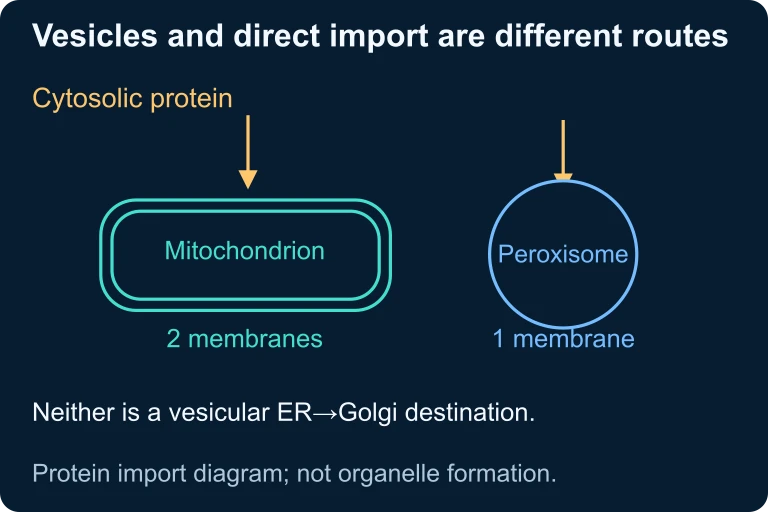
Vesicles and direct import are different routes. Mitochondrial and peroxisomal proteins can enter from the cytosol through direct-import routes distinct from ER–Golgi vesicle transport.Mitochondrial and peroxisomal proteins can enter from the cytosol through direct-import routes distinct from ER–Golgi vesicle transport.

Why Compartmentalization Matters

Efficiency
Concentrates substrates and enzymes, increasing reaction rates by orders of magnitude
Isolation
Prevents destructive enzymes (e.g., proteases) from digesting the rest of the cell
Regulation
Allows independent control of pH, ion concentration, and redox state in each organelle

Prokaryotes vs Eukaryotes

Prokaryote Nucleoid (no membrane) Ribosomes Eukaryote Nucleus Mito ER Lysosome Evolution

Prokaryotes lack membrane-bound organelles. Eukaryotes evolved internal membranes that partition cellular functions, enabling far greater metabolic complexity.

The Endomembrane Origin

Stage 1 Simple ancestor Stage 2 Membrane infolding Stage 3 Endomembrane system Nucleus ER Plasma Membrane Infolding Hypothesis

The Endosymbiotic Theory

Proposed by Lynn Margulis in 1967, endosymbiotic theory explains the origin of mitochondria and chloroplasts. An ancestral eukaryotic cell engulfed smaller prokaryotes. Instead of being digested, these prokaryotes became permanent endosymbionts.

Ancestral host Aerobic bacterium Engulfment Double membrane Gene transfer Mitochondrion Modern cell

Distinguish current protein import from evolutionary gene transfer.

Many mitochondrial proteins are encoded in the nucleus, translated in the cytosol and imported into the organelle. Illustration is schematic where scale or molecular structure is simplified.
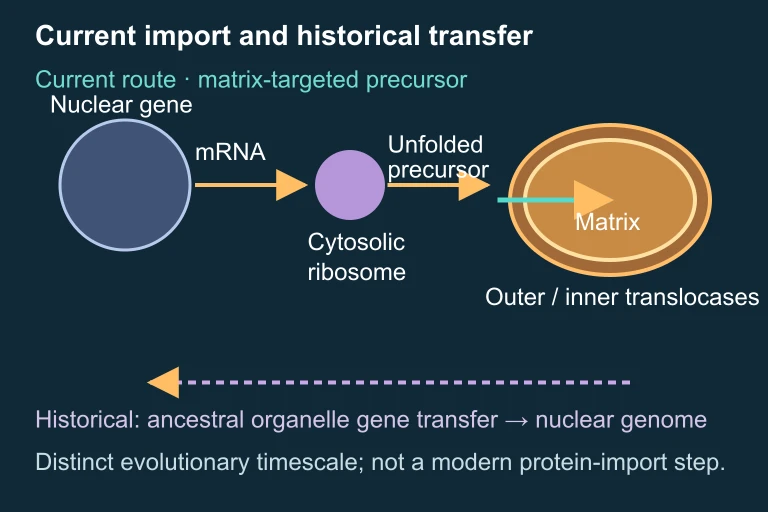
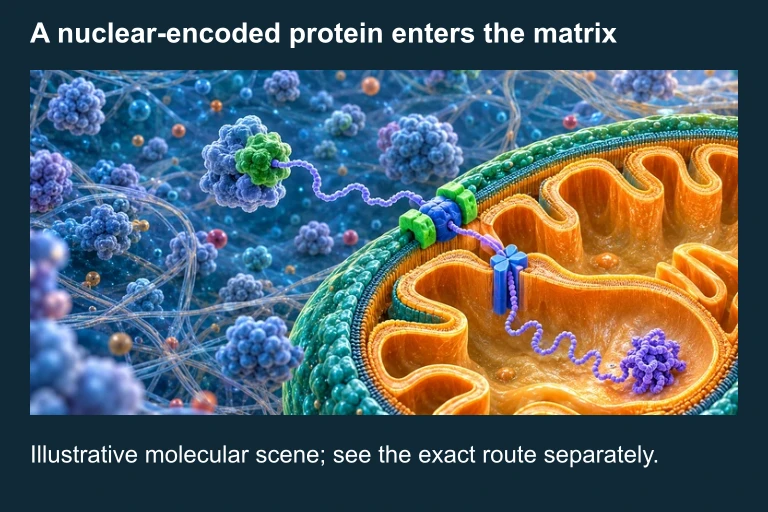
Current import and historical transfer.
Illustrative mitochondrial import scene accompanies an authored modern route from nuclear gene to matrix protein and a separate historical gene transfer.
Many mitochondrial proteins are encoded in the nucleus, translated in the cytosol and imported into the organelle. Illustration is schematic where scale or molecular structure is simplified.
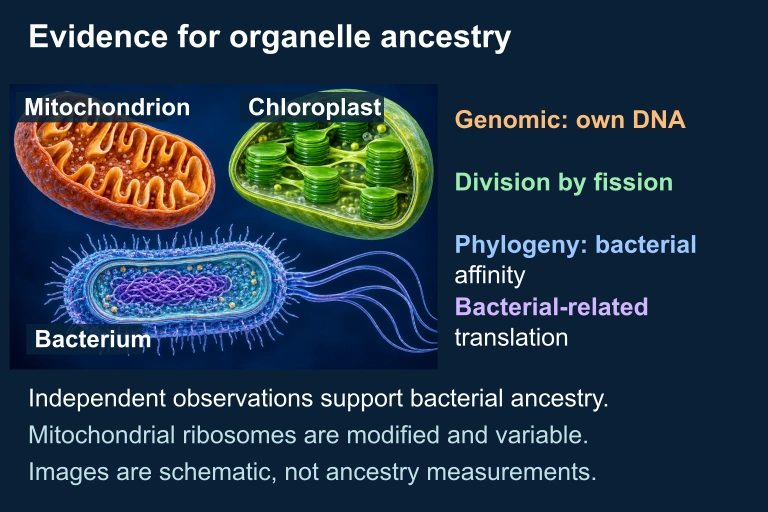
Evidence for Endosymbiosis

1
Double membranes: Mitochondria and primary chloroplasts have two bounding membranes. Interpret this architecture together with genetic and molecular evidence for their bacterial ancestry.
2
Own DNA: Both organelles contain small, circular DNA similar to bacterial chromosomes.
3
70S ribosomes: Their ribosomes match bacterial size (70S), not eukaryotic (80S).
4
Binary fission: They replicate by dividing independently, like bacteria.
5
Size similarity: Both are roughly the same size as modern-day bacteria.
Illustrative mitochondrion, chloroplast and bacterium accompany independently authored genomic, division, phylogenetic and translation evidence.
Independent evidence from organelle genomes, division, phylogeny and bacterial-related translation machinery supports bacterial ancestry of mitochondria and chloroplasts. Mitochondrial ribosomes are evolutionarily modified and variable. The organism illustrations are schematic and do not establish measurements or universal genome topology.

Infolding vs Endosymbiosis

Membrane Infolding Endosymbiosis
Organelles formed Nucleus, ER, Golgi Mitochondria, Chloroplasts
Mechanism Plasma membrane folds inward Engulfment of free-living prokaryote
Membranes ER and Golgi: one membrane; nuclear envelope: two Two bounding membranes
Own DNA? No (uses nuclear DNA) Yes (circular, bacterial-type)
Own ribosomes? No Yes (70S, bacterial-type)

The Chloroplast Story

After acquiring mitochondria, a subset of early eukaryotes engulfed photosynthetic cyanobacteria. This second endosymbiotic event gave rise to chloroplasts, enabling photosynthesis in plants and algae.

Mito Host + Mito + Cyanobacterium Endosymbiosis Plant cell

Endosymbiosis integrates lineages rather than forming organelles de novo
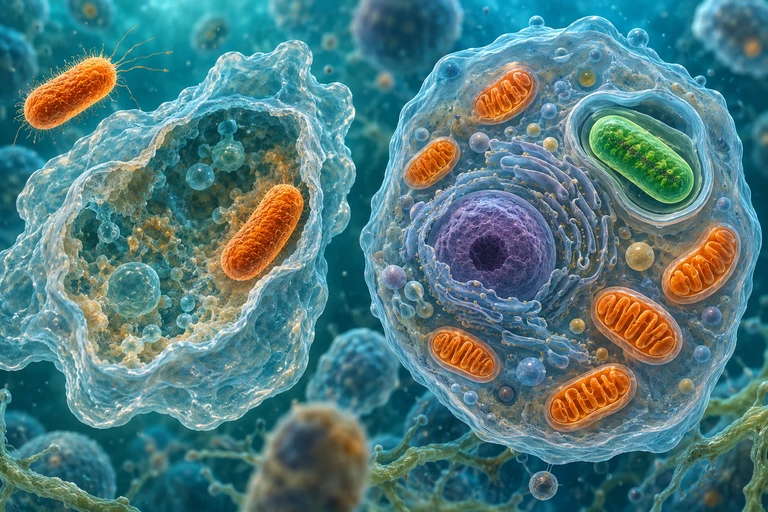
Two conceptual cell vignettes show an orange bacterial partner retained in an early host and a green cyanobacterial partner in a later mitochondria-bearing cell. An exact schematic separates their ancestry relationships.Mitochondrial ancestry traces to alphaproteobacteria. Primary plastid ancestry traces to cyanobacteria acquired by a eukaryotic lineage that already had mitochondria.

Endosymbiosis joins lineages
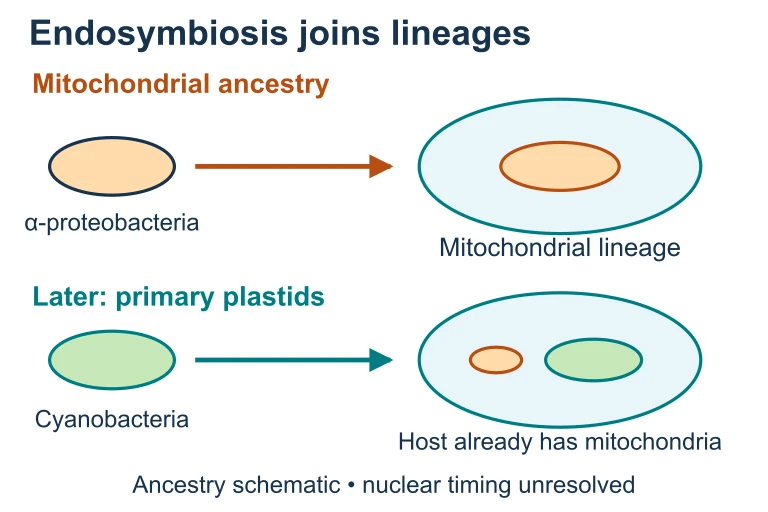
Endosymbiosis joins lineages. Mitochondrial ancestry traces to alphaproteobacteria. Primary plastid ancestry traces to cyanobacteria acquired by a eukaryotic lineage that already had mitochondria.Mitochondrial ancestry traces to alphaproteobacteria. Primary plastid ancestry traces to cyanobacteria acquired by a eukaryotic lineage that already had mitochondria.

Surface Area to Volume Ratio

As cells grow larger, the volume increases faster than the surface area. Compartmentalization solves this by adding internal membrane surface, boosting the total area available for chemical reactions.

Small High SA:V Medium Moderate SA:V Large + Membranes Compensated

How to Identify Evidence

1
Count the membranes: Membrane number describes architecture; it does not establish evolutionary origin by itself. The nuclear envelope also has two membranes.
2
Check for own DNA: Organelles with circular DNA (like bacteria) point to an independent prokaryotic ancestor.
3
Examine ribosomes: 70S ribosomes = bacterial heritage. 80S = made by the host's own genes.
4
Look at reproduction: Does the organelle divide independently via binary fission? If yes, endosymbiotic evidence.
5
Compare DNA sequences: Mitochondrial and chloroplast DNA are more similar to bacterial DNA than to nuclear DNA.

Example: Mitochondrial Evidence

Question: A researcher examines an organelle and finds it has a double membrane, circular DNA, and 70S ribosomes. It also reproduces by binary fission. What is the organelle and what is its evolutionary origin?

Example: Nuclear Envelope Origin

Question: The nuclear envelope is a double membrane continuous with the endoplasmic reticulum. It does not have its own DNA or ribosomes. Explain its likely evolutionary origin.

Example: Chloroplast vs Mitochondrion

Question: Both chloroplasts and mitochondria have double membranes and their own DNA. How do we distinguish which prokaryotic ancestor each came from?

Mitochondria
DNA is most similar to alpha-proteobacteria (aerobic, heterotrophic). Performs cellular respiration. Found in nearly all eukaryotes.
Chloroplasts
DNA is most similar to cyanobacteria (photosynthetic). Performs photosynthesis. Found only in plants and algae. Has an additional thylakoid membrane system.

Common Mistakes

✕ All organelles are endosymbiotic
Only mitochondria and chloroplasts arose via endosymbiosis. The nucleus, ER, and Golgi came from membrane infolding.
✕ Double membrane means nothing
Membrane architecture contributes evidence, but membrane count alone cannot establish origin. Compare organelle genomes and molecular relationships with bacterial lineages.
✕ Chloroplasts came first
Mitochondria evolved first. Chloroplasts arose later, only in the lineage leading to plants and algae. All eukaryotes have (or once had) mitochondria.

Summary of Compartmentalization Origins

Organelle Origin Own DNA? Evidence
Nucleus Membrane infolding No Continuous with ER
ER / Golgi Membrane infolding No Single membrane, no DNA
Mitochondria Endosymbiosis Yes Double membrane, 70S, binary fission
Chloroplasts Endosymbiosis Yes Double membrane, 70S, thylakoids
Lysosomes Golgi-derived No Single membrane, bud from Golgi

Question 1 of 5

Which of the following is the strongest evidence that mitochondria originated from a free-living prokaryote?

Question 2 of 5

The nuclear envelope most likely originated through which process?

Question 3 of 5

Chloroplasts are believed to have evolved from an ancestor most closely related to which group?

Question 4 of 5

Which organelle would you not expect to contain its own DNA?

Question 5 of 5

Why is cell compartmentalization considered essential for the evolution of complex eukaryotic life?