01 / 21

Nucleic Acids
The Code of Life

Explore the structure and function of DNA and RNA: the information-carrying molecules that direct protein synthesis and heredity in all living organisms.

AP Biology

What Are Nucleic Acids?

Nucleic acids are macromolecules composed of repeating monomer units called nucleotides. They carry genetic information and direct the synthesis of proteins. The two major types are deoxyribonucleic acid (DNA) and ribonucleic acid (RNA).

The Nucleotide Monomer

Phosphate Group 5-Carbon Sugar Nitrogenous Base \(\text{PO}_4^{3-}\) Deoxyribose / Ribose
\(A, T, G, C\) (or \(U\))
Nucleotide: The Building Block

The Nitrogenous Bases

Purines
Adenine (\(A\)) and Guanine (\(G\)): double-ring structures with two fused carbon-nitrogen rings.
Pyrimidines
Cytosine (\(C\)), Thymine (\(T\)), and Uracil (\(U\)): single-ring structures. \(T\) is in DNA; \(U\) replaces \(T\) in RNA.

DNA: The Double Helix

\(A \text{──} T\)
\(G \equiv C\)
\(T \text{──} A\)
\(C \equiv G\)
\(A \text{──} T\)
\(G \equiv C\)
\(T \text{──} A\)
\(5' \rightarrow 3'\)
\(3' \rightarrow 5'\)
Sugar-phosphate backbone Antiparallel strand

RNA: The Single Strand

mRNA
Messenger RNA carries the genetic code from DNA to ribosomes for translation into protein.
tRNA
Transfer RNA brings amino acids to ribosomes, matching anticodons to mRNA codons.
rRNA
Ribosomal RNA forms the structural and catalytic core of ribosomes.
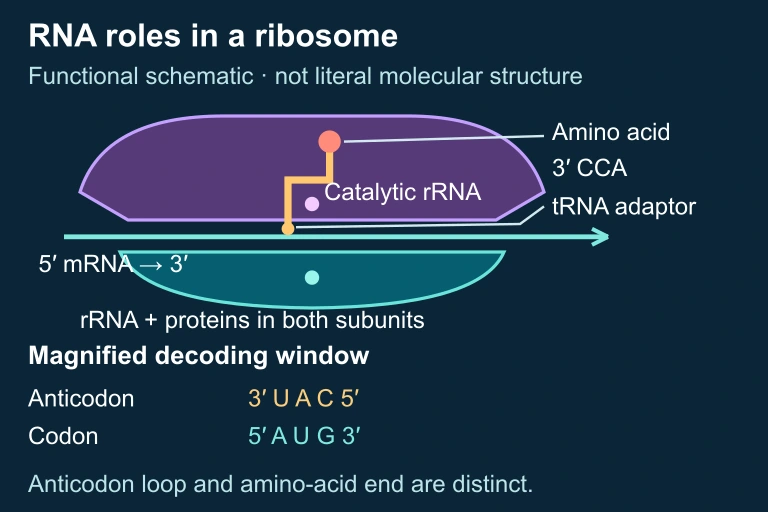
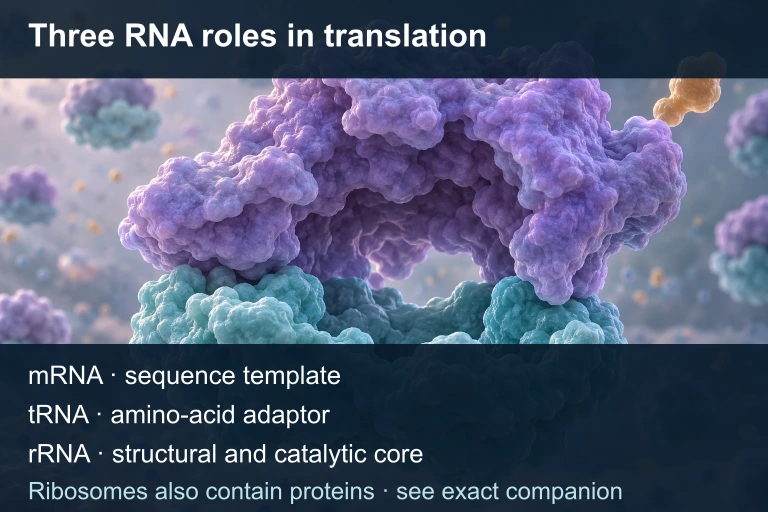
RNA roles and decoding schematic
A contextual ribosome illustration accompanies an independently authored two-subunit diagram. mRNA runs 5′ to 3′; a tRNA carries an amino acid at 3′ CCA and pairs an anticodon 3′ UAC 5′ with the codon 5′ AUG 3′.
mRNA carries a message, tRNA supplies amino acids, and rRNA forms core structural and catalytic parts of ribosomes, which also contain proteins. Illustration is schematic where scale or molecular structure is simplified.

DNA vs RNA: Key Differences

Feature DNA RNA
Sugar Deoxyribose Ribose
Strands Double-stranded Single-stranded
Bases \(A, T, G, C\) \(A, \)\(U\)\(, G, C\)
Location Nucleus Nucleus & cytoplasm
Function Long-term storage Protein synthesis
Stability More stable Less stable

Phosphodiester Bonds

Nucleotide 1
\(5'\) end : \(P \text{──} \) Sugar \( \text{──} \) Base
Phosphodiester
bond (\(3' \rightarrow 5'\))
Nucleotide 2
\(P \text{──} \) Sugar \( \text{──} \) Base
\(3'\) end ...
Dehydration Synthesis
Covalent bond forms
between the \(3'\) -OH
of one sugar and the
\(5'\) phosphate of the
next nucleotide.

The Central Dogma of Molecular Biology

DNA Transcription RNA Translation Protein Replication
\(\text{DNA} \rightarrow \text{RNA} \rightarrow \text{Protein}\)

Chargaff's Rules

In any DNA molecule, the amount of adenine equals thymine and the amount of guanine equals cytosine. This reflects complementary base pairing across the two strands.

Rule 1
\( \%A = \%T \) and \( \%G = \%C \) in any double-stranded DNA molecule.
Rule 2
\( \%A + \%G = \%T + \%C = 50\% \). Total purines equal total pyrimidines.

Solving Base Composition Problems

1
Identify the given base percentage. Check whether the molecule is double-stranded DNA or single-stranded RNA.
2
Apply Chargaff's Rules (DNA only). Set \( \%A = \%T \) and \( \%G = \%C \). For RNA, these equalities do not hold.
3
Use the total = 100% constraint. \( \%A + \%T + \%G + \%C = 100\% \). Substitute known values and solve for unknowns.
4
Verify your answer. Confirm all four percentages sum to 100% and that purine total equals pyrimidine total (for dsDNA).

Example 1: Base Composition

A double-stranded DNA sample contains 30% adenine. What are the percentages of the other three bases?

1
By Chargaff's Rule: \( \%A = \%T = 30\% \)
2
Remaining: \( 100\% - 30\% - 30\% = 40\% \)
3
Since \( \%G = \%C \): each = \( \frac{40\%}{2} = 20\% \)

Example 2: Complementary Strand

Given the DNA template strand: \(\text{3'-TACGGATC-5'}\), write the complementary strand and the resulting mRNA.

1
Complementary DNA strand: Apply A-T and G-C pairing, flip direction: \(\text{5'-ATGCCTAG-3'}\)
2
mRNA (from template): Read the template \(3' \rightarrow 5'\) and transcribe using A-U pairing: \(\text{5'-AUGCCUAG-3'}\)
3
Note: The mRNA sequence matches the coding (non-template) DNA strand, except \(U\) replaces \(T\).

Example 3: Semiconservative Replication

Parent DNA Replication Daughter 1 Daughter 2 Original strand New strand Each daughter has one original + one new strand

Common Mistakes

✕ Applying Chargaff's Rules to RNA
Chargaff's Rules (\(\%A=\%T, \%G=\%C\)) apply only to double-stranded DNA. In single-stranded RNA, base percentages are independent.
✕ Confusing Template and Coding Strands
mRNA is complementary to the template strand, not the coding strand. The coding strand has the same sequence as mRNA (with \(T\) for \(U\)).
✕ Forgetting Antiparallel Orientation
DNA strands run antiparallel: \(5'\rightarrow3'\) and \(3'\rightarrow5'\). Always specify direction when writing sequences or you may reverse the order.

Summary of Nucleic Acid Types

Property DNA mRNA tRNA rRNA
Sugar Deoxyribose Ribose Ribose Ribose
Strands Double Single Single* Single*
Unique Base Thymine Uracil Uracil Uracil
Role Storage Messenger Adaptor Catalytic

Question 1 of 5

A double-stranded DNA molecule contains 18% guanine. What percentage of the molecule is adenine?

Question 2 of 5

Which structural feature distinguishes RNA from DNA?

Question 3 of 5

If a DNA template strand reads \(\text{3'-AATGCCT-5'}\), what is the corresponding mRNA sequence?

Question 4 of 5

DNA replication is described as semiconservative. This means that each daughter molecule contains:

Question 5 of 5

Which type of RNA carries amino acids to the ribosome during translation and matches its anticodon to the mRNA codon?