Non-Mendelian
Genetics
Explore inheritance patterns that go beyond Mendel's laws: incomplete dominance, codominance, polygenic traits, and epistasis.
What is Non-Mendelian Genetics?
Gregor Mendel described inheritance governed by dominant and recessive alleles. However, many traits do not follow these simple rules. Non-Mendelian genetics encompasses every pattern of inheritance where the phenotype cannot be predicted by straightforward dominance alone.
The Major Patterns of Non-Mendelian Inheritance
Why Non-Mendelian Genetics Matters
Most real-world traits are non-Mendelian. Human skin color, height, blood type, and many disease susceptibilities all involve inheritance patterns that deviate from simple dominance.
Incomplete Dominance: The Blending Rule
Codominance: Both Alleles Express Fully
Incomplete vs. Codominance
| Incomplete Dominance | Codominance | |
|---|---|---|
| Heterozygote phenotype | Intermediate blend | Both phenotypes visible |
| Classic example | Red × White = Pink | Red × White = Red + White spots |
| Molecular basis | One allele produces less product | Both alleles produce full product |
| \( F_1 \) phenotypic ratio | \( 1:2:1 \) | \( 1:2:1 \) |
Heterozygote phenotype diagnoses dominance relationship
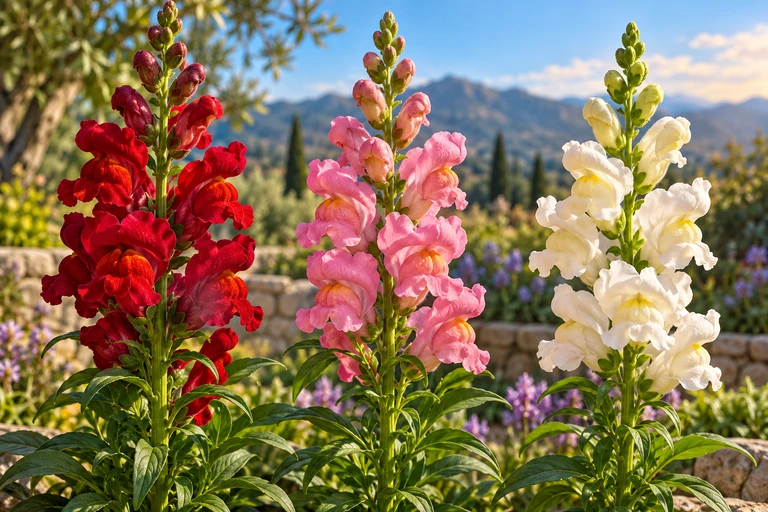 The heterozygote phenotype distinguishes dominance relationships. Snapdragon heterozygotes retain both alleles while producing intermediate color; AB red cells display both A and B carbohydrate antigens.
Score the heterozygote phenotype
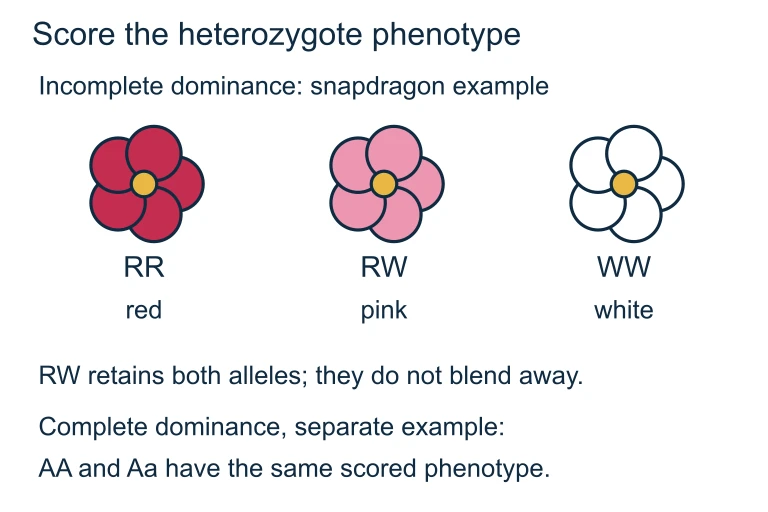 The heterozygote phenotype distinguishes dominance relationships. Snapdragon heterozygotes retain both alleles while producing intermediate color; AB red cells display both A and B carbohydrate antigens.
Codominance: both products are present
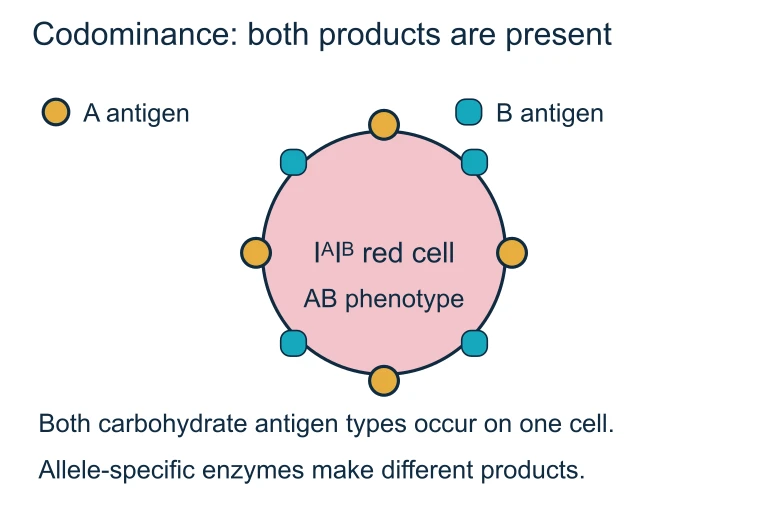 In the AB phenotype, both A and B carbohydrate antigen types occur on the same red cell because both allele-specific enzyme products are expressed.
Multiple Alleles: ABO Blood Type
A single gene can have more than two alleles in a population. The ABO blood group locus has three alleles: \( I^A \), \( I^B \), and \( i \). Each individual carries any two of them.
Polygenic Inheritance: Many Genes, One Trait
When two or more genes contribute additively to a single phenotype, the result is a continuous distribution of phenotypes rather than distinct categories. Classic examples: human skin color, height, and eye color.
Epistasis: One Gene Masks Another
Pleiotropy and Linked Genes
Sex-Linked Inheritance
Genes on the X chromosome follow a distinct pattern. Males (\( XY \)) express every X-linked allele because they have only one copy. Females (\( XX \)) can be carriers of recessive X-linked traits without showing symptoms.
How to Solve Non-Mendelian Problems
Example 1: Snapdragon Flower Color
Cross two pink snapdragons (\( RW \times RW \)). What are the offspring phenotypes?
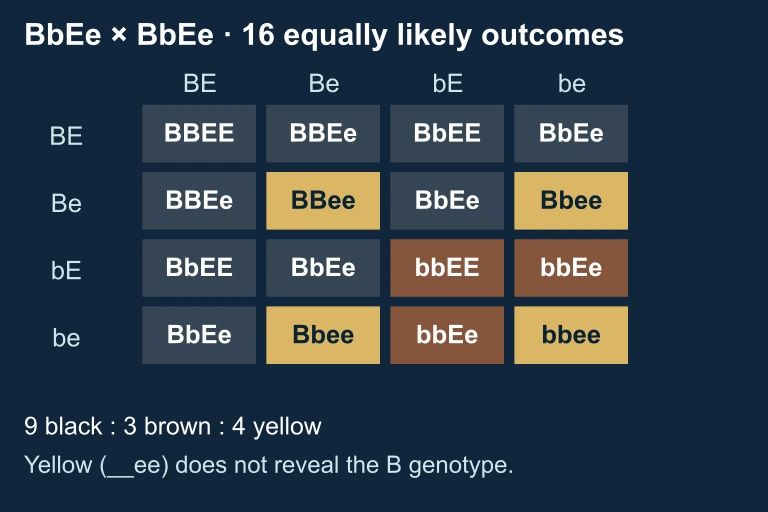
Example 2: Labrador Coat Color Epistasis
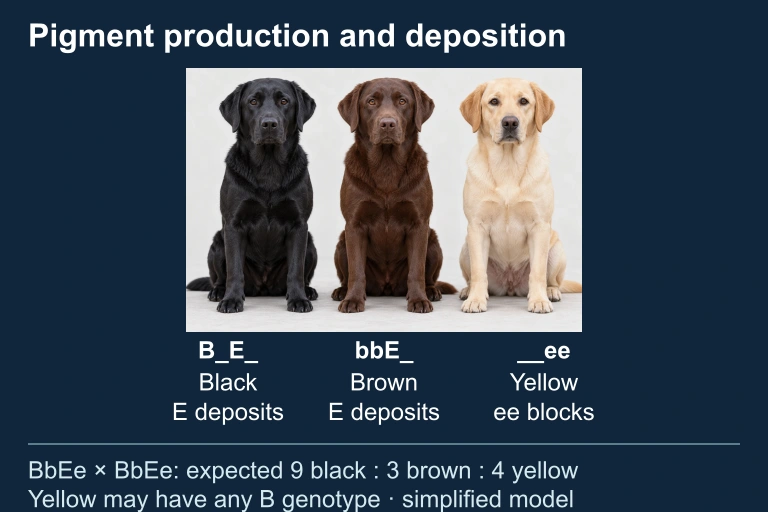
Cross \( BbEe \times BbEe \). What is the phenotypic ratio?
Example 3: X-Linked Color Blindness
A carrier woman (\( X^C X^c \)) marries a normal man (\( X^C Y \)). What fraction of their sons will be color blind?
Common Mistakes to Avoid
Summary: Non-Mendelian Patterns at a Glance
| Pattern | Heterozygote | Key Ratio | Example |
|---|---|---|---|
| Incomplete Dom. | Blend | \( 1:2:1 \) | Snapdragon color |
| Codominance | Both visible | \( 1:2:1 \) | Roan cattle, ABO |
| Multiple Alleles | Varies | Multiple phenotypes | ABO blood type |
| Polygenic | Additive | Bell curve | Skin color, height |
| Epistasis | Masked | \( 9:3:4 \) etc. | Lab coat color |
| Sex-Linked | Carrier females | Unequal by sex | Color blindness |
Question 1 of 5
A red flower is crossed with a white flower, and all \( F_1 \) offspring are pink. When two pink \( F_1 \) plants are crossed, the \( F_2 \) ratio is \( 1 \) red : \( 2 \) pink : \( 1 \) white. This is an example of:
Question 2 of 5
A person with blood type AB has the genotype \( I^A I^B \). The relationship between the \( I^A \) and \( I^B \) alleles is best described as:
Question 3 of 5
In Labrador retrievers, \( BbEe \times BbEe \) produces a 9:3:4 phenotypic ratio instead of the expected 9:3:3:1. This modified ratio indicates:
Question 4 of 5
A carrier woman (\( X^H X^h \)) and a normal man (\( X^H Y \)) have children. What is the probability that a randomly selected child will have hemophilia?
Question 5 of 5
Human skin color is determined by at least three genes, each with two alleles contributing additively. The phenotype distribution in a population forms a bell-shaped curve. This pattern is called: