Natural Selection
Continued
Explore the mechanisms, types, and evidence for natural selection: from directional and stabilizing selection to the Hardy-Weinberg principle and real-world applications.
What is Natural Selection?
Natural selection is the process by which organisms with heritable traits that are better suited to their environment tend to survive and reproduce at higher rates than organisms without those traits. Over generations, this shifts the allele frequencies in a population.
Four Conditions for Natural Selection
Fitness and Adaptation
Three Types of Selection
Directional Selection in Detail
Directional selection occurs when individuals at one extreme of a phenotypic range have higher fitness. Over time, the population's trait distribution shifts toward that extreme.
Stabilizing vs Disruptive
Natural Selection vs Genetic Drift
| Natural Selection | Genetic Drift | |
|---|---|---|
| Mechanism | Differential survival and reproduction | Random sampling of alleles |
| Direction | Non-random: favors adaptive traits | Random: no direction |
| Effect on fitness | Increases population fitness | May increase or decrease fitness |
| Population size | Effective in any size | Strongest in small populations |
| Outcome | Adaptation | Loss or fixation of alleles |
The Hardy-Weinberg Principle
The Hardy-Weinberg equations describe a population in genetic equilibrium: no evolution is occurring. When natural selection (or other forces) acts, allele frequencies deviate from these predictions.
Sexual Selection
Sexual selection is a special case of natural selection where traits are favored because they increase mating success, even if they reduce survival. It operates through two mechanisms:
How to Identify Selection Type
Example: Sickle Cell and Selection
In regions with malaria, the sickle-cell allele (\( H^S \)) is maintained at a higher frequency than expected. Let us analyze this using Hardy-Weinberg.
Example: Galapagos Finches
Calculating Relative Fitness
Relative fitness (\( w \)) compares the reproductive success of a genotype to the most fit genotype. The most fit genotype is assigned \( w = 1.0 \).
Evidence for Natural Selection
Field models test camouflage-dependent attack rates
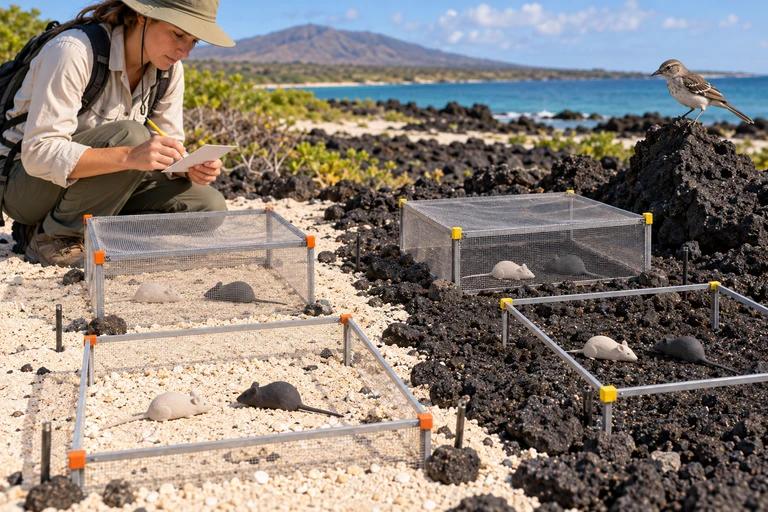 Compare light and dark models on both substrates, with predator-access and exclusion treatments. Randomized independent enclosures test camouflage-dependent attack rates; reproductive success requires additional evidence.
Test camouflage-dependent attack rates
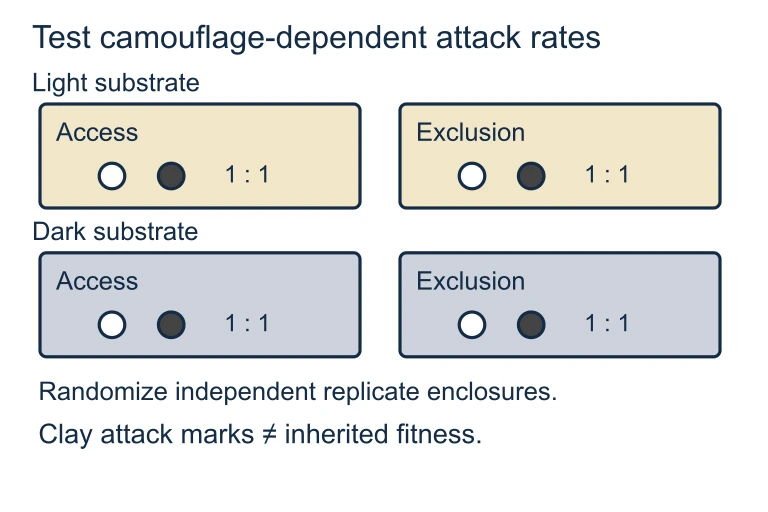 Compare light and dark models on both substrates, with predator-access and exclusion treatments. Randomized independent enclosures test camouflage-dependent attack rates; reproductive success requires additional evidence.
Common Mistakes
Selection Types: Summary
| Directional | Stabilizing | Disruptive | |
|---|---|---|---|
| Favored phenotype | One extreme | Intermediate | Both extremes |
| Effect on mean | Shifts in one direction | No change | May not change |
| Effect on variance | Decreases (one tail) | Decreases (both tails) | Increases |
| Example | Peppered moths | Human birth weight | Finch beak sizes |
| Frequency in nature | Common | Most common | Rare |
Question 1 of 5
A population of rabbits shows a shift in fur color from mostly light brown to mostly dark brown after a forest fire darkens the soil. This is an example of:
Question 2 of 5
In a population where \( p = 0.6 \) and \( q = 0.4 \), what is the expected frequency of heterozygous individuals under Hardy-Weinberg equilibrium?
Question 3 of 5
Human birth weight is an example of stabilizing selection because:
Question 4 of 5
Which of the following is NOT a condition required for Hardy-Weinberg equilibrium?
Question 5 of 5
The sickle-cell allele persists at relatively high frequencies in malaria-endemic regions because: