01 / 22

DNA Mutations

Explore how permanent changes in the DNA sequence drive evolution, cause disease, and shape the diversity of life on Earth.

AP Biology

What Is a Mutation?

A mutation is any permanent change in the nucleotide sequence of DNA. Mutations can occur in a single base pair or involve large segments of a chromosome. They are the ultimate source of all new genetic variation in every population.

Why Mutations Matter

★ Evolution
Mutations introduce new alleles that natural selection can act upon, driving adaptation over generations.
★ Disease
Harmful mutations can cause genetic disorders like sickle cell anemia, cystic fibrosis, and cancer.
★ Diversity
Mutations generate the raw genetic variation that makes each organism unique within a population.

Two Major Categories

Mutation Categories Gene-Level (Point) Substitution One base replaced Insertion Extra base(s) added Deletion Base(s) removed Chromosomal Deletion Segment lost Duplication Segment copied Inversion Segment reversed Translocation

Point Mutations: Substitutions

ORIGINAL CODON SEQUENCE A U G G A G Met Glu SUBSTITUTION (A → U) MISSENSE MUTATION A U G G U G Met Val (changed!)

Three Outcomes of Substitution

Silent
New codon codes for the same amino acid due to redundancy in the genetic code. No effect on protein.
Missense
New codon codes for a different amino acid. May alter protein folding and function (e.g., sickle cell).
Nonsense
New codon becomes a stop codon (UAA, UAG, UGA). Produces a truncated, usually nonfunctional protein.

Frameshift Mutations

ORIGINAL A U G G C U U U A Met Ala Leu INSERTION of C after first base FRAMESHIFT RESULT A C U G G C U U U Thr Gly Phe Every codon downstream is altered: completely different protein

Chromosomal Mutations

ORIGINAL CHROMOSOME SEGMENT A B C D E Deletion A B E C, D lost Duplication A B C D C D E Inversion A B D C E flipped Translocation A B X Y E from another chromosome

Somatic vs. Germline Mutations

Somatic Germline
Cells affected Body (non-reproductive) cells Eggs or sperm
Inherited? No: dies with organism Yes: passed to offspring
Evolutionary impact None: not in gene pool Drives evolution
Example Skin cancer from UV damage Inherited sickle cell allele
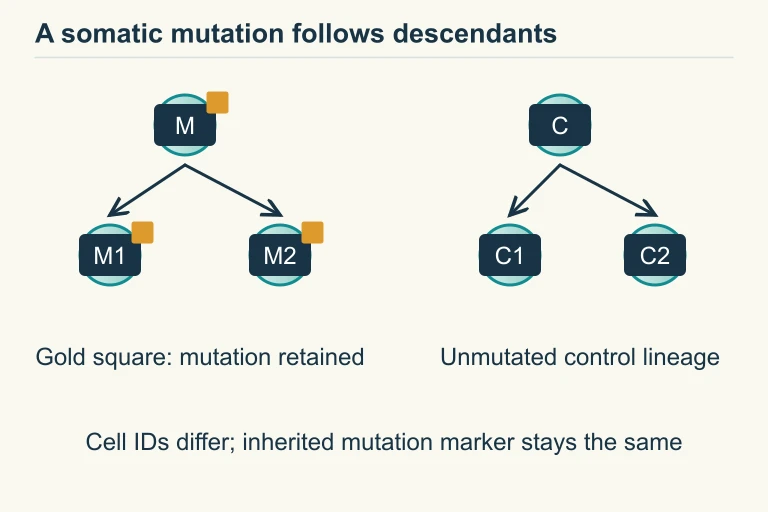
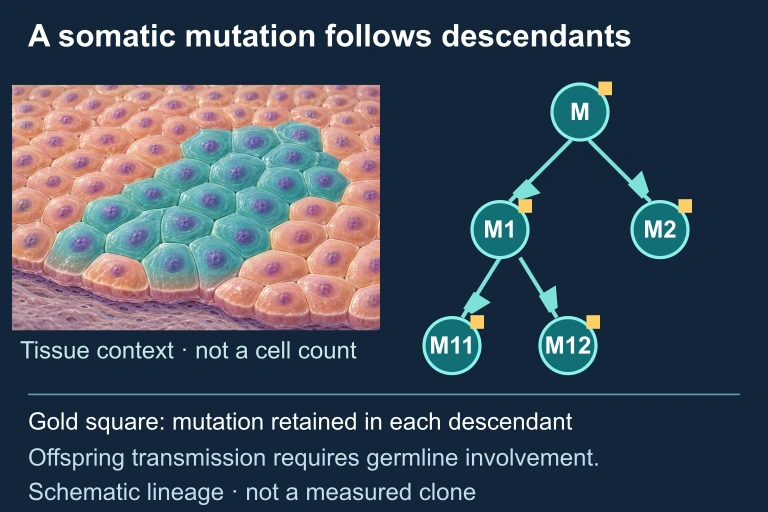
Original mutated and unmutated control lineage
A contextual tissue image accompanies an authored lineage from M to M1 and M2 and from M1 to M11 and M12, all carrying the mutation marker. A separate companion shows an unmutated control lineage.
A somatic mutation can be inherited by descendant cells within a tissue without entering the next organismal generation. Illustration is schematic where scale or molecular structure is simplified.

Causes: Mutagens and Errors

1
Spontaneous errors: DNA polymerase misincorporates a base during replication (roughly 1 error per \(10^9\) bases after proofreading).
2
Chemical mutagens: Substances like benzene, nitrous acid, or aflatoxin chemically modify bases, causing mispairing.
3
Radiation: UV light creates thymine dimers; X-rays break the DNA backbone, causing deletions and translocations.
4
Transposons: "Jumping genes" insert themselves into new locations, disrupting gene function or regulation.

Explain why DNA damage need not become a mutation.

A UV-induced lesion can be excised; an intact complementary strand guides gap filling, and ligase seals the remaining nick. DNA damage and a fixed sequence mutation are distinct events. The helix is illustrative and does not depict a measured structure or specific lesion.
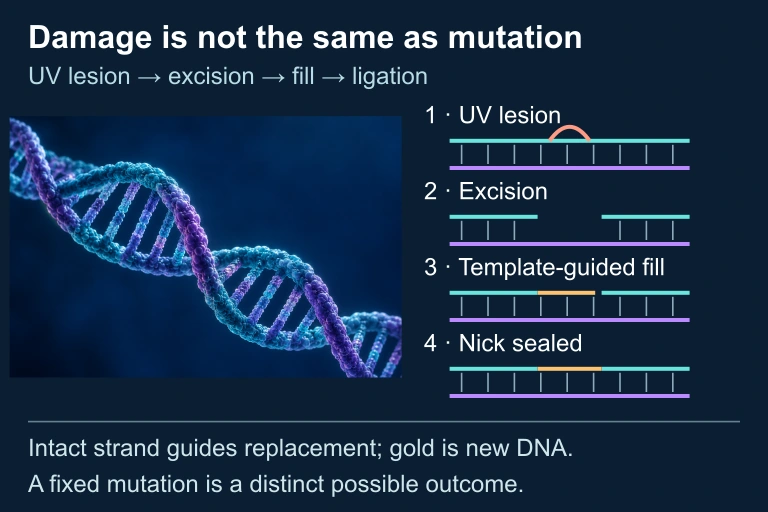
An illustrative DNA helix sits alongside four independently authored stages: UV lesion, excision, template-guided filling and sealing of a nick. The complementary strand remains intact.
A UV-induced lesion can be excised; an intact complementary strand guides gap filling, and ligase seals the remaining nick. DNA damage and a fixed sequence mutation are distinct events. The helix is illustrative and does not depict a measured structure or specific lesion.

Effects: Beneficial, Neutral, Harmful

Beneficial
Increases fitness. Example: mutations conferring antibiotic resistance in bacteria or lactose tolerance in humans.
Neutral
No effect on fitness. Most mutations fall here: silent substitutions or changes in noncoding DNA.
Harmful
Decreases fitness. Example: BRCA1 mutations dramatically increase breast cancer risk.

How to Identify Mutation Type

1
Compare sequences: Align the original and mutated DNA (or mRNA) side by side.
2
Count the bases: Same number = substitution. More = insertion. Fewer = deletion.
3
Check the reading frame: If the indel is not a multiple of 3, it is a frameshift. If it is a multiple of 3, only one amino acid is added/removed.
4
Translate both codons: Use the codon table to determine if the amino acid changes (missense), stays the same (silent), or becomes a stop (nonsense).
5
Predict the effect: Consider protein structure. Does the change affect the active site? Folding? Regulation?

Example 1: Silent Mutation

Original mRNA: G C U → Ala (Alanine) Mutated mRNA: G C C → Ala (Alanine) Same amino acid: Silent mutation!

Example 2: Nonsense Mutation

Original mRNA: U A C → Tyr (Tyrosine) Mutated mRNA: U A A → STOP Premature termination: Truncated protein!

Example 3: Frameshift Deletion

Consider an mRNA sequence: AUG-GCA-UUC-GAA, coding for Met-Ala-Phe-Glu.

If the C in GCA is deleted, the sequence becomes: AUG-GAU-UCG-AA...

Before Deletion
AUG | GCA | UUC | GAA → Met-Ala-Phe-Glu
After Deletion
AUG | GAU | UCG | AA... → Met-Asp-Ser-???

Common Mistakes

✕ All mutations are harmful
Most mutations are neutral (in noncoding DNA or silent). Many beneficial mutations drive adaptation and evolution.
✕ Substitution = frameshift
Substitutions replace one base with another, keeping the reading frame intact. Only insertions/deletions (not multiples of 3) cause frameshifts.
✕ Somatic mutations are inherited
Only germline mutations pass to offspring. Somatic mutations affect only the individual and are not transmitted to the next generation.

Mutation Summary Table

Type Mechanism Effect on Protein Severity
Silent Base substitution No change None
Missense Base substitution Different amino acid Variable
Nonsense Base substitution Premature stop Usually severe
Frameshift Insertion / deletion All downstream changed Usually severe
Chromosomal Large rearrangement Multiple genes affected Often severe

Question 1 of 5

A mutation changes the mRNA codon GAA to GAG. Both codons code for glutamic acid. What type of mutation is this?

Question 2 of 5

An insertion of two nucleotides into a coding region would most likely result in:

Question 3 of 5

A skin cell acquires a UV-induced mutation that causes uncontrolled division. This mutation is somatic. Which statement is true?

Question 4 of 5

The sickle cell allele is caused by a single base substitution in the beta-globin gene. In regions where malaria is endemic, heterozygous carriers have a survival advantage. This is an example of:

Question 5 of 5

A mutation changes a codon from UGG (tryptophan) to UGA (stop). What type of mutation is this, and what is the most likely consequence?