Mendelian
Genetics
Explore the foundational laws of inheritance discovered by Gregor Mendel: how traits are passed from parents to offspring through dominant and recessive alleles.
Who Was Gregor Mendel?
Gregor Mendel was a 19th-century Austrian monk who conducted thousands of crosses with pea plants (Pisum sativum) to discover how traits are inherited. His meticulous experiments revealed predictable patterns of inheritance that form the foundation of modern genetics.
Essential Vocabulary
Dominant vs. Recessive Alleles
A dominant allele (uppercase letter, e.g., \(B\)) masks the expression of a recessive allele (lowercase, e.g., \(b\)). Only organisms with two copies of the recessive allele (\(bb\)) express the recessive phenotype.
Mendel's First Law: Segregation
During gamete formation, the two alleles for each gene separate so that each gamete carries only one allele for each trait. This occurs during meiosis I when homologous chromosomes are pulled apart.
Mendel's Second Law: Independent Assortment
Genes for different traits assort independently during gamete formation, meaning the allele a gamete receives for one gene does not influence which allele it receives for another gene. This applies when genes are on different chromosomes.
The Principle of Dominance
In a heterozygote, one allele may be completely dominant over the other. The dominant allele is fully expressed while the recessive allele is masked. This means heterozygous (\(Bb\)) and homozygous dominant (\(BB\)) individuals look identical.
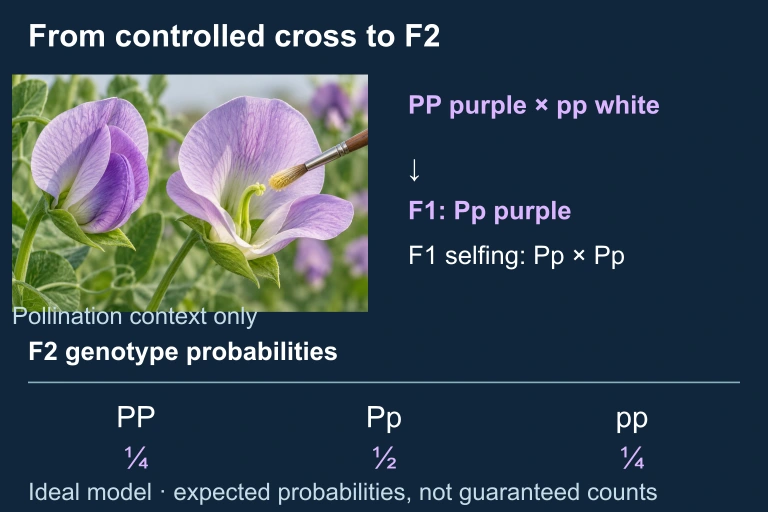
Explain how a controlled cross tests segregation.
Maternal anthers are removed before unintended self-pollination, then pollen is transferred from the selected donor. In the simplified model, PP purple × pp white produces purple F1 Pp; intentional F1 selfing gives expected F2 probabilities ¼ PP, ½ Pp, ¼ pp, not guaranteed family counts.
Genotype vs. Phenotype
| Genotype | Phenotype | |
|---|---|---|
| Definition | Genetic composition (alleles) | Observable trait expression |
| Notation | Letters: \(BB\), \(Bb\), \(bb\) | Description: purple, white |
| Determined by | Inherited allele combinations | Genotype + environment |
| Can be identical? | \(BB\) ≠ \(Bb\) | \(BB\) and \(Bb\) look the same |
| Revealed by | Genetic testing or test cross | Direct observation |
The Punnett Square
A Punnett square is a grid used to predict the genotype and phenotype ratios of offspring from a genetic cross. Each row and column represents the alleles contributed by one parent.
How to Solve a Monohybrid Cross
Example 1: \(Bb\) × \(Bb\)
Two heterozygous pea plants (\(Bb\) × \(Bb\)) are crossed. \(B\) = purple flowers (dominant), \(b\) = white flowers (recessive). What are the expected offspring ratios?
Example 2: The Test Cross
A plant with purple flowers (unknown genotype: \(B?\)) is crossed with a homozygous recessive (\(bb\)) plant. If any white offspring appear, the unknown parent must be \(Bb\).
Example 3: Dihybrid Cross
Cross two plants heterozygous for seed shape (\(R\) = round, \(r\) = wrinkled) and seed color (\(Y\) = yellow, \(y\) = green): \(RrYy\) × \(RrYy\).
Probability Rules in Genetics
Common Mistakes
Summary of Mendel's Laws
| Law / Principle | States That... | Key Cross | Expected Ratio |
|---|---|---|---|
| Segregation | Two alleles separate during meiosis | \(Bb \times Bb\) | 3:1 |
| Independent Assortment | Genes on different chromosomes sort independently | \(RrYy \times RrYy\) | 9:3:3:1 |
| Dominance | Dominant allele masks recessive | \(BB \times bb\) | All dominant |
Question 1 of 5
In a cross between two heterozygous pea plants (\(Bb \times Bb\)), what fraction of offspring are expected to show the recessive phenotype?
Question 2 of 5
A plant with purple flowers is crossed with a plant with white flowers (\(bb\)). All 40 offspring have purple flowers. The purple parent is most likely:
Question 3 of 5
Mendel's Law of Segregation occurs during which stage of cell division?
Question 4 of 5
In a dihybrid cross \(RrYy \times RrYy\), what is the expected phenotypic ratio of offspring?
Question 5 of 5
Using the multiplication rule, what is the probability of getting a homozygous dominant offspring from a \(Bb \times Bb\) cross, AND also getting a homozygous dominant offspring from a second, independent \(Bb \times Bb\) cross?