Membrane
Transport
How cells control what enters and exits through the plasma membrane: from passive diffusion to active pumps and vesicle trafficking.
The Plasma Membrane
Every living cell is enclosed by a selectively permeable plasma membrane built from a phospholipid bilayer. The hydrophilic heads face outward toward water, while the hydrophobic tails face inward, creating a barrier to most polar and charged molecules.
Why Transport Matters
Cells must constantly exchange materials with their environment. Nutrients must enter, wastes must exit, and ion gradients must be maintained for signaling and energy production. Without regulated transport, homeostasis collapses.
Passive Transport
Passive transport moves substances down their concentration gradient: from regions of higher concentration to regions of lower concentration. No cellular energy (ATP) is required: the driving force is the second law of thermodynamics.
Simple Diffusion in Action
Osmosis and Tonicity
Osmosis is the net movement of water across a selectively permeable membrane from a region of lower solute concentration to a region of higher solute concentration. The direction of water flow depends on tonicity.
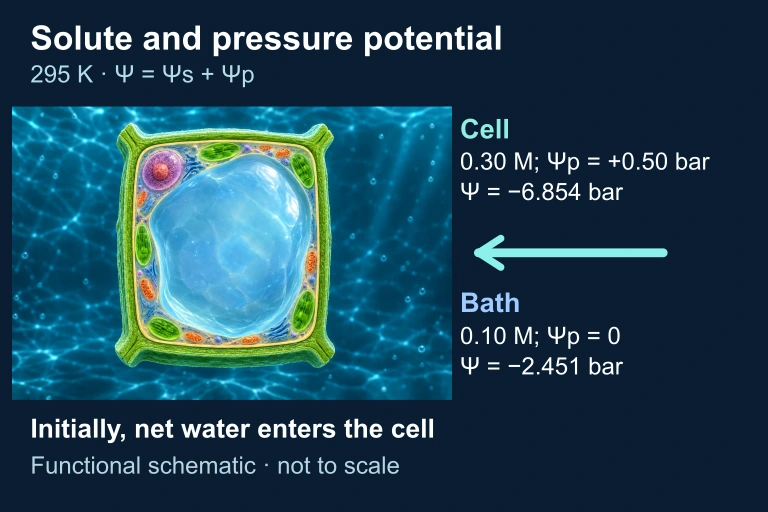
Predict water direction from total water potential rather than concentration alone.
Turgor raises water potential and can oppose solute effects; these stated initial conditions still favor water entry. Values are an explicitly stated teaching model.
A plant cell presses against a wall while an animal cell changes shape
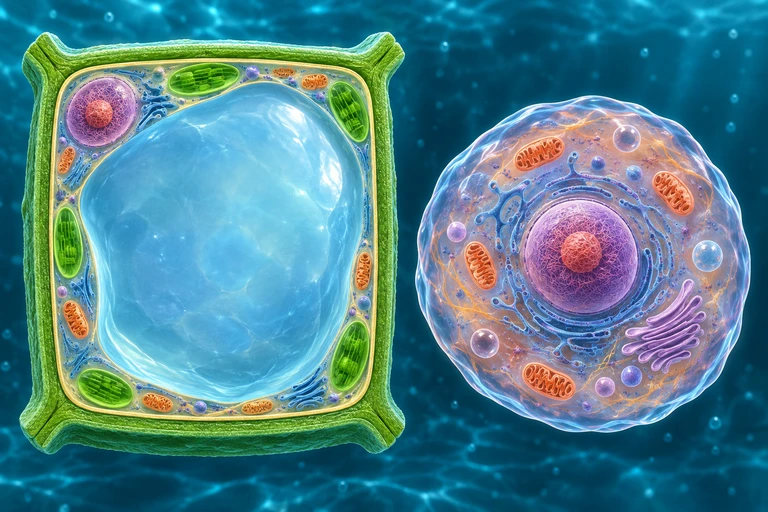 For nonpenetrating solutes, a plant wall limits expansion as water enters. Water loss retracts the protoplast from the wall during plasmolysis; animal cells lack this rigid wall.
Wall support changes the response
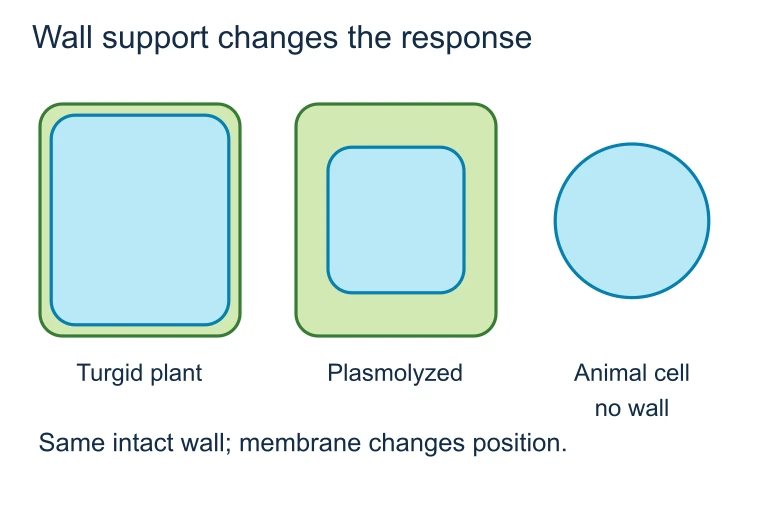 For nonpenetrating solutes, a plant wall limits expansion as water enters. Water loss retracts the protoplast from the wall during plasmolysis; animal cells lack this rigid wall.
Active Transport
Active transport moves substances against their concentration gradient (low → high). This requires energy, typically from ATP hydrolysis. It allows cells to accumulate needed molecules and expel wastes even when the gradient opposes movement.
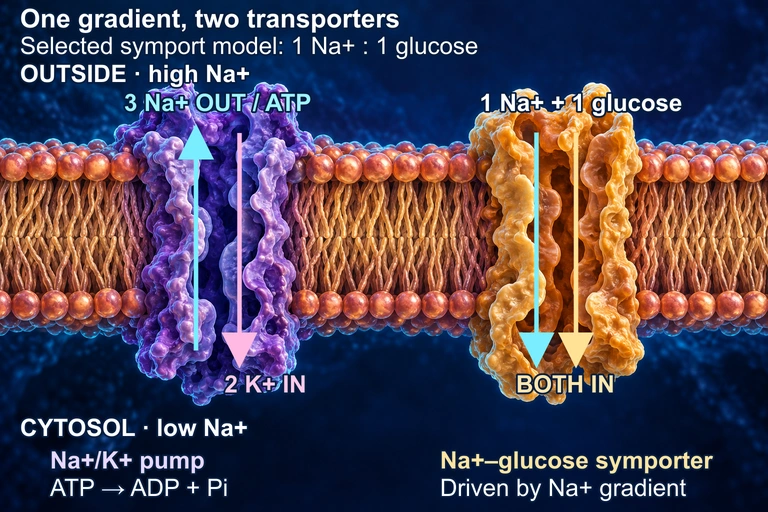
Primary vs Secondary Active Transport
Bulk Transport: Endo- and Exocytosis
Large molecules and particles that cannot cross the membrane through channels or pumps are moved in membrane-bound vesicles. These processes require ATP and involve remodeling of the plasma membrane itself.
Passive vs Active: Key Distinctions
| Passive Transport | Active Transport | |
|---|---|---|
| Energy Required | No | Yes (ATP) |
| Direction | High → Low (down gradient) | Low → High (against gradient) |
| Proteins Needed | Sometimes (facilitated) | Always (pumps or vesicles) |
| Saturability | Facilitated: yes; Simple: no | Yes (limited pump number) |
| Examples | \(O_2\) diffusion, aquaporins, glucose via GLUT | \(Na^+/K^+\) pump, endocytosis |
How to Identify the Transport Type
Example 1: Oxygen in the Alveoli
In the lungs, \(O_2\) concentration in the alveoli is higher than in the blood of pulmonary capillaries. How does \(O_2\) enter the blood?
Example 2: Glucose Uptake
After a meal, blood glucose concentration is higher outside muscle cells than inside. Glucose is a large, polar molecule. How does it enter the cell?
Example 3: The \(Na^+/K^+\) Pump
A neuron at rest has high \(Na^+\) outside and high \(K^+\) inside. To maintain this gradient after firing, the cell must move \(Na^+\) out and \(K^+\) in, both against their gradients. What type of transport is this?
Common Mistakes
Summary of Transport Types
| Type | Energy | Protein? | Direction |
|---|---|---|---|
| Simple diffusion | None | No | Down gradient |
| Facilitated diffusion | None | Yes (channel/carrier) | Down gradient |
| Osmosis | None | Aquaporins (optional) | Water → high solute |
| Primary active | ATP (direct) | Yes (pump) | Against gradient |
| Secondary active | ATP (indirect) | Yes (cotransporter) | Against gradient |
| Endocytosis/Exocytosis | ATP | Vesicle-based | Into / out of cell |
Question 1 of 5
A red blood cell is placed in a hypertonic solution. What will happen to the cell?
Question 2 of 5
Glucose enters a muscle cell via GLUT transporters down its concentration gradient. This is an example of:
Question 3 of 5
The \(Na^+/K^+\) ATPase pumps 3 \(Na^+\) out and 2 \(K^+\) in per cycle. Why is this considered primary active transport?
Question 4 of 5
A white blood cell engulfs a bacterium by wrapping its membrane around the pathogen and pinching off a vesicle. This process is called:
Question 5 of 5
Which of the following substances can cross the phospholipid bilayer by simple diffusion without any transport protein?