Membrane
Permeability
Explore how the phospholipid bilayer selectively controls what enters and exits cells: from simple diffusion to active transport.
What Is the Cell Membrane?
Every living cell is surrounded by a plasma membrane: a thin, flexible barrier composed primarily of a phospholipid bilayer studded with proteins. This membrane is not a rigid wall but rather a dynamic, fluid structure described by the fluid mosaic model.
The Phospholipid Bilayer
Why Selective Permeability Matters
Passive Transport: No Energy Required
Passive transport moves substances down their concentration gradient: from high concentration to low concentration. No cellular energy (ATP) is spent. The driving force is the natural tendency toward equilibrium.
Simple Diffusion Across the Bilayer
Facilitated Diffusion: Protein Assistance
Osmosis: Water Follows Solute
A plant cell presses against a wall while an animal cell changes shape
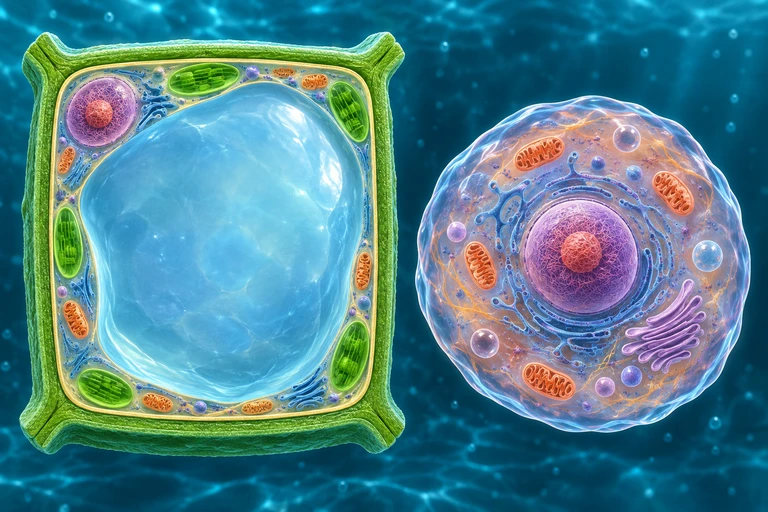 For nonpenetrating solutes, a plant wall limits expansion as water enters. Water loss retracts the protoplast from the wall during plasmolysis; animal cells lack this rigid wall.
Wall support changes the response
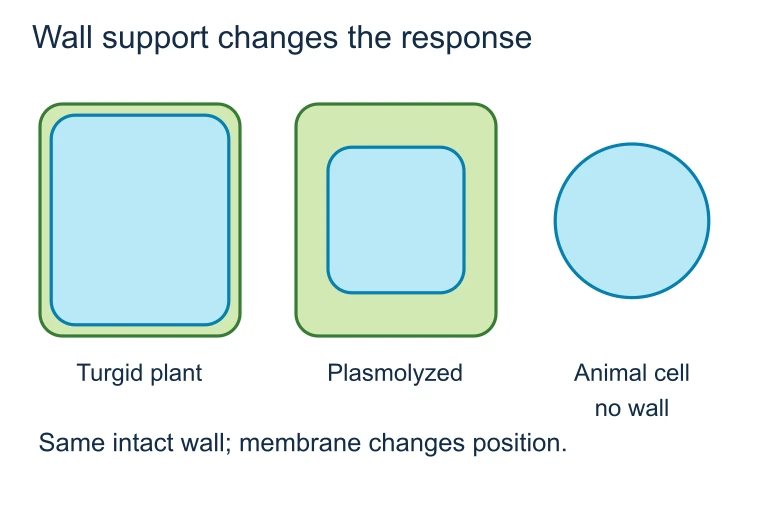 For nonpenetrating solutes, a plant wall limits expansion as water enters. Water loss retracts the protoplast from the wall during plasmolysis; animal cells lack this rigid wall.
Active Transport: Against the Gradient
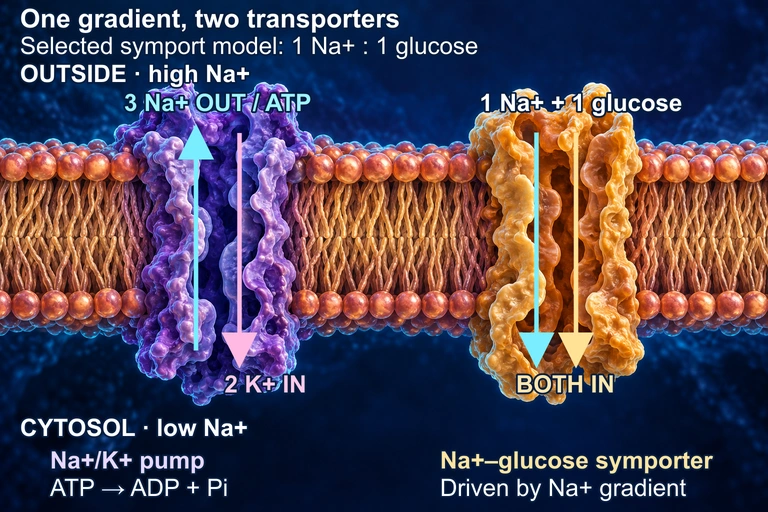
Active transport moves molecules against their concentration gradient: from low to high concentration. This requires cellular energy, usually in the form of ATP. The most famous example is the sodium-potassium pump.
Passive vs Active Transport
| Passive Transport | Active Transport | |
|---|---|---|
| Energy Required? | No | Yes (ATP) |
| Direction | High → Low (down gradient) | Low → High (against gradient) |
| Proteins Needed? | Sometimes (facilitated) | Always (pumps) |
| Examples | \( \text{O}_2 \) diffusion, osmosis, GLUT1 | \( \text{Na}^+/\text{K}^+ \) pump, \( \text{H}^+ \) pump |
| Reaches Equilibrium? | Yes | No (maintains gradient) |
Bulk Transport: Endo- and Exocytosis
Large molecules and particles that cannot cross the membrane through channels or pumps are moved in vesicles: membrane-bound compartments that bud off from or fuse with the plasma membrane.
Factors Affecting Permeability
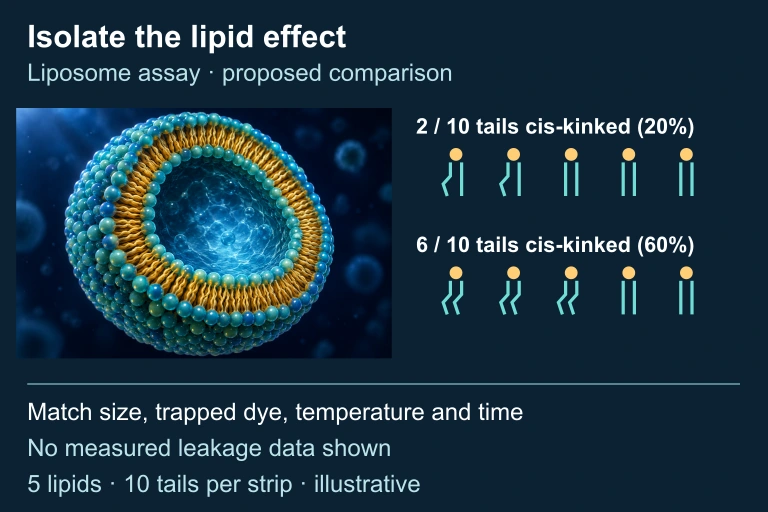
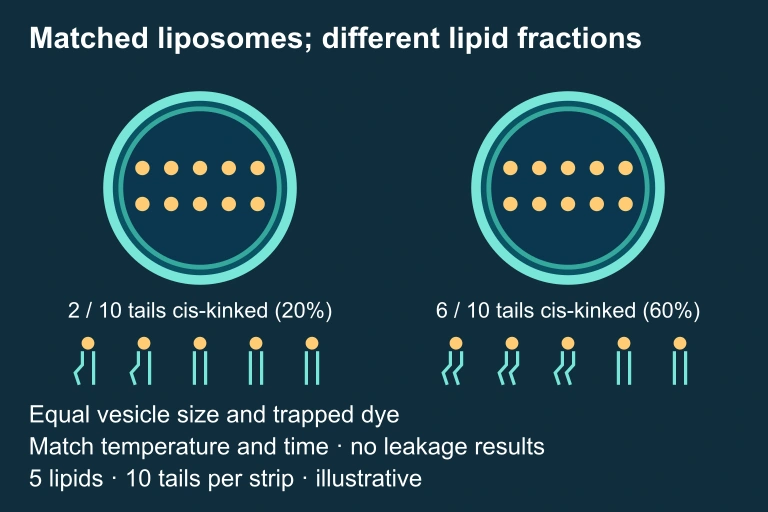
How to Determine Transport Type
Example 1: Oxygen in the Lungs
In the alveoli of the lungs, oxygen concentration is higher in the air sacs than in the blood capillaries. How does \( \text{O}_2 \) enter the blood?
Example 2: Glucose Entering a Cell
After a meal, blood glucose is higher than intracellular glucose. Glucose enters cells via GLUT transporters. What type of transport is this?
Example 3: \( \text{Na}^+/\text{K}^+ \) Pump in Neurons
After a nerve impulse, the neuron must restore resting potential by pumping 3 \( \text{Na}^+ \) out and 2 \( \text{K}^+ \) in, both against their concentration gradients.
Common Mistakes
Transport Summary
| Type | Energy? | Protein? | Example |
|---|---|---|---|
| Simple Diffusion | No | No | \( \text{O}_2 \), \( \text{CO}_2 \), steroids |
| Facilitated Diffusion | No | Yes | Glucose (GLUT), ions (channels) |
| Osmosis | No | Optional (aquaporins) | \( \text{H}_2\text{O} \) across membrane |
| Active Transport | Yes (ATP) | Yes | \( \text{Na}^+/\text{K}^+ \) pump, \( \text{H}^+ \) pump |
| Endocytosis/Exocytosis | Yes (ATP) | Yes (for formation) | Phagocytosis, secretion |
Question 1 of 5
A red blood cell is placed in a hypertonic solution. What will happen to the cell?
Question 2 of 5
Which molecule would most easily cross the phospholipid bilayer without any transport proteins?
Question 3 of 5
Facilitated diffusion differs from simple diffusion because facilitated diffusion:
Question 4 of 5
The \( \text{Na}^+/\text{K}^+ \) pump moves 3 \( \text{Na}^+ \) out and 2 \( \text{K}^+ \) in per ATP hydrolyzed. This transport is classified as:
Question 5 of 5
A cell needs to engulf a large bacterium. Which process will it use?