01 / 21

Meiosis &
Genetic Diversity

Explore how meiosis shuffles genetic information through crossing over, independent assortment, and random fertilization to produce unique offspring.

AP Biology

What Is Meiosis?

Meiosis is a specialized form of cell division that produces gametes (sperm and egg cells). Starting from a single diploid cell (\(2n\)), meiosis generates four genetically unique haploid cells (\(n\)), each with half the chromosome number of the parent.

Why Does Meiosis Matter?

★ Genetic Variation
Shuffles alleles so every gamete is genetically unique, fueling natural selection.
★ Constant Chromosome Number
Halves chromosome count so that fertilization restores the diploid number (\(2n\)).
★ Evolutionary Advantage
Variation enables populations to adapt to changing environments over generations.

Essential Vocabulary

1
Homologous chromosomes: Matching pairs (one from each parent) that carry genes for the same traits at the same loci.
2
Bivalent (tetrad): A paired structure of four chromatids formed when homologs synapse during prophase I.
3
Chiasma (pl. chiasmata): The physical point where non-sister chromatids exchange segments during crossing over.
4
Recombinant: A gamete with a new allele combination not found in either parent chromosome.

The Two Divisions of Meiosis

\(2n=4\) DNA Replication Meiosis I Pair A Pair B Crossing over occurs here Homologs separate \(n=2\) \(n=2\) Meiosis II Sister chromatids separate \(n\) \(n\) \(n\) \(n\) 4 genetically unique haploid cells

Three Sources of Genetic Variation

1 Crossing Over
Non-sister chromatids exchange segments during prophase I, creating recombinant chromosomes.
2 Independent Assortment
Homologous pairs orient randomly at the metaphase plate, producing \(2^n\) possible gamete combinations.
3 Random Fertilization
Any sperm can fuse with any egg, amplifying the total genetic combinations exponentially.
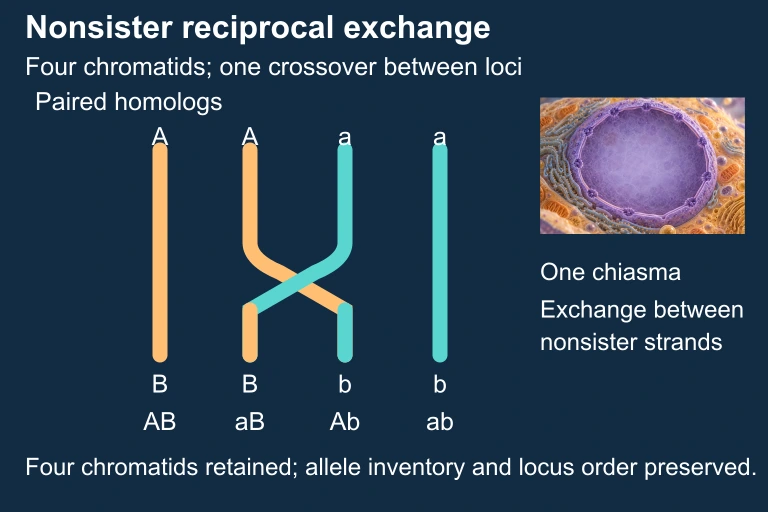
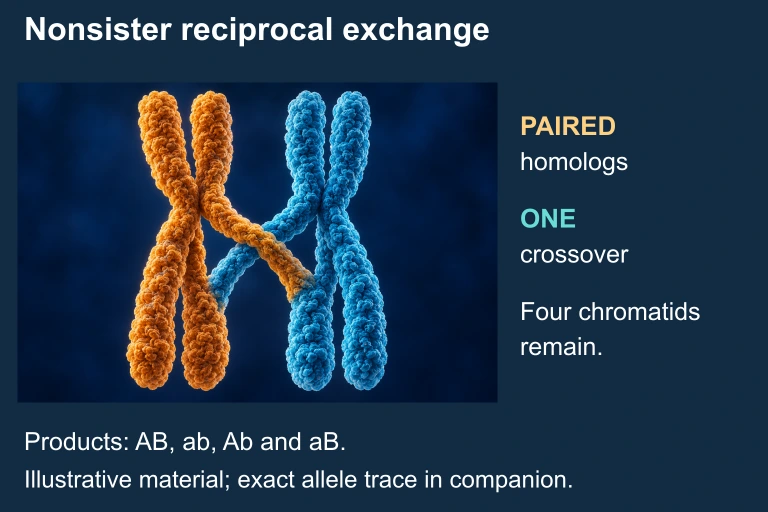
Trace the two nonsister chromatids and four resulting haplotypes.
Illustrative paired chromosomes with a crossover; a separate authored trace shows four chromatids and AB, ab, Ab and aB products.
Paired homologs allow exchange between nonsister chromatids during meiotic prophase I. Illustration is schematic where scale or molecular structure is simplified.

Crossing Over in Detail

Before Maternal Paternal A B C a b c Chiasma After Parental Recomb. Recomb. Parental A B C A B c a b C a b c Result of Crossing Over 2 parental chromatids + 2 recombinant chromatids New allele combinations: ABc, abC

Independent Assortment

Arrangement 1 plate A a B b AB ab Arrangement 2 plate A a b B Ab aB With \(n = 2\) chromosome pairs: Possible gamete types = \(2^n = 2^2 = 4\) Humans (\(n = 23\)): over 8 million combinations

Random Fertilization Multiplies Variation

Each parent produces \(2^{23}\) ≈ 8.4 million genetically distinct gametes through independent assortment alone. When a random sperm fertilizes a random egg:

This is why, except for identical twins, no two siblings are genetically the same. Each child represents a unique combination of parental alleles.

Meiosis I vs Meiosis II

Meiosis I Meiosis II
What separates Homologous chromosomes Sister chromatids
Starting ploidy Diploid (\(2n\)) Haploid (\(n\))
Ending ploidy Haploid (\(n\)) Haploid (\(n\))
Crossing over? Yes (prophase I) No
Independent assortment? Yes (metaphase I) No
Product cells 2 haploid cells 4 haploid cells
Similar to mitosis? No: unique Yes: very similar

Mitosis vs Meiosis

Mitosis Meiosis
Divisions 1 2
Daughter cells 2 (diploid) 4 (haploid)
Genetic identity Identical to parent Unique from parent
Crossing over No Yes
Function Growth, repair Gamete production
Occurs in Somatic cells Germ cells (gonads)

How to Trace Genetic Variation

1
Identify the organism's chromosome number (\(2n\)) and determine the haploid number (\(n\)).
2
Calculate gamete types from independent assortment: \(2^n\) possible combinations per parent.
3
Account for crossing over: Each chiasma creates two new recombinant chromatids, further multiplying variation.
4
Multiply by random fertilization: Total unique zygote combinations = \(2^n \times 2^n = 2^{2n}\) (without crossing over).
5
State the conclusion: All three mechanisms together ensure near-infinite genetic diversity in offspring.

Example 1: Fruit Fly Gamete Types

A fruit fly (Drosophila melanogaster) has a diploid number of \(2n = 8\). How many genetically distinct gamete types can be produced by independent assortment alone?

Example 2: Human Genetic Diversity

Humans have \(2n = 46\) chromosomes. Calculate the number of unique zygote combinations from independent assortment and random fertilization.

1
Haploid number: \(n = 23\)
2
Gametes per parent: \(2^{23} = 8{,}388{,}608\) (over 8.3 million)
3
Unique zygotes: \(2^{23} \times 2^{23} = 2^{46} \approx 7 \times 10^{13}\) (about 70 trillion)

Example 3: Nondisjunction Errors

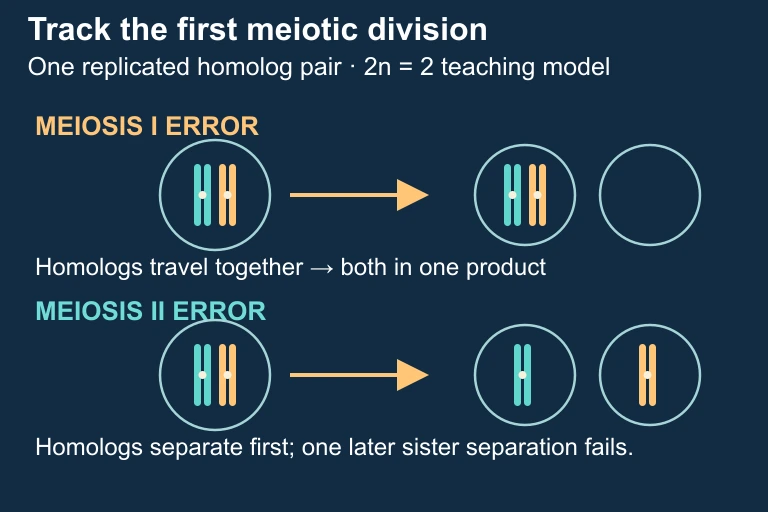
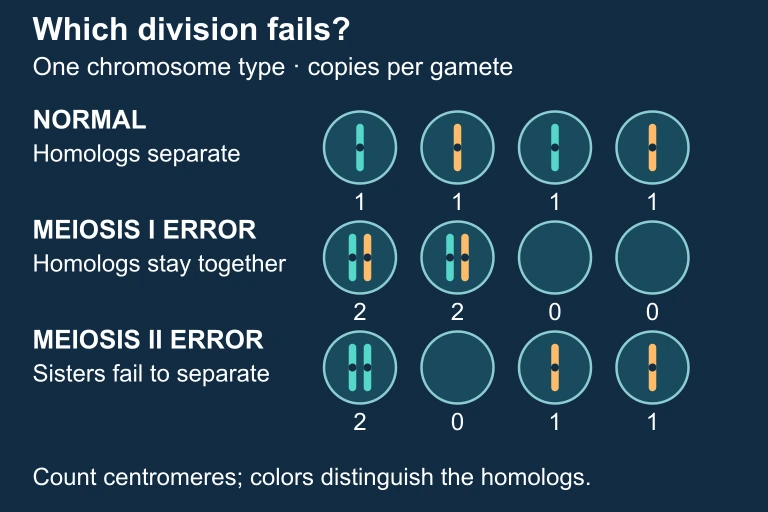
Sometimes homologous chromosomes (meiosis I) or sister chromatids (meiosis II) fail to separate. This produces gametes with abnormal chromosome numbers.
Normal \(2n\) \(n\) \(n\) Nondisjunction \(2n\) Both go to one side \(n+1\) \(n-1\) Trisomy (\(2n+1\)) Monosomy (\(2n-1\)) Clinical example: Trisomy 21 (Down syndrome): 3 copies of chromosome 21
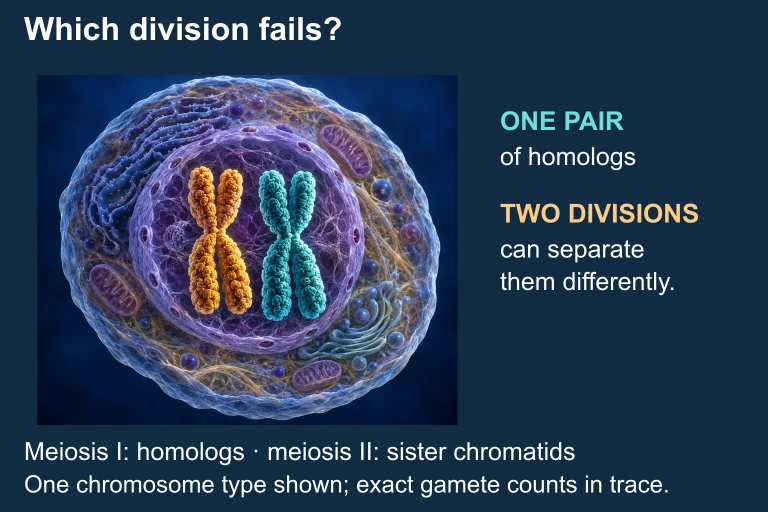
Compare first-division products.
Compare four gamete copy counts.
Illustrative meiotic cell with two replicated homologs; exact authored views compare division errors and gamete chromosome counts.
The meiotic stage at which nondisjunction occurs changes the pattern of chromosome copies among gametes. Illustration is schematic where scale or molecular structure is simplified.

Common Mistakes

✕ Confusing Meiosis I and II
Homologs separate in Meiosis I, sister chromatids in Meiosis II. They are not interchangeable.
✕ Saying Meiosis = Mitosis ✕ 2
Only Meiosis II resembles mitosis. Meiosis I is unique: it involves synapsis, crossing over, and reduction.
✕ Forgetting Crossing Over
Students often calculate \(2^n\) and stop. Crossing over adds variation beyond what independent assortment provides.

Question 1 of 5

During which phase of meiosis does crossing over occur?

Question 2 of 5

An organism has a diploid number of \(2n = 14\). How many genetically distinct gamete types are possible from independent assortment alone?

Question 3 of 5

Which of the following correctly distinguishes Meiosis I from Meiosis II?

Question 4 of 5

Nondisjunction during meiosis I would most directly result in:

Question 5 of 5

A student claims that independent assortment alone can produce recombinant chromosomes. Is this claim correct?