Meiosis
The Division of Life
Understand how one diploid cell produces four unique haploid gametes through two rounds of division, crossing over, and independent assortment.
What Is Meiosis?
Meiosis is a specialized form of cell division that reduces the chromosome number by half. Starting from a single diploid cell (\(2n\)), meiosis produces four genetically distinct haploid cells (\(n\)).
Unlike mitosis, which produces identical copies, meiosis introduces genetic variation through crossing over, independent assortment, and random fertilization.
Why Meiosis Matters
Key Vocabulary
Two Divisions: Meiosis I and Meiosis II
Stages of Meiosis I
Stages of Meiosis II
Meiosis vs Mitosis
| Feature | Meiosis | Mitosis |
|---|---|---|
| Divisions | Two (I and II) | One |
| Daughter cells | 4 haploid (\(n\)) | 2 diploid (\(2n\)) |
| Genetic identity | Genetically unique | Genetically identical |
| Crossing over | Yes (Prophase I) | No |
| Synapsis | Yes | No |
| Purpose | Gamete production | Growth and repair |
Sources of Genetic Variation
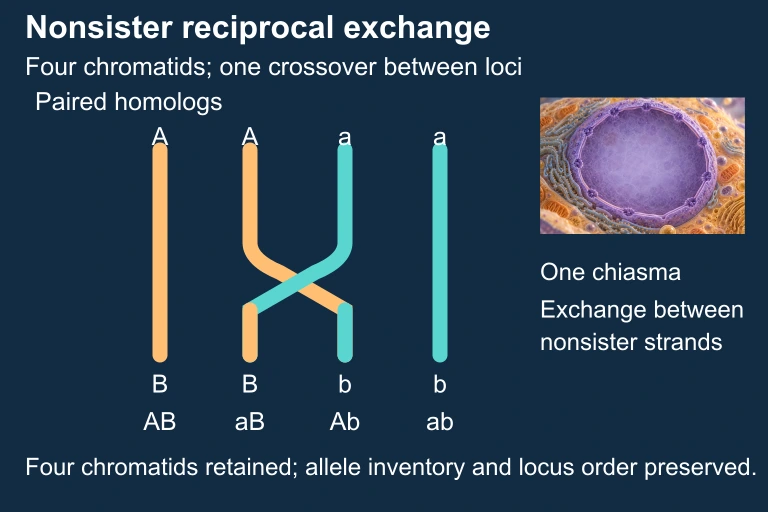
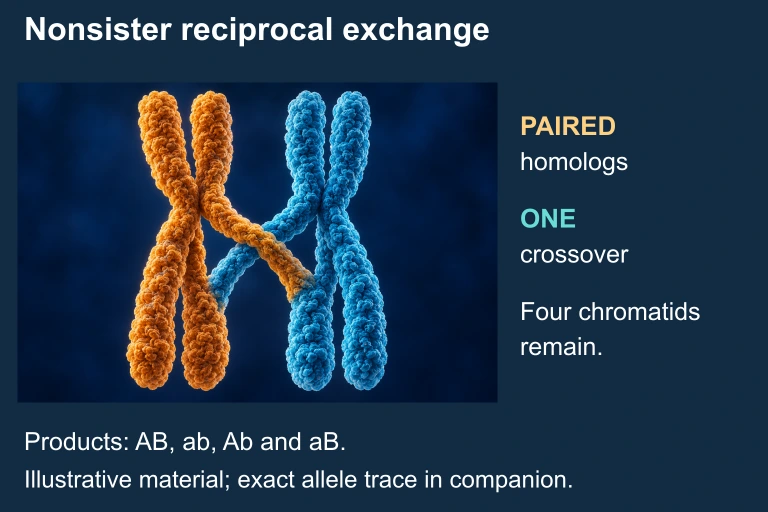
Crossing Over in Prophase I
Independent Assortment at Metaphase I
How to Solve Meiosis Problems
Example: Chromosome Counting
A cell with \(2n = 8\) chromosomes undergoes meiosis. How many chromosomes are in each cell at the end of Meiosis I? At the end of Meiosis II?
Example: DNA Content Through Meiosis
Track the DNA content per cell through meiosis using the standard \(c\)-value notation, where \(c\) = the haploid amount of DNA.
Example: Nondisjunction
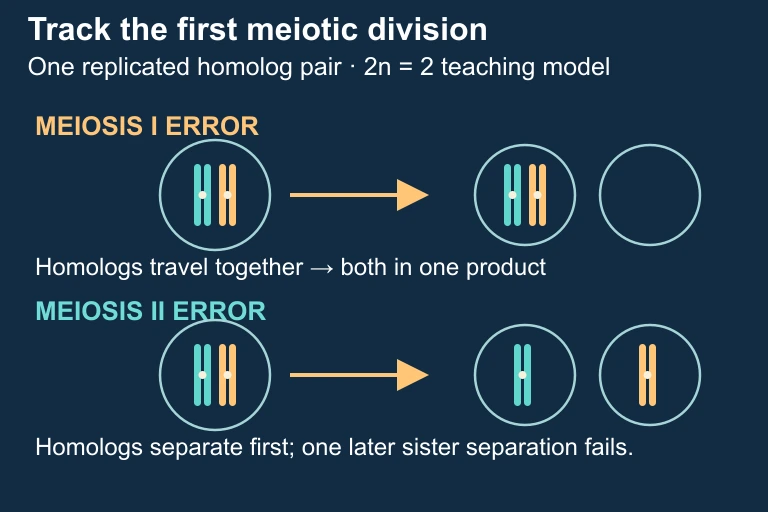
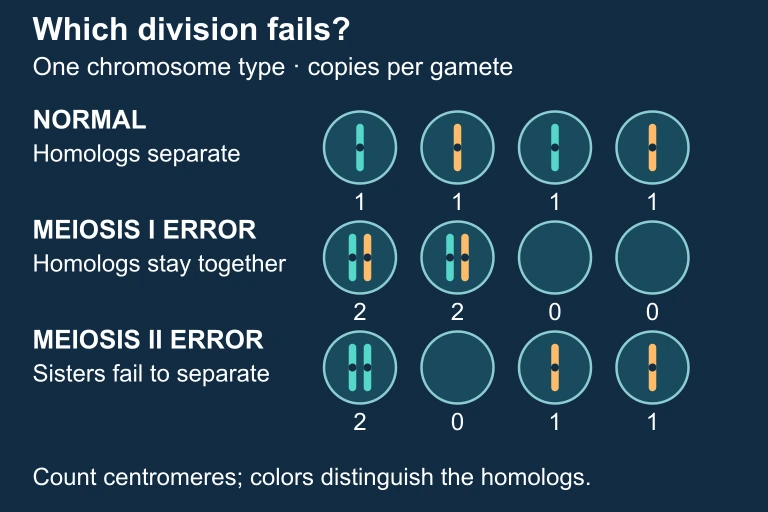
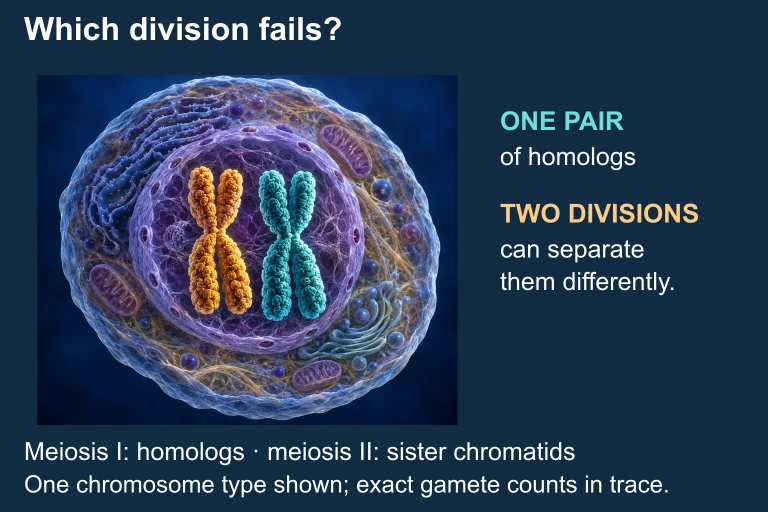
Nondisjunction is the failure of chromosomes to separate properly during meiosis. It can occur in Meiosis I (homologs fail to separate) or Meiosis II (sister chromatids fail to separate).
Distinguish the gamete outcomes of nondisjunction at different divisions.
The meiotic stage at which nondisjunction occurs changes the pattern of chromosome copies among gametes. Illustration is schematic where scale or molecular structure is simplified.
Common Mistakes
Summary: Meiosis at a Glance
| Stage | What Separates | Result | Ploidy |
|---|---|---|---|
| Meiosis I | Homologous chromosomes | 2 cells | \(n\) (replicated) |
| Meiosis II | Sister chromatids | 4 cells | \(n\) (unreplicated) |
| Crossing Over | Prophase I | Recombinant chromatids | N/A |
| Ind. Assortment | Metaphase I | \(2^n\) combinations | N/A |
Question 1 of 5
A cell with \(2n = 14\) undergoes meiosis. How many chromosomes will each resulting gamete contain?
Question 2 of 5
During which stage of meiosis does crossing over occur?
Question 3 of 5
An organism has \(n = 4\) chromosome pairs. How many genetically different gamete types can be produced by independent assortment alone?
Question 4 of 5
What is the primary difference between Meiosis I and Meiosis II?
Question 5 of 5
Nondisjunction during Meiosis I results in gametes that are: