01 / 20

Lipids
Structure and Function

Explore the hydrophobic macromolecules that build membranes, store energy, and signal between cells.

AP Biology

What Are Lipids?

Lipids are a diverse group of hydrophobic or amphipathic biomolecules. Unlike proteins, carbohydrates, and nucleic acids, lipids are not true polymers: they are not built from repeating monomer subunits linked by condensation reactions.

Lipids are united by their physical behavior (hydrophobicity) rather than a shared chemical structure: this makes them the most structurally diverse class of biological macromolecules.

Major Categories of Lipids

Fats and Oils
Triglycerides: glycerol + 3 fatty acids. Long-term energy storage.
Phospholipids
Glycerol + 2 fatty acids + phosphate group. Form cell membranes.
Steroids
Four fused carbon rings. Include cholesterol, testosterone, estrogen.
Waxes
Long-chain fatty acid + long-chain alcohol. Waterproof coatings.

Why Lipids Matter

1
Energy storage: Fats store about \( 9 \text{ kcal/g} \), more than twice that of carbohydrates (\( \approx 4 \text{ kcal/g} \)).
2
Membrane structure: Phospholipid bilayers form the selectively permeable barrier of every cell.
3
Signaling: Steroid hormones, prostaglandins, and lipid-soluble vitamins (A, D, E, K) regulate body processes.
4
Insulation and protection: Adipose tissue cushions organs and reduces heat loss.

Glycogen and fat store the same energy in different physical packages
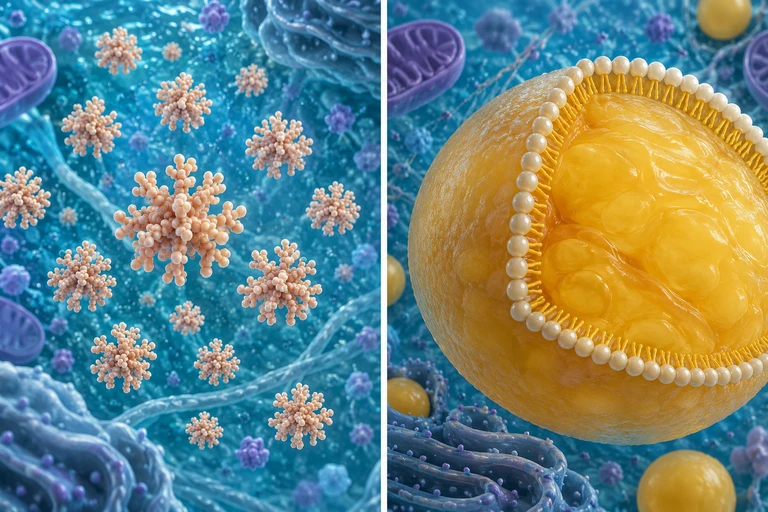
An aqueous glycogen-granule region contrasts with a neutral-lipid droplet bearing one boundary layer; exact bars compare equal-energy storage masses.Using approximate nutritional energy densities of 4 and 9 kcal/g, 100 kcal requires 25 g of dry glycogen or 11.1 g of fat. If glycogen carries 2 g of water per gram, its total storage mass is 75 g; hydration varies.

Compare the same energy target
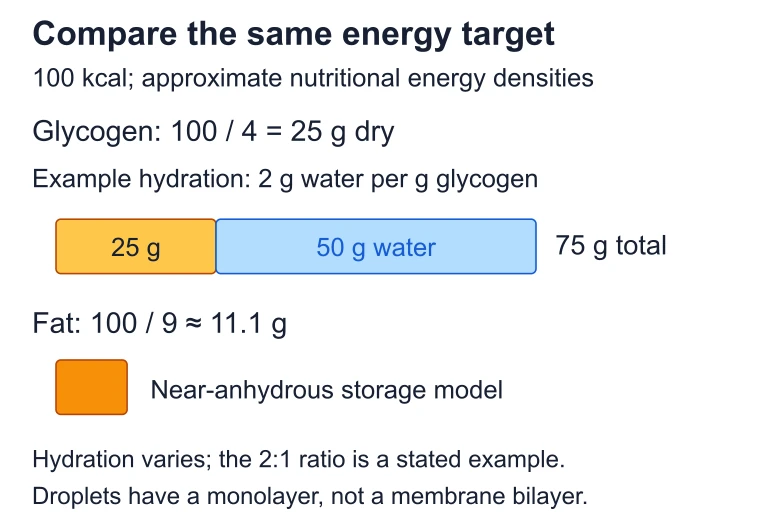
Compare the same energy target. Using approximate nutritional energy densities of 4 and 9 kcal/g, 100 kcal requires 25 g of dry glycogen or 11.1 g of fat. If glycogen carries 2 g of water per gram, its total storage mass is 75 g; hydration varies.Using approximate nutritional energy densities of 4 and 9 kcal/g, 100 kcal requires 25 g of dry glycogen or 11.1 g of fat. If glycogen carries 2 g of water per gram, its total storage mass is 75 g; hydration varies.

Fatty Acid Structure

\( \text{COOH} \)
Carboxyl
\( \text{CH}_2 \)
\( \text{CH}_2 \)
\( \text{CH}_2 \)
...
\( \text{CH}_2 \)
\( \text{CH}_3 \)
Methyl Hydrocarbon chain (nonpolar, hydrophobic) Polar head

Saturated vs. Unsaturated

Saturated No C=C double bonds Straight chain: packs tightly Solid at room temperature Unsaturated cis bend cis bend Has C=C double bonds Kinked chain: packs loosely Liquid at room temperature Trans fats: unsaturated but straight (trans configuration at C=C)

Triglycerides: Energy Storage

Glycerol ester ester ester Fatty acid 1 (saturated) Fatty acid 2 (unsaturated) Fatty acid 3 (unsaturated) Triglyceride (triacylglycerol)

The Phospholipid Bilayer

Extracellular fluid (aqueous) Cytoplasm (aqueous) Polar heads Nonpolar tails
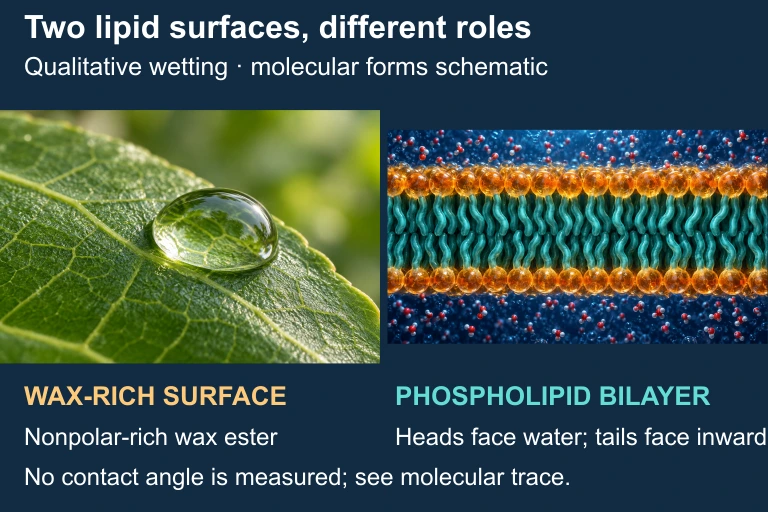
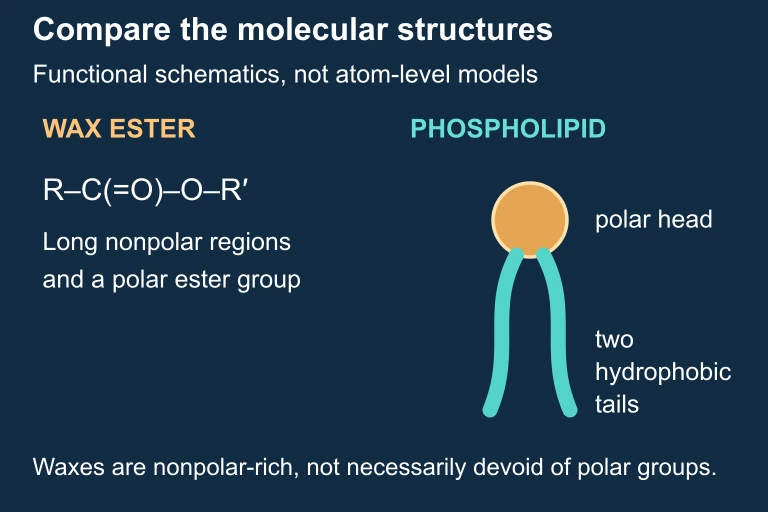
A droplet on a leaf beside a conceptual bilayer; a molecular trace compares a wax ester to a phospholipid with a polar head and two tails.
A wax-rich cuticle limits wetting, while phospholipids organize with polar heads exposed to water. Illustration is schematic where scale or molecular structure is simplified.
Compare a wax ester with a phospholipid head and two tails.

Steroids: Four-Ring Framework

A B C D Steroid core: 3 six-membered + 1 five-membered ring Examples Cholesterol Testosterone Estrogen

Fats vs. Phospholipids

Triglycerides (Fats) Phospholipids
Glycerol Yes Yes
Fatty acid tails 3 2
Phosphate group No Yes
Polarity Entirely nonpolar Amphipathic
Primary function Energy storage Membrane structure
In water Clump together Form bilayers / micelles

How to Identify a Lipid

1
Check solubility: Does the molecule dissolve in nonpolar solvents but NOT in water?
2
Look for long hydrocarbon chains: Fatty acids have chains of 12+ carbons with mostly C-H bonds.
3
Identify the backbone: Glycerol backbone indicates a fat or phospholipid. Fused ring structure indicates a steroid.
4
Count the components: 3 fatty acids = triglyceride. 2 fatty acids + phosphate = phospholipid.
5
Check for double bonds: No C=C = saturated. One or more C=C = unsaturated (mono- or polyunsaturated).

Example: Dehydration Synthesis

A glycerol molecule reacts with three fatty acids. How many water molecules are released, and what type of bond forms?

Glycerol + FA 1 FA 2 FA 3 Triglyceride +
\( 3\,\text{H}_2\text{O} \)

Example: Predicting State

Butter contains mainly saturated fatty acids. Olive oil contains mainly unsaturated fatty acids. Which is solid at room temperature, and why?

Butter
Saturated chains are straight. They pack tightly via van der Waals interactions. Solid at room temp.
Olive Oil
Unsaturated chains have cis kinks. They cannot pack tightly. Liquid at room temp.

Example: Membrane Fluidity

A cell membrane at low temperature becomes too rigid. Which modifications would increase fluidity?
1
More unsaturated fatty acid tails: Kinks prevent tight packing, keeping the membrane fluid.
2
Shorter fatty acid tails: Fewer van der Waals interactions between neighboring phospholipids.
3
Cholesterol: At low temperatures, cholesterol inserts between phospholipids to prevent tight crystalline packing, acting as a fluidity buffer.
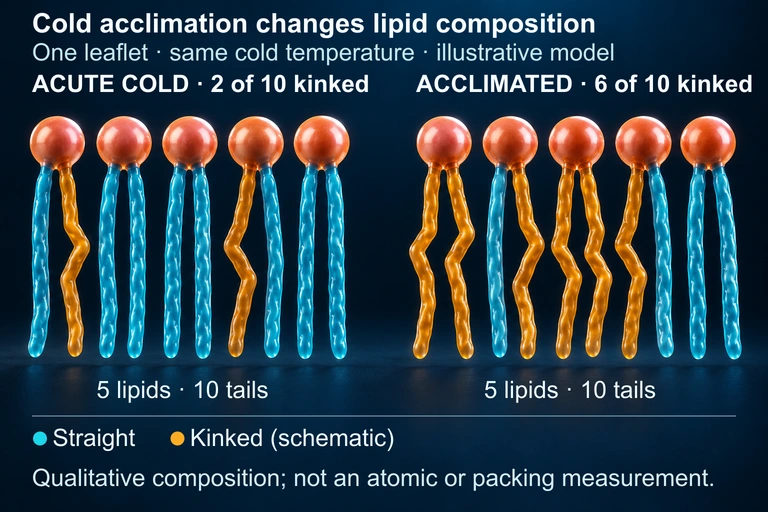
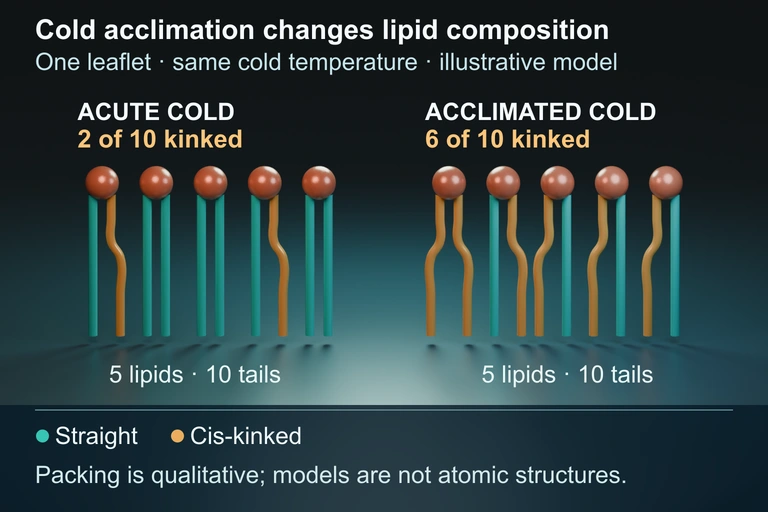
Two illustrated single leaflets each have five lipid heads and ten tails. In the acute cold example, two tails are kinked; in the acclimated cold example, six are kinked. Both are shown at the same cold temperature.
Some organisms acclimate to cold by increasing unsaturated fatty-acid content, helping maintain membrane fluidity. This qualitative composition model compares leaflets at the same cold temperature; it is not an atomic structure or packing measurement.
Authored geometry companion

Common Mistakes

✕ Lipids are polymers
Lipids are NOT true polymers. They do not consist of repeating monomer subunits like proteins or nucleic acids.
✕ Unsaturated = unhealthy
Unsaturated fats (especially omega-3 and omega-6) are generally beneficial. Trans fats, not all unsaturated fats, are harmful.
✕ Cholesterol is only bad
Cholesterol is essential: it stabilizes membranes and serves as a precursor for steroid hormones and vitamin D.

Lipid Summary

Lipid Type Building Blocks Function Example
Triglyceride Glycerol + 3 fatty acids Energy storage Body fat, oils
Phospholipid Glycerol + 2 FA + phosphate Cell membranes Bilayer
Steroid 4 fused carbon rings Signaling, structure Cholesterol
Wax Fatty acid + long alcohol Waterproofing Cuticle, beeswax

Question 1 of 5

Which structural feature makes phospholipids amphipathic?

Question 2 of 5

During the formation of a triglyceride, how many water molecules are released?

Question 3 of 5

An unsaturated fatty acid differs from a saturated fatty acid because it contains:

Question 4 of 5

At low temperatures, cholesterol in a cell membrane primarily functions to:

Question 5 of 5

Why are lipids not classified as true polymers?