Introduction to
Natural Selection
Explore how heritable variation, differential survival, and reproduction drive the evolution of populations over time.
What Is Evolution?
In biology, evolution is the change in allele frequencies within a population over successive generations. It is not about individual organisms changing during their lifetimes: it is about populations shifting over time.
Natural selection is one of the primary mechanisms that drives evolution. Charles Darwin and Alfred Russel Wallace independently proposed this mechanism in the 19th century.
The Four Conditions for Natural Selection
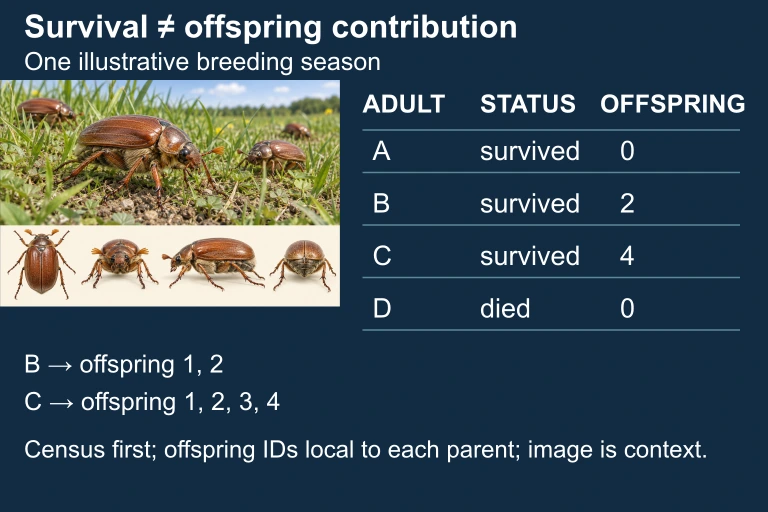
Explain fitness as contribution to later generations.
One illustrative breeding-season ledger separates survival from offspring contribution. The beetle illustration and four-angle strip provide organism context only; they are not identified as synthetic adults A–D or used to infer their offspring.
Visualizing Variation in a Population
A population of Darwin's finches shows a bell-shaped distribution of beak depths. The mean represents the average, while the full spread shows the variation that natural selection can act upon.
The Core Mechanism of Natural Selection
Understanding Fitness
In evolutionary biology, fitness does not mean physical strength. It is a measure of an organism's reproductive success: how many viable offspring it contributes to the next generation relative to other individuals.
Natural Selection vs. Other Evolutionary Mechanisms
| Natural Selection | Genetic Drift | |
|---|---|---|
| Driver | Environmental pressure | Random chance events |
| Direction | Non-random: favors advantageous traits | Random: no consistent direction |
| Population size | Operates in any size population | Strongest in small populations |
| Outcome | Adaptive evolution (better fit to environment) | Non-adaptive change (may lose beneficial alleles) |
Three Modes of Selection
How to Identify Natural Selection in a Scenario
Example 1: Peppered Moths
Example 2: Antibiotic Resistance
Example 3: Stabilizing Selection in Human Birth Weight
Stabilizing selection in human birth weight: babies that are too light or too heavy historically had lower survival rates. The optimal range around 3.5 kg had the highest infant survival, keeping the population mean stable over generations.
Adaptation vs. Acclimation
Common Mistakes
Summary: Key Concepts
| Concept | Definition | Key Detail |
|---|---|---|
| Natural Selection | Differential survival and reproduction based on traits | Non-random, leads to adaptation |
| Fitness | Reproductive success relative to others | Not physical strength |
| Directional | One extreme favored | Distribution shifts |
| Stabilizing | Intermediate favored | Distribution narrows |
| Disruptive | Both extremes favored | Distribution splits (bimodal) |
| Genetic Drift | Random allele changes | Strong in small populations |
Question 1 of 5
Which of the following is required for natural selection to occur?
Question 2 of 5
A population of rabbits lives in a snowy environment. Over many generations, the proportion of white-furred rabbits increases while brown-furred rabbits decrease. This is an example of:
Question 3 of 5
When bacteria are exposed to an antibiotic, a few resistant individuals survive and reproduce. The antibiotic did not:
Question 4 of 5
In evolutionary biology, fitness is best defined as:
Question 5 of 5
Human birth weight exhibits stabilizing selection because: