Gene Expression &
Cell Specialization
Discover how one genome produces hundreds of distinct cell types through differential gene expression and the molecular machinery that controls it.
What Is Gene Expression?
Gene expression is the process by which the information encoded in a gene is used to produce a functional product, typically a protein. It involves two major steps:
The Central Dogma of Molecular Biology
The central dogma describes the flow of genetic information: DNA is transcribed into mRNA, which is then translated into protein. This framework is essential for understanding how gene expression is regulated at every step.
Why Cell Specialization Matters
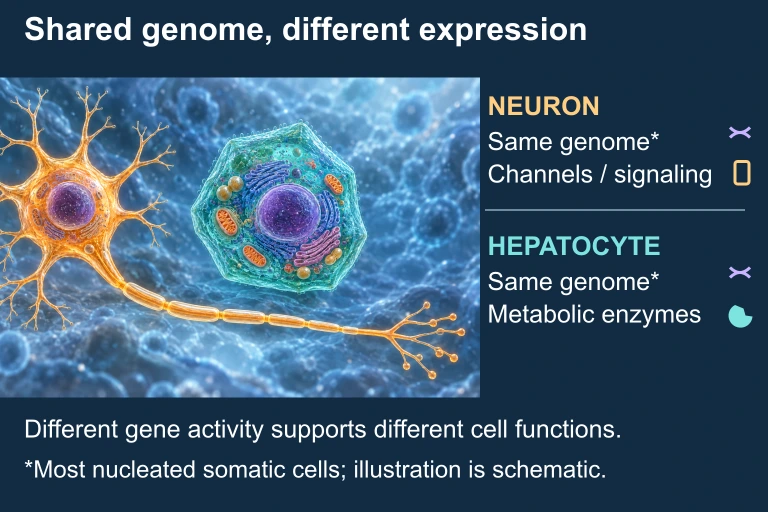
Every cell in a multicellular organism contains the same genome, yet the human body has over 200 distinct cell types: neurons, muscle cells, red blood cells, and more. The key question is:
Differential Gene Expression

Shared genome produces distinct expression profiles
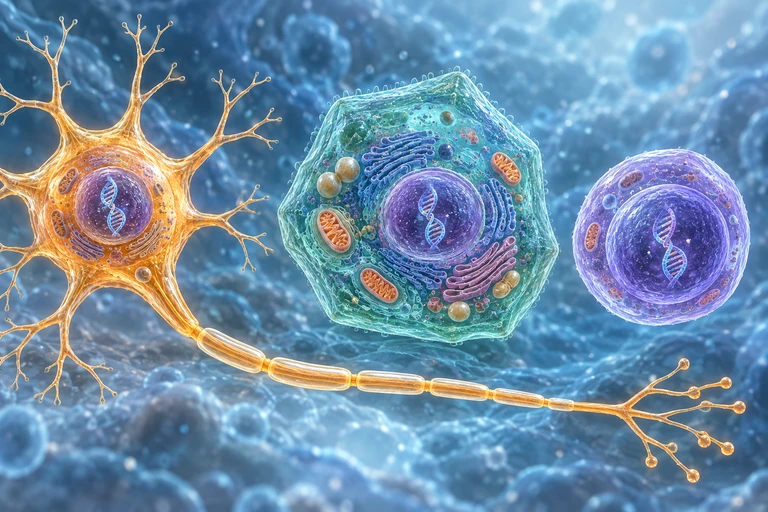
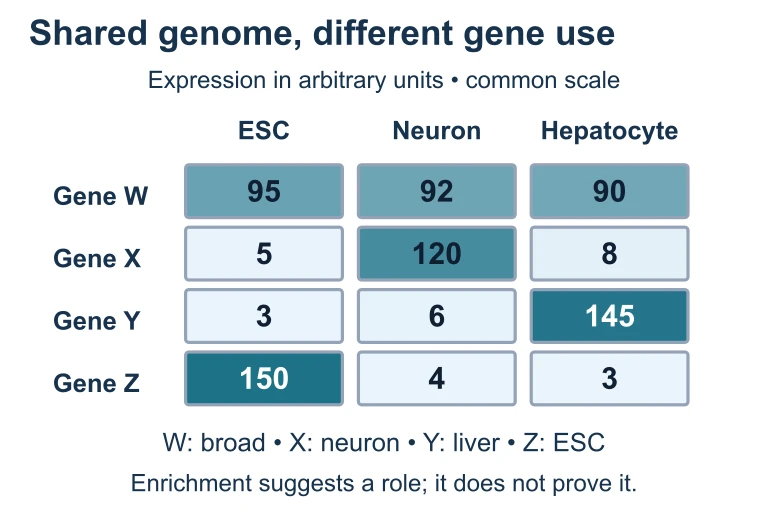
Nearly identical genomes support different expression profiles. Gene W is broadly expressed in these cells, while X, Y and Z are enriched in neurons, hepatocytes and embryonic stem cells, respectively.Shared genome, different gene use
Nearly identical genomes support different expression profiles. Gene W is broadly expressed in these cells, while X, Y and Z are enriched in neurons, hepatocytes and embryonic stem cells, respectively.Levels of Gene Regulation
Gene expression can be regulated at multiple levels, each providing a control point for the cell to fine-tune which proteins are produced and when:
Epigenetic Modifications
Epigenetics refers to heritable changes in gene expression that do not involve changes to the DNA sequence itself. These chemical modifications act as molecular switches:
Transcription Factors & Enhancers
Regulation vs. Mutation
Students often confuse changes in gene expression with changes in the gene itself. Here is the critical distinction:
| Gene Regulation | Mutation | |
|---|---|---|
| DNA Sequence | Unchanged | Altered |
| Mechanism | Epigenetics, transcription factors, mRNA processing | Substitution, insertion, deletion of nucleotides |
| Reversibility | Often reversible | Generally permanent |
| Role in Specialization | Primary driver of cell differentiation | Not involved in normal differentiation |
| Example | Methylation silences a gene in liver cells | Sickle-cell: single nucleotide change in hemoglobin gene |
From Stem Cell to Specialized Cell
Explain why stable specialization need not require changing DNA sequence.
Cell division can preserve a differentiated regulatory state without changing the DNA sequence. Illustration is schematic where scale or molecular structure is simplified.
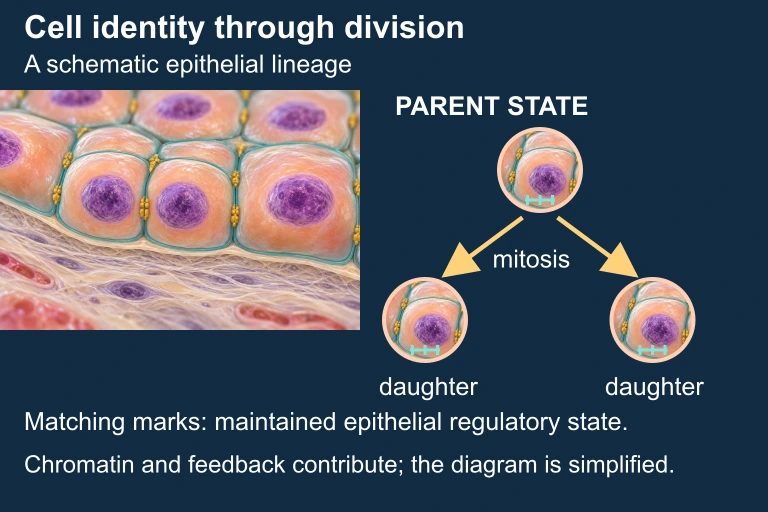
Differentiation restricts potential, reprogramming changes expression
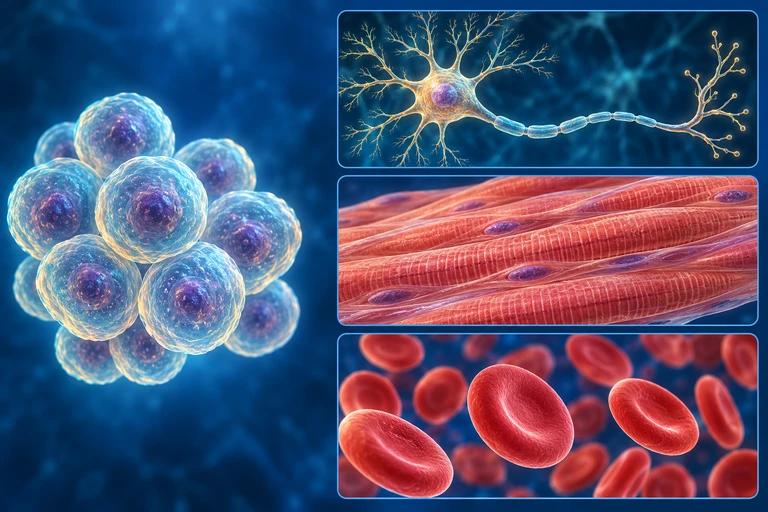
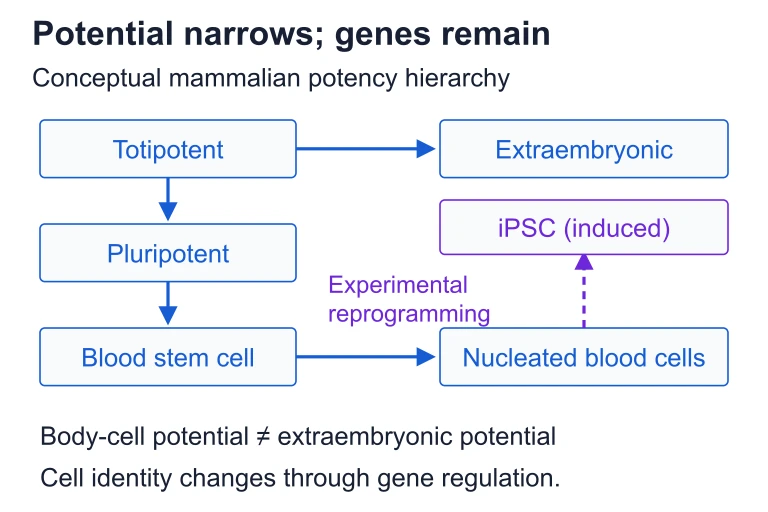
Differentiation restricts developmental potential through gene regulation. Reprogramming can restore pluripotency in nucleated somatic cells; mature mammalian red cells have lost their nuclei and cannot serve as the source cells in this route.Potential narrows; genes remain
Differentiation restricts developmental potential through gene regulation. Reprogramming can restore pluripotency in nucleated somatic cells; mature mammalian red cells have lost their nuclei and cannot serve as the source cells in this route.How to Analyze Gene Expression
When given an AP Biology question about gene expression and cell specialization, follow this step-by-step approach:
Example: Hemoglobin Gene Expression
Scenario: Red blood cells produce large amounts of hemoglobin, but neurons do not. Both cell types contain the hemoglobin gene. Why?
Example: The lac Operon Model
Scenario: In E. coli, the lac operon is a classic model for understanding how environmental signals regulate gene expression.
Example: Morphogen Gradients in Development
Scenario: During embryonic development, cells receive different concentrations of signaling molecules (morphogens) depending on their position. This leads to different gene expression patterns.
A morphogen source patterns a continuous developing tissue
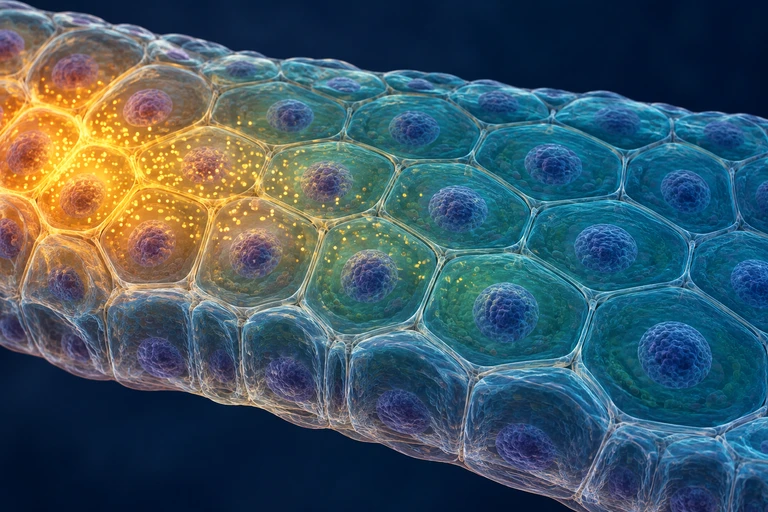
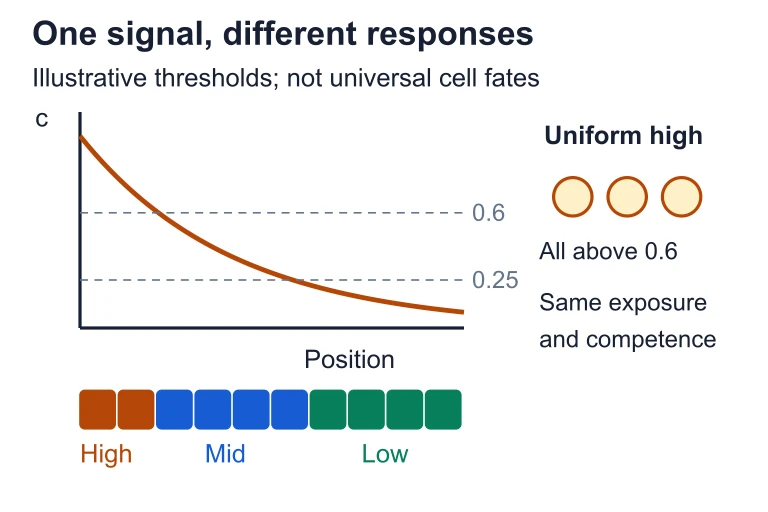
Cells at different positions receive different morphogen concentrations. At matched exposure time and competence, concentration thresholds can produce distinct response domains; other signals also influence cell fate.One signal, different responses
Cells at different positions receive different morphogen concentrations. At matched exposure time and competence, concentration thresholds can produce distinct response domains; other signals also influence cell fate.Common Mistakes to Avoid
Summary: Regulation at Every Level
| Level | Mechanism | Effect | Example |
|---|---|---|---|
| Chromatin | Methylation, acetylation | Open/close DNA access | Barr body (X-inactivation) |
| Transcription | TFs, enhancers, silencers | Activate/repress genes | Hox genes in development |
| Post-transcription | Splicing, miRNA, mRNA stability | Control mRNA availability | Alternative splicing of antibodies |
| Translation | Initiation factors, ribosome regulation | Control protein synthesis rate | Iron response elements |
| Post-translation | Phosphorylation, ubiquitination | Modify/degrade protein | Cyclin degradation in cell cycle |
Question 1 of 5
A muscle cell and a neuron from the same organism differ in structure and function. What is the primary reason for these differences?
Question 2 of 5
A researcher finds that a specific gene in liver cells has heavily methylated promoter regions. What is the most likely effect on that gene?
Question 3 of 5
In the lac operon of E. coli, what happens when lactose is absent from the environment?
Question 4 of 5
Which of the following is an example of post-translational regulation of gene expression?
Question 5 of 5
During embryonic development, cells at different positions along the anterior-posterior axis express different Hox genes. What mechanism best explains this pattern?